Tuesday, July 3, 2012

Adventure of the Week: King Tut's Tomb (1978)


This week we'll be looking at one of Greg Hassett's early text adventures, King Tut's Tomb, written in BASIC and published in 1978 for the TRS-80 Model I computer.  Ports also exist for the Commodore PET and C-64; no publisher is identified here, but the game appeared in type-in form in Bob Liddil's The Captain 80 Book of BASIC Adventures.  This proved very important as I tried to solve this one!

The game begins with a minimal title screen:


This release predates wide availability of lowercase kits for the TRS-80, so commands must be entered in all uppercase characters or they will not be recognized.  As was the case with several of the author's other games, LOOK is treated as a room-level look, and there's no EXAMINE verb for closer inspection, though READ applies in a few cases.  Nor is there a TAKE verb, only GET works.  Young Mr. Hassett's spelling remains uneven, but there's no questioning his coding skills -- performance is very good for a BASIC-language adventure.  This game's theme and certain elements are clearly influenced by the Crowther/Woods Colossal Cave Adventure, or possibly by the Radio Shack release Pyramid 2000, which borrowed heavily from the early sections of that game.

I would normally suggest that interested readers explore King Tut's Tomb independently before diving into my comments, but in this case there's a significant caveat -- the version I found in the online archives cannot be completed.  It appears that whoever typed KINGTUT/BAS in decided to swap some of the map data around, and prevented the player from returning to the tomb's entrance in the process.  Some of the errors are typos, some look like intentional transpositions, but the net effect is that I was not able to finish the game until I sat down with the Captain 80 book and corrected a number of lines of code.  Other versions may be accurate, but at least one TRS-80 edition is broken.  So don't feel guilty if you opt to proceed directly into the...

***** SPOILERS AHEAD! *****

(Note that my directions in the game's early stages may be wrong, as I had not yet corrected the map data.  I didn't go back and correct my notes after fixing the problem, so you will get to witness a little extra confusion!)


We begin the story standing outside AN ENOURMOUS [sic] PYRAMID -- and in this case, the misspelling is due to the anonymous typist, not Mr. Hassett's original listing.  There are some basic supplies on hand -- a package of food, an ancient torch, and THERE IS [sic] SOME MATCHES HERE as well.  (Greg Hassett was a skilled and precocious coder, but most of his games could have done with a little proofreading.) 

There's nowhere to go but E into the Pyramid -- and even though I went in without the matches or a lit torch, and IT IS PITCH DARK, we can still see that HOLY BAND-AIDS! AN ANCIENT MUMMY WALKED IN TO PUT ME TO DEATH!  If we do nothing, then this surprisingly spry collection of bones and bandages is suddenly charging at us, killing us in short order.

This is a randomized event, but when the player meets such an untimely end, the game will "TRY AND REINCARNATE YOU" -- borrowing from the original Adventure, we are reincarnated in a puff of orange smoke.  We can do this twice, but it's only marginally useful as some of the items we need get left wherever we were last standing, forcing a collection trip to resume play.  It's usually best to RESTORE (the SAVE goes to cassette only, so an emulator with save state support is easier to work with.)

With a lit torch, we can find an OPAL DRINKING CUP.  To the south we are CRAWLING OVER A JUMBLE OF BROKEN ROCK, another Adventure-inspired reference it would seem.  Further south, through an AWKWARD N/S PASSAGEWAY, we suddenly find ourselves in the 1970s again, in a game room with A STEVE MARTIN POSTER, referencing Martin's novelty song hit, King TutREAD POSTER yields, "BEST FISHES -- STEVE MARTIN (KING TUT)."  Time to put on our cruel shoes, because comedy is not pretty.


Further south, we find ourselves at the west end of a temple, where we discover a GOLDEN CHALICE.  Going west again leads us to a TWISTING CORRODOR [sic], and a maze.

The torch is remarkably brief in duration -- mine ran out just a few rooms into the pyramid!  Fortunately, we can LIGHT TORCH again after it goes out, we just need to carry the matches with us.  Checking out the east end of the temple this time yields a golden key, and nowhere else to go, really, so we'll have to deal with the maze.  It's not a complicated maze, just a couple of rooms, but the other rooms in this area are also a bit mazey.

There are a number of treasures lying about in the royal chambers on the other side of the maze -- a PLATINUM SPEAR in the annex, an ALABASTER NECKLACE in the JEWELRY CHAMBER, and a RUBY EARRING in the QUARTERS OF PRINCESS ANKA

In THE ARTIST'S STUDIO we find a JADE STATUETTE -- but another randomized threat rears its ugly (I assume) head, as THERE IS A THREATENING LITTLE GOOBER IN THE ROOM WITH ME.  A peanut?  We can try to KILL GOOBER, but THE GOOBERS ARE IMMORTAL.  Eventually this fellow throws a knife at us, fatally, so we probably need to dispose of him somehow.  We can't FEED GOOBER -- THERE IS NOTHING HERE IT WANTS TO EAT.  (EXCEPT PERHAPS ME!)  But it doesn't attack immediately, so we can do a little more exploring while it follows us around.

An EGYPTIAN LIBRARY contains the fabled BOOK OF THE DEAD, which is written in EGYPTIAN HYROGLYPHICS [sic].  A disappointing WINE CLOSET (ALL CHEAP STUFF) contains a GOBLET OF WINE.  A hard-to-visualize BEDROOM DESIGNED FOR THE AFTERLIFE leads to a STABLE and then to a WARRIOR'S QUARTERS where a GLASS MEDALLION awaits.

There are a ton of treasures in the game -- there's no SCORE room identified, but if we bring the treasures to our starting location we are awarded points.  There's an eight-item inventory limit, so we will have to make multiple trips, and doing this efficiently presents the game's primary challenge.

A ROYAL THRONE room contains AN IVORY THRONE.  When we encounter the MUMMY again, we can try to BURN MUMMY and LIGHT MUMMY and TORCH MUMMY, to no apparent avail.  Except the mummy does seem to leave us alone if we try?

South of the HIGH PRIEST'S CHAMBER we suddenly find out that I'M IN THE KING'S HAREM.  Fortunately this is just a location name, and the King is nowhere in sight.  A SNAKE PIT contains a FIERCE SNAKEKILL SNAKE suggests only that THAT IS A STUPID THING TO TRY!  But the snake doesn't actually block our passage, and if we can get the the threatening little goober to follow us in here, we get some relief as THE GOOBER SEES THE SNAKE, LEAPS UP AND RUNS AWAY!  He will return later to harass us, though.

There aren't many puzzles as such in this game.  We just have to round up the treasures -- all we can carry -- and get them out the door.  Except (or so I thought before figuring out that the map data was incorrect) we can't get out the same way we came in, it seems.  There's a LABYRYNTH [sic] OF PASSAGES DESIGNED TO KEEP OUT TOMB ROBBERS, which we will probably need to navigate to get back out (or not, actually, pending code corrections.) 

The labyrinth contains a GIANT PEARL, and leads to a locked gate that can be opened with the golden key.  This leads to the BURIAL CHAMBER where KING TUT'S COFFIN lies.  But we're no closer to an exit.

I broke down and asked for HELP -- but IT'S AGAINST COMPANY RULES TO GIVE AVERAGE ADVENTURERS HELP.  We can OPEN COFFIN, but can't seem to PUT or INSERT anything in it, or ENTER it.   

The randomness extends to a couple of specific scenarios -- on one retry, instead of the HOLY BAND-AIDS! message, I got SUFFRIN' SUCCOTASH! when the ancient mummy walked in to put us to death.  And at another time, in KARMAK'S CATHEDRAL, I saw that THE MUMMY IS CHARGING AT ME!! but HE SLIPS ON A CONVENIENTLY PLACED BANANA PEEL AND CRACKS HIS SKULL. THE BODY VANISHES.  Odd.  Good luck?

This time, looking at the Book of the Dead, I attempt to TRANSLATE BOOK -- and it works!  IT SAYS: GOOBERS HATE SNAKES.  MOM IS FLAMIBLE. [sic].  This is unusual because Hassett's games don't usually employ a lot of special-case verbs; apparently trying to BURN MUMMY still makes sense, maybe it just doesn't produce a visible response.  If we FEED SNAKE, then we can carry it around and avoid goobers. 

I'm stuck -- can't seem to find my way back out after going in.  But two different walkthroughs at CASA are inconsistent with my navigation (prior to fixing the bugs) -- I can't follow the paths they suggest, those entrances are closed off.  Looking at the code -- how do I get back to room 6?  No path is apparent from the data.  Both walkthroughs suggest that there should be a path from room 18 (end of the maze) east to part of the labyrinth; this map is different but can be navigated.  What seems to be missing is a path that goes east, back to the Entrance to the pyramid.

Something else is wrong with this version -- the mummy walks in, and if we BURN MUMMY we get WHAZZAT? but the mummy still disappears.  Time for a little research -- this game's source code was published as part of The Captain 80 Book of BASIC Adventures.  If only I could find an original listing!  Ah, I did!  Amazon is sometimes just the ticket.

There are definitely changes in the map data -- these appear to be intentional but end up breaking the game.  This is not a comprehensive list, I know I fixed a few other things to get this into playable shape.  But to provide a flavor of the issues... line 219 is incorrect; data for second room should be "2,7,3,6" but is entered as "0,2,7,3."  Line 227 should have "9, 13, 5, 0" but has "5, 13, 0, 0."  Line 237 should be "18,37,15,18" but is "15,37,0,18".  Line 239 should be "14,0,0,24" but is "13,24,0,0."  Line 246 has a typo, the last value is "026" but should be "0."  Line 240 repeats data from the line before it.

Whew!  With all those fixes, the walkthrough at CASA is almost good now -- we just need to improvise a bit when the little goober shows up or the torch goes out.  And with a few saves and restores, victory is finally ours, with all the treasures gathered!


After quitting and getting the bonus point evaluation, I found that I'd only earned 200 of the 207 points possible -- that is, 25 of the 32 possible bonus points.


So what did I miss?  And is it worth going back for them?  Another look at the code indicates that anything above 182 still qualifies us as an ADVENTURER GRANDMASTER.  We earn points for visiting certain locations, I believe I got all of those; we lose points if we run out of matches or take too many moves, no issues there.  Some points are based on the number of matches left in inventory, and I used several relighting the torch when I could have carefully navigated in the darkness.  And we can earn some points for bringing non-treasure items of significance out to the entryway.

Good enough -- solving the mystery of King Tut's Tomb was not as difficult as solving the mystery of the anonymous typist, so I'll call this one complete.  There are still several Greg Hassett TRS-80 adventures I haven't tackled, and I intend to get around to them in due course.

Sunday, July 1, 2012

Physical Reality, Virtual Reality

I'm always fascinated by the way our brains work when it comes to games.  It doesn't take a lot to fool us into feeling like we have "been" to a place that exists only as a map in a computer, if we have had to do the work of learning our way around it.  It seems that the process of exploring and discovering triggers the brain's handling for real-world geography, even when the world we're working with is completely virtual.  What we see and hear and sense feels immediate and "real," but it's all being processed and interpreted by our brains; our internal hardware can't necessarily distinguish between real and virtual inputs at a certain level.

So it was interesting to hear from Mr. Neil Bradley this week, the at-the-time uncredited author of an old SoftSide text adventure I covered a while back called Crime Adventure.  He emailed, and I reproduce with his kind permission, this interesting bit of background:

I wrote it originally for the TRS-80 Model I. It was based on my Portland, Oregon neighborhood at the time. There's a 7-11 at 114th & Halsey that I called the "arcade." There was a Gateway bowling alley on 102nd that I moved right along side it. The Tsein-Tsein Chinese restaurant is across the street. Mr. Fenwick was actually Mr. Forsberg, a nice old guy who lived up the street from me who was BIG into golf. There was a family of Gypsies who lived nearby (inspiration for the fortune teller). Wow - this is bringing back memories!

So apparently it can work the other way around too -- creating a virtual recreation of a familiar environment can also encode memories associated with that environment.  Neato!


Saturday, June 30, 2012

Airwave Adventures!

I had forgotten completely about Tiger Media's Airwave Adventures series -- in fact, I had forgotten it was a series until I ran across this old ad in MPC World magazine:


The company only ever produced these two games, using CD-ROM technology to provide digitized, non-animated comic-book artwork and radio drama-style voice tracks.  Their products originally ran on the Japanese FM-TOWNS computer and Commodore's ill-fated CDTV system, but came to DOS PCs later on as the technology became available.

Neither of the Airwave Adventures seems to have sold particularly well -- while the visuals and voice acting are nicely done for the era, the gameplay wasn't great even then, and the retro 1930s style may not have been appreciated by the core video game market in those pre-Bioshock days.  I own a copy of The Case of the Cautious Condor -- we have to solve the case within a 30-minute time limit, but if we don't visit the right locations and talk to the right people to discover all the right details, then we have to start over.  And it's not really an adventure game -- it's more like The Manhole, with limited opportunities for exploration and interaction.  This rigid structure quickly becomes repetitive, and I never finished the case.  From what I can find online, Murder Makes Strange Deadfellows is similar in style -- it came out later, and apparently escaped my notice (or at least my memory) completely.

What I do remember about Tiger Media is that I was very impressed by their customer service department.  My original copy of Condor was bought at a Radio Shack, in the early days of CD-ROM when very few games took advantage of the medium.  Much to my chagrin when I got home, this edition was designed strictly for use with the Tandy 1000/2000 computers' audio hardware, so I was unable to play it on a system with a Soundblaster-compatible card.  I messed around with the raw audio data a bit and was able to listen to some of it after correctly guessing the sample rate, but it wasn't the same as hearing the audio in synch with the game.

I filed the disc away and forgot about it until a few years later, at which time I phoned Tiger Media to see if they had ever released a Soundblaster version.  They had, and when I explained the situation and asked if there was an upgrade price, they just sent me a new disc, free of charge, without asking for so much as a proof of purchase.  I appreciated that -- the company took its products seriously, and while they didn't make a big splash in the game marketplace, they did contribute to the development of the art form.  One of their staff members even published an AES (Audio Engineering Society) paper discussing the use of low-bandwidth audio on CD-ROM, an abstract of which can be read here.

Maybe that's why they're still around today, as Iacta, developing interactive TV software for set-top boxes.


Friday, June 29, 2012

Of Import: Mad Stalker (1994)

Sometimes I can't resist picking up a Japanese game based solely on the way its name plays in English.  And that's certainly the case with Mad Stalker: Full Metal Force, a 1994 scrolling mecha beat-'em-up created by KOGADO STUDIO and Fill in Cafe Co. Ltd., published by NEC on the PC Engine's most powerful iteration, the System 3.0 Arcade CD-ROM format:


It's not actually a game about a mad stalker -- the title seems to refer to a class of mechanical exoskeletons driven by human pilots, in the standard mech mold.  The production values are high, as was usually the case with these late-in-the-life-cycle PC Engine games.  The CD-Audio soundtrack is typical of the era, with synthesized horns, bass guitars and percussion driving the action forward.  And even though the game's voice-acted dialogue is in Japanese, all of the onscreen text is in English, so it's not a difficult game to get one's Western head around.  The game opens with a lengthy animated sequence, apparently pitting two CEOs against each other -- this grumbling, angular older gentleman:


And this attractive female executive and her attractive executive assistant:


The introduction also introduces us to three playable mech pilot characters -- Chico Rodriges, Richard Winston and Eve Lurdia, with the traditional stats and blood type:


Each stage is preceded by another lengthy intro, though the animation is simpler, limited to lip-synced portraits and illustrations that pop up over the player's radar:


And then, we select our pilot of choice, and the action begins... or ought to.  First, there's a lengthy loading screen -- something of a rarity on the PC Engine, or at least it's usually better disguised.  (This is the same image displayed if we try to boot the game with a System 1.0 or 2.0 card, along with a Japanese message indicating we need to use the 3.0 version.)


Once we get into the action, we discover that this is basically a scrolling beat-'em-up in the vein of Final Fight or Golden Axe.  Our mech runs from left to right, knocking various robot enemies out of commission with punches, kicks, grabs and throws.  Some of the one-on-one fights are a little more challenging, feeling more like a Street Fighter clone based on duration and the quality of the enemy AI.

I'm running this on the Magic Engine emulator for ease in capturing screenshots, and it appears that the official System 3.0 card is NOT the best way to run the game -- the graphics tend to get rather garbled, though it does provide an interesting look at how the sprites are laid out and the matrix of occupied "squares" modified from frame to frame:


Running correctly (using the Magic System 3.0 card in this case), the game looks much more like the mid-80s coin-op standard many PC Engine games successfully mimicked:


This flying mech is an interesting enemy to deal with -- we have to jump up while he's preparing to fire to knock him down, and then attack steadily and rapidly to keep him grounded.  I spent quite a bit of time ducking his attacks while the clock counted down before I realized patience was not going to win the day.  He's initially presented as if he's a mid-level boss, but then more of them show up and we realize we're just going to have to deal with his like on a regular basis:


The game's engine does have its limitations -- while the animation is very smooth and flicker-free, it can only handle so many moving objects at once.  This battle near the end of the level features clinging robots that push the player's mech around; they're meant to attack as a swarm, but only four are ever seen at the same time.  When one is disposed of, another one flies in until the supply is exhausted and we can move on:


The game is fairly difficult -- we have a limited number of credits, arcade-style, and I had burned through my second token by the time I did much damage to the first stage's boss:


Continuing, I used up at least another credit before I finally managed to dispose of this charging, hopping robot:


The next mission takes place in an industrial building of some kind, and we see pretty much the same assortment of enemies we've already met, just toughened up.  The boss at the end of stage 2 proved to be my undoing; the mechs occasionally suffer equipment malfunctions after taking damage, making it impossible to do anything for a few seconds, but this is a proud boss, who stands by patiently until his opponent recovers.  I was unable to get past this guy, even after starting over with the difficulty turned down to easy:


Mad Stalker: Full Metal Force is remarkable primarily for its system requirements -- most of the Arcade CD-ROM games for the PC Engine were ports of SNK coin-ops, and while this game takes advantage of the extra memory, it seems like it could have been squeezed onto a lower-spec configuration.  But the game clearly had its fans -- an enhanced version made it to the Sony Playstation in 1997, upgrading the audiovisuals but retaining the basic gameplay.  The action is competent and challenging in the classic arcade tradition, and sometimes that's enough.


This is a decent if unspectacular game that collectors and mech fans might want to own.  Keep in mind that the American TurboDuo was only a System 2.0 console, so this is one of the rare Japanese PCE CD-ROM titles that will not work on a North American system.  If you're equipped with suitable hardware or emulation technology, you might be able to buy a copy here (and there's actually a copy in stock as I write this, which is often not the case!)

Thursday, June 28, 2012

The LoadDown -- 06/28/2012

It's an unusually quiet week for consoles as the US Independence Day holiday approaches, though handhelds remain pretty active for gamers on the go...

WiiWare -- Nothing here this week, or on the Virtual Console.

DSiWare -- Two new games here... Flip the Core is a super-retro-styled 2D shooter, with a cube-flipping mechanic that thrusts the player's ship into different environments whenever it rotates.  Escape the Virus: Swarm Survival is kind of a cross between Robotron: 2084 and those early videogames where the player's snake gets longer the more the player eats.  Don't try that at home.

3DS eShop --  Two new games and two retail demos this week.  First up is Marvel Pinball 3D, which features a number of classic Marvel Comics characters and 4 distinct tables; it's a quality effort from Zen Studios that might keep us busy while we continue to hope that Pinball Arcade makes it to the 3DS at some point.  There's also Bomb Monkey, which looks like another match-three puzzle game but adds some fun new mechanics, primarily setting off the combos by dropping a bomb.  From a monkey!  And there are free downloadable demos of Rhythm Thief & The Emperor's Treasure, and Kingdom Hearts 3D.  Nintendo is also launching a "Game of the Weekend" sale series, similar to sales on other platforms, so keep an eye out for deals.

XBox Live Arcade -- Same titles here as on the PS3 (below), although The Walking Dead episode 2 arrived on Wednesday instead of Friday.  Lucky XBLAers!

PS3 on PSN --  One new title, Jeremy McGrath's Offroad, celebrates rough-and-tumble dirt track racing.  And the second episode of The Walking Dead will be out on Friday if all goes as planned.

PSOne Classics -- An unusual licensed title shows up here -- The Little Mermaid II, based on the Disney direct-to-video sequel.

Notable on Steam and Elsewhere --  The long-awaited second episode of Telltale's The Walking Dead also hits the PC this Friday, barring any technical glitches.  And the even-longer-awaited (if not necessarily as eagerly) Penny Arcade Adventures series finally sees episode 3 after a three-year hiatus, with a new pixel-art style and a new publisher.

Wednesday, June 27, 2012

Kickstarter Adventure Game Updates

This isn't necessarily going to be a regular feature, but I've been keeping an eye on the various adventure game projects being launched and funded via Kickstarter, so a few updates now and then are easy to pass along.  With so many veteran designers re-emerging with the tempting prospect of fan funding, and some worthy new projects turning up, I remain enthusiastic about the possibilities for a renaissance in the genre.  (For a well-considered opposing view from someone who probably knows better than I do, check out Wadjet Eye Games founder and Blackwell series designer Dave Gilbert's thoughts, here.)  My personal biases are likely to be clear -- take this as a gossip column, with plenty of unsubstantiated speculation by yours truly!

First, there's an interesting new entry from Stacy Davidson, the filmmaker and creator behind the unofficial Lucasarts-style Han Solo Adventures fan game.  It's a retro-style sci-fi adventure called Jack Houston and the Necronauts, in the Flash Gordon/Buck Rogers/John Carter vein.  He's trying to raise a reasonable $56,000 and seems likely to do it at this writing, with plenty of time to go.  The project is ambitious, with painted backgrounds merged with stop-motion animation for the characters, executed using physical puppets in the Ray Harryhausen tradition.  There's not much implementation done yet, but Davidson has shown he can produce a playable game as a labor of love, and I'm always a sucker for that pulp art-deco sci-fi look.

It looks like HeXit, another sci-fi point-and-click adventure with a sleek Heavy Metal-style visual look, is not faring so well, with only about 20% of its $75K goal raised with less than a week left.  I don't know if its funding struggles are due to xenophobia -- the game is being developed in Hungary by names most gamers may not be familiar with -- or just that while the graphics look very nice, it seems that most of the team is focused on the artwork, with a solitary coder listed who hasn't really developed an adventure game before.  It's probably just a (good) sign that the Kickstarter community is becoming a bit more discerning about which projects get funded.

Infamous Quests' Quest for Infamy has its backing well in hand, with $46K raised at this writing, well above its goal of $25K.   This project is led by Steven "Blackthorne" Alexander, who's had a hand in a couple of King's Quest and Space Quest fan remakes, and this one is clearly inspired by Sierra's Quest for Glory games.  From the look of the artwork and demo so far, that classic VGA-era Sierra vibe is being well preserved.

Reincarnation: The Root of All-Evil is more than halfway to its modest $15K goal with a couple of weeks left.  It's a cartoon adventure starring a little demon character; the animation shown to date is a little simplistic for my tastes, and the project's stated goals may be more ambitious than it can manage.  But the cartoonist behind it has put out a number of free point-and-click games in the past, so I'm pretty sure the project will get finished.   I'm just not sure about the management approach -- some of the bullet points for the budget include "Hiring people to help" and "Better sounds," neither of which is specific enough to inspire confidence.

The horror adventure The Verge looks like it's not going to make its modest $5K goal, for obvious reasons.  There just isn't enough on show to convince anyone that this will be a compelling experience, not with indie games like Amnesia: The Dark Descent targeting a similar style and doing it so much better, and it's a first-person game which means the "point-and-click" terminology is a bit misleading.  Some projects come to Kickstarter too early -- I hope that the people behind unsuccessful projects like this one will take a hard look at why they were not funded, and come back with better ideas or more concrete progress to try again.

And Lilly Looking Through, a personal favorite, is well over its initial $18K funding goal.  The demo is charming, with fun, well-designed puzzles.  And I'm thoroughly impressed by the animation -- young Lilly is really well-grounded in the environment, and she runs and stands naturally in context, without that sprite-pasted-over-background look that even the best vintage point-and-click games tend to have.

One surprise -- it appears that Sam Suede in Undercover Exposure is not going to make its goal, or even come close, with a mere $14K of its proposed $500K budget raised so far with time running out.  Despite the past involvement of Al Lowe (Leisure Suit Larry) and current involvement of Steve Ince (the Broken Sword trilogy), it's not getting much Kickstarter love.  This may be due to some controversy about the pitch, which implied that Al Lowe was currently actively engaged, while his design work on the project concluded back in 2006 when the project was abandoned, before much dialogue writing was done.  Age may not have done the design much good, and it may also be that the appeal of a certain style of "titillating" humor is weaker than it was in Larry's day.


I'm also trying to monitor some of the big projects that have been funded and are now hypothetically underway, but there's not much real news yet.  Jane Jensen's new Pinkerton Road studio was launched with Kickstarter, but doesn't have much to show beyond the early concept art already revealed.   The Two Guys from Andromeda have more progress on display, including updated demos and audio material, but it's a long way from a finished game, and I hope the team isn't being distracted by all the fan communication necessary to operate this way.  Both efforts are trying to raise some additional funding on top of their original Kickstarter targets, which makes me wonder if the balance sheets were realistic to begin with, or, more worryingly, whether the projects are being appropriately managed to budget.

But this is what's fun about Kickstarter -- anticipation, hype, speculation, fear, and hope, all mixed together with a genre I love.  It's a fun little horse race to watch, and with any luck we'll get some cracking new adventure games out of the process, even if there are a few noble failures too.

Tuesday, June 26, 2012

Adventure of the Week: Space Quest IV - Roger Wilco and the Time Rippers (1992)

I've probably played the first section of Space Quest IV: Roger Wilco and the Time Rippers more than any other Sierra title -- on the original floppy disk release, on CD-ROM for DOS, and on Windows CD-ROM, to see how the new interpreter managed (it was pretty buggy at the time, with color issues and audio glitches.)  Technology aside, I can't say it was one of my favorite adventure games -- in fact, I don't really remember much of the plot, aside from the return of Sludge Vohaul from Space Quest II.  But The Two Guys from Andromeda (Mark Crowe and Scott Murphy) are usually good for a laugh and a challenge, so it's time to play this one again.


This was Sierra's third (counting Mixed-Up Mother Goose CD) adventure to feature 256-color VGA graphics, and some of the background paintings are beautiful, with a different feel from the King's Quest series.  And it was the first to feature professional voice talent, though one suspects most of the talent budget went to Gary Owen, of Laugh-In and radio fame, who must have spent quite a few hours in the studio reading all of the location and item descriptions in addition to the traditional narration duties.  The audio is a bit noisy and crackly, and the lip-synch rather approximate in places; some of the voice actors are still clearly in-house Sierra employees..  But the audio production is improved over King's Quest V.

As always, I encourage interested readers to play Space Quest IV before proceeding below.  It's still commercially available at a bargain price as part of the Space Quest Collection, available at Steam and other digital outlets.  It's not a difficult game, although there are a few hard-to-predict deaths and "gotcha" puzzles if we've missed something earlier, and it's still fun to play.  Feel free to go play and come back later if you like.  Beyond this point, there are bound to be...

***** SPACE SPOILERS AHEAD! *****

The story begins as Roger Wilco tells exaggerated stories of his past adventures at the cantina on Magmetheus, making a pit stop on his way back to his home world of Xenon.  But when the cyborg Sequel Police arrive to deliver a threatening message from the formerly-departed Sludge Vohaul, Roger is in a panic.


Fortunately, the Time Rippers -- rebels with time-jump technology and mediocre voice-acting -- arrive to spirit him away.  Post-wormhole, Roger finds himself in a desolate post-apocalyptic version of Xenon, from the as-yet-unreleased Space Quest XII - Vohaul's Revenge II, where the only apparent life is the Energizer Bunny.  There's some unstable ordnance in a ship parked down an alley, introducing the first of this game's annoying "whoops, I did that!" fatal mistakes if we pick it up.  At least we can put it back in place after we learn about the danger, because if we do much moving around while carrying it, it tends to blow Roger up.  We are informed that is unstable, at least, so this isn't a totally unfair situation, though it is a bit of a red herring.

There's also a security droid that tends to show up and shoot Roger dead, no questions asked.  This seems to be random, but in some places we can earn a few points by hiding behind something so it leaves Roger alone.   The buildings are destroyed and uninteresting, but we can pick up a short, frayed length of rope in front of one to the southeast.  We can also obtain a PocketPal laptop from the glovebox of a destroyed landspeeder.  There's also a strange man wandering around, apparently the victim of some sort of cyber-surgery, and if we engage him he screams, summoning the security droid.


The laptop is a dumb terminal, and has no battery; clearly we will need to get one from the toy rabbit.  But he's not easy to catch -- he tends to walk in on the opposite side of the screen from Roger, and runs off before we can get close to him.  Mr. Owens suggests that being out in the open, barehanded, is not the best approach.  If we put the rope out on the ground, it takes the form of a snare; we just need to hide where the rabbit won't see us so we can snag it... and grab it when it's in the snare.. and avoid the everpresent droids.  The rope is destroyed by the "bunny snatching," so we cast it aside.  We can now put the power pellet in the laptop, but it's still not useful for anything.

This first part of the game is a bit frustrating, because there are so many dangers to avoid and the deaths Roger suffers are rather repetitive as we struggle to solve the few puzzles on hand.  I eventually realized that this game suffers the same technical problem as King's Quest VII -- while the animation is adjusted to the system's speed, internal countdown timers are not.  This tends to make security droids show up more often, and the sequel police fire more rapidly -- I had an easier go of it after I turned the DOSBox CPU speed down from the default 3000 cycle rate.

We can duck -- one way -- down a grate to reach a Sewer Maintenance office area beneath the street.  Roger can pick up a jar on the table, which we will need much, much later.  A button beneath a desk blotter summons a recorded holographic message from the past which explains much of the present circumstances.  A supercomputer was given control over Xenon, it seems, including its weather control and defense systems, and all was well until a copy of Leisure Suit Larry infected the system with a crippling virus.  "WILCO MUST PAY," the system announced, and began waging war on the inhabitants of Xenon, and assimilating them -- the wandering husk cyborgs are modified Xenonians.

From the office, Roger can enter the sewers -- though the door, of course, slams shut behind him, so we'd better hope we have anything we needed to grab earlier.  In the tunnel he is pursued by a green slime, which is of course capable of skeletonizing Roger if it touches him.  We can't seem to capture it in the jar at its points of origin from vents along the sewer tunnels, so we should just climb the ladder to the west.  This brings us... back up to the street.

 
From his safe observation point, Roger can see as a spaceship lands and police officers emerge.  Roger doesn't have time to just sprint for their ship, so perhaps we have to make use of the unstable ordnance?  There isn't time to get to it, and we can't hide from these officers as easily as we could the robots. Hmmmm.  If we duck back down the manhole before coming out, we seem to be able to avoid the first patrol.  We can approach the ship, but another officer arrives to shoot Roger before we can do anything with it.  (This is really only difficult if we haven't turned down the CPU speed, but this worked out okay in my case as it forced me to go back and check some other possibilities out more thoroughly.)

Can we grab the slime?  Gary Owens is helpful -- if we use the jar on it, he tells us we should wait until it stops moving.  That should be doable.  We can only scoop up a portion of the slime, so we need to get moving again pretty quickly after doing so.

Now that we have the slime, can we do something different with the police?  We still can't get to the ordnance -- if we go over there, Roger just pauses until he gets shot.  Turning down the DOSBox CPU speed really helped here -- I was finally able to get him into the ship, by stowing away in the landing gear compartment.  This lands Roger -- as is often the case in this series -- in a new facility, where he must explore and try to figure out what's going on. 

We can just get back into the ship, in which case we are taken back to the ruined city.  But we should probably do something different while we are here.  If we wander to the right, a guard picks Roger off.  But to the left, two guards converse after one returns from an investigation of Space Quest II.  Roger has just enough time to steal one of the time machines (which can also be seen making a cameo appearance in Sierra's VGA remake of Space Quest I.)  We have to punch in a code -- though for now, anything will do at random... oh, wait, no it won't!  But a second try seems to work.  And we should write down the SQ XII code on the display before entering any random tries of our own -- I forgot to do this, but fortunately retained a save game before trying any codes, so I was able to come back later and capture this critical information.

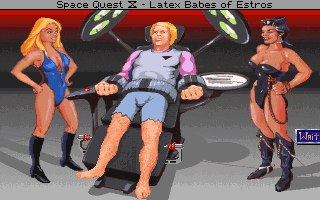
Roger ends up in Space Quest X - Latex Babes of Estros, an affectionate poke at Infocom's Leather Goddesses of Phobos, no doubt.  There's an odd rock formation down below, which (perhaps fortunately) Roger cannot touch, sniff, look inside or taste.


A pterodactyl-like creature passing overhead casts an ominous shadow on the rocky platform higher up, and a distinctly female silhouette ducks out of sight after spotting Roger exploring.  We reach a dead end down a flight of stony stairs, where water blocks our progress.  Is there nothing to do here?  Should we just get back into the machine?  Wandering back down near Roger's landing site yields progress, of a sort -- our hero is snatched up by an unseen flying, taloned beast, and dropped in a skull-strewn nest high atop a tower.  A Sequel Policeman shortly follows, and is neatly skewered on a branch.  A quick search of the body yields a paper-wrapped wad of chewing gum.

Roger should not wait around here -- he can drop out of the nest, landing semi-safely in the water below.  After swimming to shore, he soon meets a beautiful blonde in a skintight blue latex bodysuit, whom he has apparently abandoned in a previous game in the series.  He is summarily kidnapped by his ex and her henchwomen, taken to this apparently all-female tribe's headquarters, and cuffed into a chair, where lasers turn his space slacks into ragged cutoffs, to provide a little sexism for the ladies as well.


Torture mistress Thorine plans to shave Roger's legs as a form of torture, using the EpiRip 357, but her work is interrupted by the arrival of a sea slug.  The women run off, but the creature's tentacles inadvertently free Roger from his shackles before sucking him into its maw.  We can't apply the slime acid to it, but we can probably fire the chair's lasers to sting it a little and buy some time -- and maybe use the oxygen tanks stacked to the side somehow.   Yep -- stuffing one into its mouth destroys the creature, earning Roger his freedom and a shopping trip to the Galaxy Galleria with the girls, providing yet more sexism for the guys.

"Meanwhile, back in Space Quest XII," a cutscene informs us that the Sequel Police have captured one of the Time Rippers who helped Roger escape.  Sludge Vohaul clearly has a trap of some kind in store for our hero.

The game's second act takes place entirely within the mall, where there are quite a few sights to see and puzzles to solve.  A Skate-O-Rama hover-skating rink occupies the center of the layout, surrounded by moving conveyor belts and shops.  If Roger tries to exit the mall, Sequel Police cyborgs take him out.  There's an ATM card (Autobox Teller Machine) on the floor as we arrive, which may come in handy.  The walkways are annoying to deal with -- as intended, I'm sure -- because it's difficult to get Roger to walk in the opposite direction when we miss a store's narrow entryway.

A software store reminiscent of erstwhile game retailers Babbage's and Electronics Boutique plays beepy AGI-era themes from other Sierra games, but the crowd is initally so thick Roger can't really get inside.  An ATM machine stands near the shop, but Roger looks insufficiently like the card's real owner, a blonde woman.  So a little wardrobe shopping will likely be in order.

The electronics store, Hz. So Good (called Radio Shock in the original floppy disk release, before certain lawyers initiated certain communications), is run entirely by a sales robot through a menu screen.  There are specials -- the ReShrinkwrap 2000 (aimed at retail software chains) is the only one on offer, for 1033 buckazoids.  The rest of the store includes a Swiss Army MicroEntertainment center, a ridiculous surround-sound system, a CDGIROMTV system that plays CD-ROM, CG-G, CD-I, CDTV and "high-quality laserdisc movies, sure to become popular any century now."  The PocketPal Portable Terminal is also available, "with chiclet-style keyboard and dentyne-style mouse."  And we can buy something we didn't know we needed-- the PocketPal Connector, for 1999 buckazoids, which might actually be useful if we had any money.  Most of the items in the catalog are just for laughs, and are either sold out or not yet available.  And Roger can't buy anything without cash in hand, anyway.

There's a Monolith Burger on the premises, of course, but Roger can't enter without doing something about his attire -- he has no shoes, so no service, per the pig creature who seems to be the manager.  There is a men's clothing store nearby, run by a supercilious droid with a bad French accent.  And Roger has enough buckazoids from previous adventures to spare 20 for new boots and pants, restoring his standard outfit from the store's "generic space hero" line.


Entering Monolith Burger, Roger can converse with the manager.  They're out of everything, employees included; we can apply for a job, and opt to skip the ensuing arcade sequence if we want to chicken out, but it's worth a quick go.  We have to assemble burgers, assembly-line style, and the conveyor belt speeds up as we go; with my laptop mousepad I was only able to earn $5 before getting fired.  We can come back later if we need to earn more; the more pressing point of this exercise is to pick up the cigar butt the manager throws at Roger after kicking him out.

A women's clothing store is also open for business, offering wigs and dresses.  The female droid clerk sounds like Mae West, and fixes Roger up with a basic black dress and a blonde wig.  The tab comes to 60 buckazoids; with only 44 in hand, Roger gets thrown out of this fine establishment too, without the outfit he needs, so we'll have to come back later with sufficient funds.


The mall's arcade has yet another iteration of the Astro Chicken franchise -- Ms. Astro Chicken.  There's no apparent high score in need of beating, and a round costs a buckazoid, so we won't bother with it much right now.  I played enough to note that Cedric the Owl from KQ V makes a cameo appearance in Ms. Astro Chicken, just flying by at the top of the screen, and we also occasionally see a biplane towing an advertising banner for MediaVision, a now-defunct multimedia card manufacturer.  Pressed for cash and time, I skipped the arcade sequence at Monolith Burger on my return visit, walking quickly out with 71 buckazoids now in my pocket.


Now Roger can buy the dress and wig, fooling the Buckmaster 2000 into allowing him access to the funds belonging to the ATM card's owner.  There's $2001 available, and only one menu option - "Clean It Out."  So now Roger is flush enough to buy the PocketPal Connector at Hz. So Good.  This is good indeed... except we have to pick a specific plug to buy -- how do we know which one to get???  We'll probably have to come back with better information in hand.

The crowd has dispersed at the software store, which is now sold out of Sierra Software, but there are some vintage software parodies in the "box of slop" -- rather, bargain bin, which I can't resist sharing with fellow vintage gaming fans here.  BOOM is a LOOM parody by "Morrie Brianarty," and the description pokes fun at rival Lucasarts' approach to point-and-click adventuring. 


Sierra itself also comes in for a little ribbing with King's Quest XXXXVIII: Quest for Disk Space, which is "over 12 gigabytes in length," a joke that hasn't really held up in the age of DVD-ROM.  But who would have thought games would reach the GB range at all at the time?


There's also SimSim, the questionably ethnically-humorous Where In The World is Hymie Lipschitz?, It Came For Dessert, and Phil Phudge's Checkerboard Construction Set.  Also notable is Cluck Egger's Advanced Chicken Simulator, a parody of EA's Chuck Yeager Flight Simulator -- and a foreshadowing of Cluck Y'egger, a character in the Two Guys' new SpaceVenture project recently funded on Kickstarter. 

What we actually need here is the Space Quest IV Hint Book -- for 5 buckazoids, perfect.  After we've made our purchase, most of the stores close (except for the arcade and Hz. So Good, fortunately.)

The Hint Book works like the Infocom Invisiclues -- we can use a pen to reveal progressive hints in invisible ink, most of which are irrelevant to the actual game.  There's also a Twin Peaks joke, with a question saying, "I can't seem to find the one-armed man anywhere" and the first response: "Ask Bob."  The only real info in the book is the Time Machine code for Ulence Flats, and a code to be used in a "strange room inside the Super Computer" we haven't yet encountered.


I ran into an odd bug in the game engine somewhere, probably due to the memory management problems Sierra's SCI engine was sometimes prone to -- it's possible to get the display mode set to garbage instead of "Text" or "Speech," which seems to disable both and makes the game pretty much impossible to continue.  I'm not sure how this happened but it was associated with a particular save game in my case, so all I had to do was back up and replay a little bit from an earlier good save.

Roger can return to the dress shop to change back into his normal outfit, and in fact he needs to do this to trigger the next series of important events.  If we go back to the arcade, the Sequel Police eventually arrive -- now we must help Roger elude them and steal their time machine.  The best way to avoid them seems to be by entering the Skate-o-Rama hover rink, but even so it's hard to keep Roger alive; we have to keep him in almost constant motion, and then, once the police take to the rink in hot pursuit and run into recoil issues with their laser weapons, we can escape.  Turning the DOSBox CPU speed down also seems to help a lot here, as it slows down the enemy's rate of fire and seems to make the game logic more forgiving as we try to make sure Roger is a moving target. 

Once we manage to leave the Sequel Police behind, we can move on to Ulence Flats.  Now with the speech back on, I learn that only half of the Ulence Flats destination is visible in the hint book -- without that info, it just seems like a short code.  And the code already in the time machine's system is already in use, but this time I realized I should write it down so we can return to get the PocketPal connector later.  I was stumped for a moment, but an inventory review helped -- the rest of the code is written on the gum wrapper we snagged from the dead policeborg in the pterodactyl's nest earlier.

If we stop now to play Ms. Astro Chicken, after the game is over Roger is surrounded by Sequel Police.  So we'd better not do that.  Ulence Flats is, of course, the world of Space Quest I, rendered in an odd SCI/AGI hybrid style -- 320x200 resolution, 16 colors -- which ruins the effect a little.  The familiar DROIDS B US and Tiny's Used Spaceships retail establishments are closed, and a Wall-Mart force field keeps Roger in town.  The local bar is still open though, with music playing and some AGI-era sprites about, including the Blues Brothers-alikes from the earlier game.


The locals, stuck in black-and-white, aren't happy about Roger's fancy-pants VGA 256-color look, and keep him from taking the matchbook on the bar.  A frustrated Roger can kick their hoverbikes over outside, at which point they all rush off in a state of high dudgeon, and we note that they can pass through the force field.  Roger's still in danger, though, and when one of them zooms in from the east we have to time a mouse click correctly to roll him out of danger's way.  Now we can pick up the matches; there's nothing to read on the blank book, so these must have a practical purpose.  If we talk to the bartender, he recognizes Roger as the guy who broke his slot machine back in SQ I.

Where to now?  Space Quest XII again?  There are no sequel police hanging around by the timepods now, so we can check out the dispatch computer.  But there doesn't seem to be anything we can do with it.  A door at the other end of the docking bay doesn't respond to anything Roger can think to do with it.  And the PocketPal terminal doesn't seem to hook up to either one.  Hmmm.  We can use the slime acid on the door to open it, good.

Inside the tunnel is a keypad.  In my playthrough, the hint book suggests 69-65-84-76-69 as a code, but that code doesn't fit in this situation.  We need to disable some invisible barriers that kill Roger if we try to go deeper inside.  These are lethal laser beams, apparently -- we can see holes in the three rings lining the corridor, and use the stogie and matches to puff enough smoke out to see the beams.  Now can we figure out the controls? 000 makes no change; other values rotate the beams, but it's not a degree-based system.  Goofing around with values of 020 and 040 eventually got everything lined up for me. 

We enter a maze of layered corridors, but our immediate goal is to see what sort of connector the terminals dotting the area require.  Security droids show up, again on a CPU-speed-influenced basis, so we have to be careful and quick.  Back to the mall we go, to get the right connector for the PocketPal.


Now we can return and hook into the system.  Fortunately our cigar smoke from earlier is still hanging around. I was missing a battery for the PocketPal, but just had to get it from the toy rabbit.  We can't dawdle looking at the terminal display, as the security droids keep moving.  It looks like Roger needs to head west to reach something of interest there.

Navigating the maze, we are given hints about the droids' whereabouts -- "You can hear an electronic hum approaching from your left," for example, which is helpful for avoiding them if we're quick to respond.  Checking in at the last terminal on our way in to check out the supercomputer, Sludge Vohaul's electronic visage appears and shows Roger an image of some poor slob held in electronic cuffs -- and says that it's Roger's SON???

The computer itself is H.R. Giger-inspired, and there's a terminal behind the door once we enter the unlocking code from the hintbook.  This is one of my favorite paintings from the game, but I'm a big Giger fan:


The computer is a primitive Amiga-style windowing desktop.  We can see LSL4 is installed, and just drop it into the toilet -- I thought this might clear the virus, but it's just something to do.  We can also flush the Security Droid icon to turn those off, which should be very useful.  Most of the system's memory is consumed by a King's Quest sequel, following up on the earlier gag.  And putting SQ IV into the toilet ends the game immediately, dumping back to the DOS prompt -- a nice little meta-joke.

We need to put the system's brain icon into the toilet, starting a countdown to reformatting that starts at 5000 and moves fast, although this too is influenced by the CPU speed.  Dilly-dallying here can be fatal, as even though the onscreen count was still at 4000 I managed to die in the process.... ?  Ah -- this is because I panicked at the countdown and tried to leave the way I came in, forgetting all about rescuing Roger's hitherto-unknown son!  We have to circle around the (now thankfully droid-free) levels and take the elevator to the top floor. 

Here, on a suspiciously isolated platform, Roger finds his son -- who unfortunately is currently occupied by Sludge Vohaul, who also throws the disk containing the mental record of Roger's son off the platform.  After a brief, largely non-interactive scuffle which requires just a few mouse clicks in the general vicinity of the struggle between Roger and Sludge/Roger's son, we have an opportunity to climb down and retrieve the disk.  Then we can use the system's control panel to download Sludge, upload Roger's son to his own body again, and save the day.


Roger and Son have an awkward but touching reunion, and we learn that Xenon took peace for granted and put too much control into the hands of the computer management system, as was suggested earlier.  Roger Wilco was intentionally sought out because it was known he had defeated Sludge Vohaul in an earlier era, but there's no information available concerning what happened to Roger in between Space Quest IV and XII.  We see an image of Roger's wife, Beatrice, a Wagnerian beauty who is also no longer with us.  Roger is sent back through time to his own Space Quest IV era, and the game is over.

The end credits inform us that Jane Jensen (Gabriel Knight) voiced the Maebot robot from the Galaxy Galleria, and Josh Mandel (many projects at Sierra, and King Graham's speaking voice) played the Monolith Burger manager.  And now, before too much longer, I intend to tackle Space Quest V, which I have never played before.