
Monday, June 25, 2012
Some News from Scott Adams
Just when I thought I had nothing newsworthy to post today, adventure gaming pioneer Scott Adams sent out a note to his mailing list.
If you don't know who I'm talking about, visit the Great Scott Project and catch up. Mr. Adams' efficient, highly portable engine and innovative game designs brought the mainframe text adventure concept to the PC, and influenced almost every other adventure game produced in the late 1970s and early 80s.
The new adventure game he has had in the works for a while, a biblically-inspired work called The Inheritance, has enough reportable progress to merit a demo at the recent Midwest Gaming Expo. And now he's established a Facebook page to track its road to completion:
(UPDATE 06/30/2012 -- new link!)
The Inheritance - A Scott Adams Bible Adventure Game
Check it out! And, per his request, pester the master if he doesn't report progress on a regular basis. A new work is intriguing -- and he's doing it without raising umpteenhundredthousand Kickstarter dollars, to boot.


Sunday, June 24, 2012
True Crime in the TRS-80 Era
I've recently been playing Bill Miller's 1980 adventure game, House of Thirty Gables, published by Instant Software on the TRS-80; it's targeted for a future Adventure of the Week post if I ever manage to solve it. In the middle of what's otherwise a fairly ordinary dungeon treasure hunt, I came across this cryptic reference:

For clarity if the screenshot is painful to read: a small room with yellow tile walls contains A MAN WITH A FRIENDLY SMILE OFFERING YOU A GOLD COIN. If the player opts to TAKE COIN, a tempting choice as one of the game's goals is to collect a certain number of them, the man vanishes in the traditional puff of smoke. And, much to the player's chagrin, any coins accumulated up to this point are replaced by:
This struck me as odd and intriguing -- usually these kinds of "gotcha" incidents are accompanied by puns, jabs at the player's misstep, or pop culture jokes with an obvious reference. But this mention of WORLD POWER SYSTEMS was new to me. I thought it might be an in-joke of some sort, and a little research established the fascinating story behind it.
Norman Hunt, an escaped convict and "bust out" con artist, started a mail-order home computer peripherals company called World Power Systems in the late 1970s. Using a false name, he ran advertisements in Byte and Creative Computing magazines, took people's money, and of course never delivered the promised goods (if these "products" even existed beyond the photo mockup stage.)
I suspect that adventure author Bill Miller (who also wrote several non-adventure games for Adventure International) may have been among the defrauded. In any case, this in-game reference stands as a contemporary record of the incident's impact on the computing community of the time -- "Jim Anderson" is now forever immortalized as the MAN WITH A FRIENDLY SMILE.
You can read the details of the scam at www.trs-80.org, documented by Matthew Reed. This site has some additional scans of World Power Systems' fraudulent ads.

For clarity if the screenshot is painful to read: a small room with yellow tile walls contains A MAN WITH A FRIENDLY SMILE OFFERING YOU A GOLD COIN. If the player opts to TAKE COIN, a tempting choice as one of the game's goals is to collect a certain number of them, the man vanishes in the traditional puff of smoke. And, much to the player's chagrin, any coins accumulated up to this point are replaced by:
AN I.O.U. FOR 10 GOLD COINS SIGNED BY WORLD POWER SYSTEMS
This struck me as odd and intriguing -- usually these kinds of "gotcha" incidents are accompanied by puns, jabs at the player's misstep, or pop culture jokes with an obvious reference. But this mention of WORLD POWER SYSTEMS was new to me. I thought it might be an in-joke of some sort, and a little research established the fascinating story behind it.
Norman Hunt, an escaped convict and "bust out" con artist, started a mail-order home computer peripherals company called World Power Systems in the late 1970s. Using a false name, he ran advertisements in Byte and Creative Computing magazines, took people's money, and of course never delivered the promised goods (if these "products" even existed beyond the photo mockup stage.)
I suspect that adventure author Bill Miller (who also wrote several non-adventure games for Adventure International) may have been among the defrauded. In any case, this in-game reference stands as a contemporary record of the incident's impact on the computing community of the time -- "Jim Anderson" is now forever immortalized as the MAN WITH A FRIENDLY SMILE.
You can read the details of the scam at www.trs-80.org, documented by Matthew Reed. This site has some additional scans of World Power Systems' fraudulent ads.
Saturday, June 23, 2012
The Standard That Time Forgot
Today, we take full-motion video and digitized audio on a variety of devices for granted, even on the Web. But the transition to this level of capability on home computers was one of fits and starts. Early CD-ROM drives were designed to read large quantities of data, like encyclopedias and mailing lists, and not necessarily for video playback; many could sustain only short bursts of full (single) speed reading, and access time to read a different section of the disc was often abysmal. Raw CD Redbook audio was the only reliable standard, with the Soundblaster, AdLib Gold, Pro Audio Spectrum and other varied and incompatible sound cards competing for marketshare.
So an organization called the Multimedia PC Marketing Council was formed by the industry, and the official "MPC" label was introduced to help consumers identify machines and upgrade kits which met the defined specifications. There was even a magazine dedicated to promoting the MPC standard:

If the cover seems like a parody of a computer magazine, you're not far off. It's a bit odd, thin and generic in terms of content, and even advertisers seemed unsure about what they should be advertising; gaming was already driving PC improvements on the "multimedia" front, so most of what we see are ads for educational and reference titles taking advantage of the newfangled CD-ROM medium. Most of the articles have a vaguely optimistic "The Future Is Now!" tone about all the great things that would happen now that we could access a whopping 650 MB of text, video and sound on our PCs, but they don't really say much about specifics; it wasn't clear at the time that the Internet was still the missing ingredient that would make PCs truly useful for most people.
The MPC label itself failed to catch on, primarily because the industry matured faster than anyone anticipated and these kinds of features became must-haves around the time The 7th Guest came out. With the arrival of Windows 3.1, device drivers at the DOS level became less of an issue -- games could just rely on the operating system to provide the necessary services via a standard API. And the MPC standard didn't really go far enough -- it said nothing about video resolution or color-depth, focusing only on minimal CD-ROM drive and sound specifications:
* CD-ROM drive capable of a sustained transfer rate of 150k per second (1x!)
* Maximum CD-ROM seek time of 1 second (no Dragon's Lair please!)
* Digitized audio support at an 11 Khz sample rate, 8-bit resolution for recording, 22 Khz, 8-bit for output (below CD standard, 44.1 KHz, 16-bit)
* Audio mixing capabilities to blend digital audio, MIDI music and CD-audio (using an external mixer if necessary)
Fortunately, most of this has been sorted out now; PCs are able to accommodate a range of devices, even in the graphics card arena where technical variation is still substantial. MPC World magazine eventually morphed into Multimedia World magazine before disappearing entirely; even for an old gamer like me, this one fails to inspire the warm glow of nostalgia.
So an organization called the Multimedia PC Marketing Council was formed by the industry, and the official "MPC" label was introduced to help consumers identify machines and upgrade kits which met the defined specifications. There was even a magazine dedicated to promoting the MPC standard:

If the cover seems like a parody of a computer magazine, you're not far off. It's a bit odd, thin and generic in terms of content, and even advertisers seemed unsure about what they should be advertising; gaming was already driving PC improvements on the "multimedia" front, so most of what we see are ads for educational and reference titles taking advantage of the newfangled CD-ROM medium. Most of the articles have a vaguely optimistic "The Future Is Now!" tone about all the great things that would happen now that we could access a whopping 650 MB of text, video and sound on our PCs, but they don't really say much about specifics; it wasn't clear at the time that the Internet was still the missing ingredient that would make PCs truly useful for most people.
The MPC label itself failed to catch on, primarily because the industry matured faster than anyone anticipated and these kinds of features became must-haves around the time The 7th Guest came out. With the arrival of Windows 3.1, device drivers at the DOS level became less of an issue -- games could just rely on the operating system to provide the necessary services via a standard API. And the MPC standard didn't really go far enough -- it said nothing about video resolution or color-depth, focusing only on minimal CD-ROM drive and sound specifications:
* CD-ROM drive capable of a sustained transfer rate of 150k per second (1x!)
* Maximum CD-ROM seek time of 1 second (no Dragon's Lair please!)
* Digitized audio support at an 11 Khz sample rate, 8-bit resolution for recording, 22 Khz, 8-bit for output (below CD standard, 44.1 KHz, 16-bit)
* Audio mixing capabilities to blend digital audio, MIDI music and CD-audio (using an external mixer if necessary)
Fortunately, most of this has been sorted out now; PCs are able to accommodate a range of devices, even in the graphics card arena where technical variation is still substantial. MPC World magazine eventually morphed into Multimedia World magazine before disappearing entirely; even for an old gamer like me, this one fails to inspire the warm glow of nostalgia.
Friday, June 22, 2012
Of Import: Mine Sweeper (1992)
During the 8-bit and 16-bit console era, most of the software development was done in Japan. But occasionally a Western computer game would appeal enough to Eastern sensibilities for a port to be developed. Most of these ports were dungeon-crawl RPGs, but puzzle games were also in the running. Sometimes this led to odd choices, like the PC Engine port of the game known by most people as the Windows freebie Mine Sweeper. This is an unusual case in terms of licensing -- Minesweeper and variations on the theme go back to the mainframe days, so a generic variant could have been produced just as easily. But here it is, and on the PC Engine's CD-ROM format, making ARC Co. and Pack-In-Video's version, if nothing else, probably the bulkiest edition ever produced.

The core game plays just like the Windows version with which most readers will be familiar, though without a mouse the interface is clunkier than the ideal. Each tile contains either a mine, or a number indicating how many mines are detected in the surrounding tiles. There's some guesswork involved, and some deductive strategy, making for a simple but compelling one-more-time play experience. And the CD-Audio soundtrack of this version is rich and varied.

This version justifies its retail existence by adding a couple of extra modes -- there's an Edit Mode allowing players to construct new puzzles, and two additional game modes:

The Voyage moves the game to a more realistic environment, kicking off with a battleship sunk by enemy mines and adopting a different graphical style, replacing modern mines with old-fashioned explosive barrels and markers with skulls. This mode is broken up into missions, with a password system for retaining progress; failure on any mission means the game is over, but the levels are not randomized so it's possible to win with patience and a good memory.

The Cook's Quest mode features some rather bizarre imagery that looks very strange indeed to Western eyes. It stars a little cook, who appears to be trying to tunnel out of someplace, pursued by a slow-moving boulder. Instead of safely marking all the mines on the screen, our goal is to find a safe path through the minefield to the exit and the next room, as quickly as possible.
What's strange is that the cook character resembles 1920's-vintage cartoon caricatures of African-Americans, right down to the "Wah!" sound he makes as the game begins and the boulder encroaches, except he's rendered in chalky whiteface:

And... erm... when a mine is discovered, it's portrayed as... a Star of David?!? Perhaps this mode is meant as some kind of metaphor about flour and unleavened bread, but I hesitate to speculate further. Japanese games of this era often featured insensitive racial and religious imagery, but usually the choices made sense from a certain perspective. This one leaves me speechless.

That's all there really is to say about Mine Sweeper. It's a competent version of a classic game, with some questionable visual choices that would certainly have been controversial if it had made it to North American shores. Fortunately, I think NEC realized that TurboGrafx-16 owners were not about to spend significant money on a game included free with Windows 3.1, and in this case we're probably better off for it.
If you really must pay good money for a game whose most popular versions were free, you might be able to find a copy of this console port here.

The core game plays just like the Windows version with which most readers will be familiar, though without a mouse the interface is clunkier than the ideal. Each tile contains either a mine, or a number indicating how many mines are detected in the surrounding tiles. There's some guesswork involved, and some deductive strategy, making for a simple but compelling one-more-time play experience. And the CD-Audio soundtrack of this version is rich and varied.

This version justifies its retail existence by adding a couple of extra modes -- there's an Edit Mode allowing players to construct new puzzles, and two additional game modes:

The Voyage moves the game to a more realistic environment, kicking off with a battleship sunk by enemy mines and adopting a different graphical style, replacing modern mines with old-fashioned explosive barrels and markers with skulls. This mode is broken up into missions, with a password system for retaining progress; failure on any mission means the game is over, but the levels are not randomized so it's possible to win with patience and a good memory.

The Cook's Quest mode features some rather bizarre imagery that looks very strange indeed to Western eyes. It stars a little cook, who appears to be trying to tunnel out of someplace, pursued by a slow-moving boulder. Instead of safely marking all the mines on the screen, our goal is to find a safe path through the minefield to the exit and the next room, as quickly as possible.
What's strange is that the cook character resembles 1920's-vintage cartoon caricatures of African-Americans, right down to the "Wah!" sound he makes as the game begins and the boulder encroaches, except he's rendered in chalky whiteface:

And... erm... when a mine is discovered, it's portrayed as... a Star of David?!? Perhaps this mode is meant as some kind of metaphor about flour and unleavened bread, but I hesitate to speculate further. Japanese games of this era often featured insensitive racial and religious imagery, but usually the choices made sense from a certain perspective. This one leaves me speechless.

That's all there really is to say about Mine Sweeper. It's a competent version of a classic game, with some questionable visual choices that would certainly have been controversial if it had made it to North American shores. Fortunately, I think NEC realized that TurboGrafx-16 owners were not about to spend significant money on a game included free with Windows 3.1, and in this case we're probably better off for it.
If you really must pay good money for a game whose most popular versions were free, you might be able to find a copy of this console port here.
Thursday, June 21, 2012
The LoadDown -- 06/21/2012
It's mid-June, traditionally a quiet time for new video game releases. But there's still some online activity...
WiiWare -- Just as I'm about to start ignoring this category altogether, Save the Furries arrives; it's a Lemmings-style game challenging the player to guide odd little creatures to safety, ported over from the iPad/iPhone original.
Wii Virtual Console -- It appears this platform has emerged from a lengthy dormant period, as the NES actioner Double Dragon II turns up this week.
DSiWare -- Two new games for the DSi and 3DS: Lola's Fruit Shop Sudoku, aimed at younger players with cartoon animals and maximum 4 x 4 grids, and Jewel Legends: Tree of Life, a hybrid falling object/match-three puzzle game with a bit of a story tacked on for good measure.
3DS eShop -- Two new 3DS titles: Order Up!! is a time management cooking game with fun character design and a sense of humor, previously seen on WiiWare. Slitherlink by Nikoli features 50 puzzles wherein the player must connect dots with lines according to rules influenced by the numbers in the grid... I can't make head or tail of the "rules" from the press release or from watching the short video here, but if you can, enjoy!
XBox Live Arcade -- One big new title for a certain audience this week, as Magic: The Gathering - Duels of the Planeswalkers 2013 arrives. This computer adaptation of the now-classic fantasy card game has been very successful in its own right.
PS3 on PSN -- Magic: The Gathering - Duels of the Planeswalkers 2013; Eat at Joe's - This Space Intentionally Left Blank | Deluxe Edition!!! 2.0 shows up here as well.
PSOne Classics -- A good one this week -- Tomba!, a comical side-scroller with 2.5-D graphics and a legitimately wacky sense of humor. It never saw the commercial success many feel it deserved, so it's nice to see it available again.
Notable on Steam and Elsewhere: Multiplayer hex-based strategy title Fray arrives on the PC, along with that Gathering Magic game all the kids are playing nowadays. Not on Steam yet, but available directly from publisher Wadjet Eye Games, is the new point-and-click adventure, Resonance.
WiiWare -- Just as I'm about to start ignoring this category altogether, Save the Furries arrives; it's a Lemmings-style game challenging the player to guide odd little creatures to safety, ported over from the iPad/iPhone original.
Wii Virtual Console -- It appears this platform has emerged from a lengthy dormant period, as the NES actioner Double Dragon II turns up this week.
DSiWare -- Two new games for the DSi and 3DS: Lola's Fruit Shop Sudoku, aimed at younger players with cartoon animals and maximum 4 x 4 grids, and Jewel Legends: Tree of Life, a hybrid falling object/match-three puzzle game with a bit of a story tacked on for good measure.
3DS eShop -- Two new 3DS titles: Order Up!! is a time management cooking game with fun character design and a sense of humor, previously seen on WiiWare. Slitherlink by Nikoli features 50 puzzles wherein the player must connect dots with lines according to rules influenced by the numbers in the grid... I can't make head or tail of the "rules" from the press release or from watching the short video here, but if you can, enjoy!
XBox Live Arcade -- One big new title for a certain audience this week, as Magic: The Gathering - Duels of the Planeswalkers 2013 arrives. This computer adaptation of the now-classic fantasy card game has been very successful in its own right.
PS3 on PSN -- Magic: The Gathering - Duels of the Planeswalkers 2013
PSOne Classics -- A good one this week -- Tomba!, a comical side-scroller with 2.5-D graphics and a legitimately wacky sense of humor. It never saw the commercial success many feel it deserved, so it's nice to see it available again.
Notable on Steam and Elsewhere: Multiplayer hex-based strategy title Fray arrives on the PC, along with that Gathering Magic game all the kids are playing nowadays. Not on Steam yet, but available directly from publisher Wadjet Eye Games, is the new point-and-click adventure, Resonance.
Wednesday, June 20, 2012
At Random: Attack of the Timelord! (1982)
Attack of the Timelord! is not a game about a rogue Dr. Who, though I wouldn't put it past that Peter Davison fellow, but according to the manual, one Spyrus the Deathless, Timelord of Chaos. He stars in a game for the Magnavox Odyssey^2 that started development under the more descriptive title, Snake Ships from Sirius. Arriving late in the system's life, Attack of the Timelord! supported "The Voice" voice-synthesis peripheral to bring a little coin-op flavor to the proceedings.
The Odyssey^2 was the also-ran in its day; at the time of release, its hardware seemed comparable to the Atari 2600, and more sophisticated in some ways, with its keyboard and built-in ROM set of alphanumeric characters and sprites. But as programmers learned how to squeeze more and more out of the simple but incredibly flexible Atari machine, the O^2's rigid architecture, fixed palette and double-line resolution made it seem old and hidebound before its time.
I mention this because Attack of the Timelord! deserves special attention for its technical wizardry -- it pulls off a few things that almost no other game on the console ever managed. It is fast and therefore a lot more exciting than most of the games in the Odyssey^2 library, and it crams a fair amount of variety into its scant 4K of ROM.
The visuals are also nicely done, given the system's limitations; unfortunately, the still screenshots I've captured here can't demonstrate the neat "flickering" trick devised to create intermediate colors with a 60 Hz refresh rate. This is the rare case where the packaging's "artist's renderings" actually provide a better approximation of the look than actual captures do. Suffice it to say that explosions and the vortex from which the enemy ships emerge look really nice in motion, and the Timelord's appearances look a lot more impressive live, with a rainbow starburst of flickering lines surrounding his skull-like visage and reaching all the way to the screen borders:

With The Voice installed, our would-be alien overlord utters a few suitably despotic phrases, like "Seize the planet!", "Prepare for defeat!" and "Goodbye, Earthling," as well as the oddly empathetic "Comfort the world." Perhaps Spyrus the Deathless plans to conquer our planet only so he can try to become the next Bob Geldof.
The invading alien ships (more like squat saucers, really) snake around the screen (hence the original moniker) quickly, and with minimal flickering. I thought that the snaking movements might have been a clever trick to keep sprites on separate scanlines, but that's clearly not the case in this shot:

The enemy flight patterns are pre-programmed but not overly predictable, creating something like a bare-bones, more intense version of Galaga -- our targets never settle down into a convenient formation, they just keep flitting about until we shoot every one of them. And the alien ordnance varies -- early waves feature clusters of three dagger-like bombs that fall straight down, but later waves add homing spheres, ground-hugging mines that move toward the player for a brief while after hitting the ground, and more aggressive homing diamonds.
Attack of the Timelord! presents a considerable challenge, especially as the player has but one life to give for his or her home planet; when one alien shot connects, our ship explodes and the score resets to zero, ready for another try at setting a high score. There are no variations, just 256 levels of increasing difficulty; I can't speak to whether there's any sort of ending, as I never made it past level 3 while preparing this post. It's no Demon Attack or Space Fury, to cite a couple of likely inspirations, but Attack of the Timelord! is still worth a few quick rounds, and belongs in any serious Odyssey^2 collection.
The Odyssey^2 was the also-ran in its day; at the time of release, its hardware seemed comparable to the Atari 2600, and more sophisticated in some ways, with its keyboard and built-in ROM set of alphanumeric characters and sprites. But as programmers learned how to squeeze more and more out of the simple but incredibly flexible Atari machine, the O^2's rigid architecture, fixed palette and double-line resolution made it seem old and hidebound before its time.
I mention this because Attack of the Timelord! deserves special attention for its technical wizardry -- it pulls off a few things that almost no other game on the console ever managed. It is fast and therefore a lot more exciting than most of the games in the Odyssey^2 library, and it crams a fair amount of variety into its scant 4K of ROM.
The visuals are also nicely done, given the system's limitations; unfortunately, the still screenshots I've captured here can't demonstrate the neat "flickering" trick devised to create intermediate colors with a 60 Hz refresh rate. This is the rare case where the packaging's "artist's renderings" actually provide a better approximation of the look than actual captures do. Suffice it to say that explosions and the vortex from which the enemy ships emerge look really nice in motion, and the Timelord's appearances look a lot more impressive live, with a rainbow starburst of flickering lines surrounding his skull-like visage and reaching all the way to the screen borders:

With The Voice installed, our would-be alien overlord utters a few suitably despotic phrases, like "Seize the planet!", "Prepare for defeat!" and "Goodbye, Earthling," as well as the oddly empathetic "Comfort the world." Perhaps Spyrus the Deathless plans to conquer our planet only so he can try to become the next Bob Geldof.
The invading alien ships (more like squat saucers, really) snake around the screen (hence the original moniker) quickly, and with minimal flickering. I thought that the snaking movements might have been a clever trick to keep sprites on separate scanlines, but that's clearly not the case in this shot:

The enemy flight patterns are pre-programmed but not overly predictable, creating something like a bare-bones, more intense version of Galaga -- our targets never settle down into a convenient formation, they just keep flitting about until we shoot every one of them. And the alien ordnance varies -- early waves feature clusters of three dagger-like bombs that fall straight down, but later waves add homing spheres, ground-hugging mines that move toward the player for a brief while after hitting the ground, and more aggressive homing diamonds.
Attack of the Timelord! presents a considerable challenge, especially as the player has but one life to give for his or her home planet; when one alien shot connects, our ship explodes and the score resets to zero, ready for another try at setting a high score. There are no variations, just 256 levels of increasing difficulty; I can't speak to whether there's any sort of ending, as I never made it past level 3 while preparing this post. It's no Demon Attack or Space Fury, to cite a couple of likely inspirations, but Attack of the Timelord! is still worth a few quick rounds, and belongs in any serious Odyssey^2 collection.
Tuesday, June 19, 2012
Adventure of the Week: World's Edge (1980)
It's been a while since I've played one of the early TRS-80 text adventure games written by the prolific and precocious young programmer, Greg Hassett. So this week we're playing World's Edge, a sci-fi explore-the-planetoid-and-retrieve-the-mineral game from 1980. This is one of Hassett's later efforts, written in machine language for speed; no publisher is cited, but several different company names including Adventure World and Mad Hatter Software were used to publish his works out of Chelmsford, Massachusetts back in the day.

I always encourage interested readers to try these games out independently before I get into the details, and World's Edge isn't too difficult to solve. As always, beyond this point there lie...
***** SPOILERS AHEAD! *****
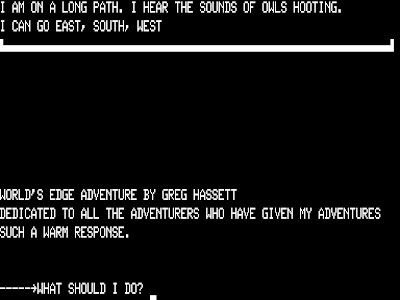
We begin on a long path, where we hear the sound of owls hooting. So this planet has owls on it? We can't LISTEN to anything. The path leads to a barnyard with a barn and silo; this story is not feeling very science-fictiony so far.
The barn contains a sickle, a ladder, and a letter... written on NASA letterhead. We learn that smog is overtaking Earth, and we have to go to planet AW-8 near Alpha-Centauri to retrieve a mineral that can absorb it. We're also warned that the mineral, APC-80, is central to the locals' RELIGEOUS [sic] BELIEFS, so we will presumably have some opposition to deal with when we get there.
We can't take the ladder with us, but we can CLIMB LADDER to find a haystack in the loft. LOOK HAYSTACK reveals a NEEDLE -- rather more easily than conventional wisdom would have it. We can use this to PICK LOCK and get into the silo.
The silo, of course, turns out to be A ROCKET-SHIP. IT LOOKS MIGHTY COMPLICATED, but all we see is a LEVER. All we have to do is PULL LEVER, and IT TAKES OFF, THEN LANDS. And a voice over the loudspeaker informs us that when we exit, the ship will vanish into a time warp. That may prove inconvenient, and it doesn't make a lot of sense unless our transportation depends on some newfangled silo/wormhole effect currently unknown to physics.
Now we find ourselves in a SMALL FLAT ON THE PLANET. An apartment? With TALL GRASS? We must just be standing in a small flat area, actually. With the sickle we brought from home, we can CUT GRASS to discover a JETPAK and the remnant of a PAPER, which tells us to say START to start the jetpak. But the part telling us what to use for fuel has been cut off. We can SAY START -- we go up a ways, then down a ways, before we fatally crash. So it has some fuel, but we shouldn't try to do this just yet.
Next we come to a DARK SWAMP, a maze in the traditional vein. We find a pointy knife, a chunk of plastic, and something referred to as a SPORK HORN. The maze isn't too difficult -- most rooms just have some directions that cycle back and some that go to new locations, but it still requires some traditional drop-and-check mapping. We need to come in here to find the various objects hidden in the swamp, but there's no exit as such.
To the south of our landing site, we find ourselves standing on a SMALL, BURNT-OUT PLANETOID near a building. Apparently this PLANETOID has actually landed somewhere and is not hurtling through space, and it's not big enough for us to do anything interesting on it.
The building nearby is something called the HOLOFAME, where a voice repeats, "INSERT YOUR CREDIT DISC FOR THE NEXT SHOW!" Fortunately, there's a square credit disc just lying here on the ground. The parser insists that we refer to it as a SQUARE; apparently we will encounter other shapes later. We can discover a minor bug if we try to READ SQUARE, as I SEE NO WRITING THERE! -- and then the game chugs right on into re-reading the NASA letter, even if we are no longer carrying it.
INSERT SQUARE whisks us into the Holofame on a moving speedwalk, where we find not so much a show as a puzzle. Three buttons, round, square, and triangular are available; the round one won't press, and the square one presents an unlicensed image of FLASH GORDON, who says, "YOU SHOULD HAVE SAVED YOUR SQUARE DISC..." I tell you, these showbiz people think they can get away with anything. A step back is in order.
Inside the cave is a SEMI-DARK TALL CHAMBER with a glowstone, a vent in the ceiling, and a SPACE AMOEBA. Funny how space amoebae are always visible to the naked eye, unlike their Earthly counterparts. It guards the glowstone, which we will likely need to explore the darker recesses of the cave. Can we KILL AMOEBA? No, because this is a pacifist parser and I DO NOT KNOW HOW TO "KILL" SOMETHING. POKE isn't recognized either, though STAB AMOEBA simply DOESN'T WORK. So the pointy knife we found earlier isn't helping. HIT AMOEBA finally puts us into a fight with the creature -- but then we die after throwing PUNCH AFTER PUNCH, presumably drowning in a miasma of space protoplasm.
Even without the glowstone, we can poke around in the dark a bit without dying -- we're told if we run into a wall, and there are no accidental trip-and-fall deaths. We can discover that there's a TROLL on the lower level who won't let us go east. But we're really going to need that glowstone. BLOW HORN doesn't do anything interesting in the troll's room. THROW KNIFE produces the interesting, "NAH... I THREW OUT MY ARM YESTERDAY WHILE GUIDING SOMEONE THROUGH 'MYSTERY MANSION ADVENTURE.' YOU MIGHT TRY 'DROP'." I haven't been able to confirm that such a game exists; perhaps it's an unpublished or lost Hassett work, or it might have just sounded like a generic adventure name for the purpose.
We can KICK TROLL, apparently defeating it handily (or footily) even in the dark. If we BLOW HORN in the dark room east of the space amoeba, an ANGRY SPORK shows up and eats it. But (again even in darkness) we can see that SHE'S GOT A LITTLE EGG WITH HER that MIGHT BE VALUABLE TO THE INHABITANTS OF AW-80. TAKE EGG isn't successful though -- THE MOTHER SPORK IS STARTLED, BUT SHE KILLS ME. We can, however, STAB SPORK with the pointy knife; "PLEASE... PLEASE DON'T CRACK MY EGG...", she says, before IT KICKS THE BUCKET AND VANISHES. The egg is listed as a LUMINOUS SPORK EGG in inventory, but it apparently doesn't throw off enough light for us to see any better in the dark areas.
Given our general disregard for the native flora and fauna, we may decide to CRACK EGG anyway -- a baby spork emerges and says, "GO BACK TO THE CAVE ENTRANCE" before running off. We find a NOTE at that location now, reading DROP THE POWDER HERE, GO BACK TO THE HOLOFAME, AND YOU'LL FIND A CREDIT DISC.
This proves true -- the powder is a LUMINOUS POWDER left over after we crack the egg -- and the triangular holoshow features James T. Kirk, another unlicensed stalwart of 80s adventure games, who tells us, "FOR FUEL USE WATER..." The AW-80ans must be desperate for entertainment if they enjoy these short, cryptic presentations. We can't FILL JETPAK in the swamp, though; we must need a cleaner source of water.
What to do with the amoeba? GIVE PLASTIC produces unexpected results -- IT EXPLODES AND DESTROYS ME. So apparently it is a plastic explosive, and should be handled with care, but it doesn't do anything to the amoeba that it doesn't also do to us.
We can use the jetpak outside the cave to fly up to THE EDGE OF A CLIFF. We're out of fuel now, it seems, but we can enter the cliffside to the east to find a depression in the rock, and the entrance to a gated city. GO HOLE in the depression lands us on the amoeba, AND IT SWALLOWS ME ALIVE. I'M DEAD. So this must be the way back down, if we have disposed of the amoeba. LOOK HOLE reveals that it LOOKS LIKE I CAN SEE AMOEBA TRACKS DOWN THERE... Ewww.
The city's gates require insertion of a DELOCKING CUBE, which we don't have, and the amoeba is starting to be a roadblock. But the Troll room, dark though it may be, contains the CUBE we now know we seek if we just go there and TAKE CUBE, so we're not stumped yet.
Unlocking the city gates whisks us into the city, where a sign informs us we are in POLARIZON, LARGEST CITY ON AW-80. But it's not very big. There's a park, IMMACULATE, and a bookstore.
The guard at the police station can be heard muttering to himself, "I SURE WISH I HAD A DISC TO GO TO THE HOLOFAME, BUT UNTIL THEN, I'M GONNA BE REAL MEAN TO ALL MY PRISONERS." He apparently considers us one of his prisoners, just because we've wandered into the police station, as if we try to go E we are told that THE MEAN POLICEMAN WON'T LET ME GO! But giving him the square disc sends him running off, presumably to see Flash Gordon tell him he's wasted his entry fee. Perhaps we should conclude our business here as quickly as possible.
Below the police station is a scene that prefigures both Space Quest and The Secret of Monkey Island, as we arrive at HONEST QUORON'S USED SPACECRAFT LOT, where a STARHAWK FIGHTER is on sale. There's no fuel onboard, so we will need to FILL TANK before we can TURN KNOB.
The local FLOWER SHOP has a FLOWER POT; we can just take it, there's no clerk on duty who would force us to BUY it. A GUN SHOP has a LASER PISTOL, which can be similarly lifted. Further into town we find a manhole, a fuel station with a pump where we can FILL POT to obtain a flowerpot full of fuel, and the POLARIZON SAVINGS BANK with a locked iron safe. It's too dark to see down the manhole, and if we try to DROP PLASTIC down the manhole, it doesn't work -- it still hits the ground and explodes.
Once we're inside the town, it appears we cannot exit through the gates. But we can use the fuel in the Starhawk fighter, and TURN KNOB -- at this point, though, we're too early: I TAKE OFF AND LAND ON EARTH.... I HAVE FAILED. I DIDN'T GET THE CRYSTALS.
So now we have the general lay of the land mapped out. But I still haven't dealt with the space amoeba, which seems to be key to finishing the game properly. We can't reach the vent above the amoeba, or JUMP VENT; maybe it's just the exit from the hole above. Can we drop the plastic down that hole? Oh, yes! That actually worked. And now there's a SMALL POOL OF WATER conveniently left behind so we can refuel the jetpak for a second run.
I made a lucky guess that we can RUB GLOWSTONE to gain illumination. Now we can see SPORK TRACKS in the room where mama spork shows up. And we can see that the troll is in fact a SPACE-TROLL. And that there's a ROUND CREDIT DISC in the room to the east of the troll.
At the Holofame, the round disc summons an image of Luke Skywalker who hints that, "THE SPACE ORC HAS A POINT." If that's a hint that the SPORK is a SPACE ORC and that we can stab her with the pointy knife, we already figured that out, working blind to boot. (The only credit disc the police guard wants is the square one, apparently, so he must already have seen this oddly specific message.)
The manhole takes us into another maze, of sewers. There's an ENERGY CAPSULE down here, and apparently no other reason to explore it. We can't INSERT CAPSULE or CHARGE PISTOL, but we can LOAD PISTOL to put the capsule in and push its energy meter to full.
Now we can go back to the bank, SHOOT SAFE, and POW! IT DEMATERIALIZES! LOOK WHAT WAS INSIDE... Which turns out to be the APC-80 CRYSTALS we were sent to retrieve at great expense. There's no sign of the religious ramifications of these sacred crystals, so far at least. And no, as it turns out, there are none at all; we can just get in the Starhawk fighter, FILL TANK, TURN KNOB, and head back to Earth, victorious!

This game was easier and more logical than some of Hassett's games, with some sensible built-in clues, and aside from the amoeba puzzle I didn't really get stuck anywhere. World's Edge was good fun, and a good quick play; I will likely return to this author's body of work before too long.

I always encourage interested readers to try these games out independently before I get into the details, and World's Edge isn't too difficult to solve. As always, beyond this point there lie...
***** SPOILERS AHEAD! *****

We begin on a long path, where we hear the sound of owls hooting. So this planet has owls on it? We can't LISTEN to anything. The path leads to a barnyard with a barn and silo; this story is not feeling very science-fictiony so far.
The barn contains a sickle, a ladder, and a letter... written on NASA letterhead. We learn that smog is overtaking Earth, and we have to go to planet AW-8 near Alpha-Centauri to retrieve a mineral that can absorb it. We're also warned that the mineral, APC-80, is central to the locals' RELIGEOUS [sic] BELIEFS, so we will presumably have some opposition to deal with when we get there.
We can't take the ladder with us, but we can CLIMB LADDER to find a haystack in the loft. LOOK HAYSTACK reveals a NEEDLE -- rather more easily than conventional wisdom would have it. We can use this to PICK LOCK and get into the silo.
The silo, of course, turns out to be A ROCKET-SHIP. IT LOOKS MIGHTY COMPLICATED, but all we see is a LEVER. All we have to do is PULL LEVER, and IT TAKES OFF, THEN LANDS. And a voice over the loudspeaker informs us that when we exit, the ship will vanish into a time warp. That may prove inconvenient, and it doesn't make a lot of sense unless our transportation depends on some newfangled silo/wormhole effect currently unknown to physics.
Now we find ourselves in a SMALL FLAT ON THE PLANET. An apartment? With TALL GRASS? We must just be standing in a small flat area, actually. With the sickle we brought from home, we can CUT GRASS to discover a JETPAK and the remnant of a PAPER, which tells us to say START to start the jetpak. But the part telling us what to use for fuel has been cut off. We can SAY START -- we go up a ways, then down a ways, before we fatally crash. So it has some fuel, but we shouldn't try to do this just yet.
Next we come to a DARK SWAMP, a maze in the traditional vein. We find a pointy knife, a chunk of plastic, and something referred to as a SPORK HORN. The maze isn't too difficult -- most rooms just have some directions that cycle back and some that go to new locations, but it still requires some traditional drop-and-check mapping. We need to come in here to find the various objects hidden in the swamp, but there's no exit as such.
To the south of our landing site, we find ourselves standing on a SMALL, BURNT-OUT PLANETOID near a building. Apparently this PLANETOID has actually landed somewhere and is not hurtling through space, and it's not big enough for us to do anything interesting on it.
The building nearby is something called the HOLOFAME, where a voice repeats, "INSERT YOUR CREDIT DISC FOR THE NEXT SHOW!" Fortunately, there's a square credit disc just lying here on the ground. The parser insists that we refer to it as a SQUARE; apparently we will encounter other shapes later. We can discover a minor bug if we try to READ SQUARE, as I SEE NO WRITING THERE! -- and then the game chugs right on into re-reading the NASA letter, even if we are no longer carrying it.
INSERT SQUARE whisks us into the Holofame on a moving speedwalk, where we find not so much a show as a puzzle. Three buttons, round, square, and triangular are available; the round one won't press, and the square one presents an unlicensed image of FLASH GORDON, who says, "YOU SHOULD HAVE SAVED YOUR SQUARE DISC..." I tell you, these showbiz people think they can get away with anything. A step back is in order.
Inside the cave is a SEMI-DARK TALL CHAMBER with a glowstone, a vent in the ceiling, and a SPACE AMOEBA. Funny how space amoebae are always visible to the naked eye, unlike their Earthly counterparts. It guards the glowstone, which we will likely need to explore the darker recesses of the cave. Can we KILL AMOEBA? No, because this is a pacifist parser and I DO NOT KNOW HOW TO "KILL" SOMETHING. POKE isn't recognized either, though STAB AMOEBA simply DOESN'T WORK. So the pointy knife we found earlier isn't helping. HIT AMOEBA finally puts us into a fight with the creature -- but then we die after throwing PUNCH AFTER PUNCH, presumably drowning in a miasma of space protoplasm.
Even without the glowstone, we can poke around in the dark a bit without dying -- we're told if we run into a wall, and there are no accidental trip-and-fall deaths. We can discover that there's a TROLL on the lower level who won't let us go east. But we're really going to need that glowstone. BLOW HORN doesn't do anything interesting in the troll's room. THROW KNIFE produces the interesting, "NAH... I THREW OUT MY ARM YESTERDAY WHILE GUIDING SOMEONE THROUGH 'MYSTERY MANSION ADVENTURE.' YOU MIGHT TRY 'DROP'." I haven't been able to confirm that such a game exists; perhaps it's an unpublished or lost Hassett work, or it might have just sounded like a generic adventure name for the purpose.
We can KICK TROLL, apparently defeating it handily (or footily) even in the dark. If we BLOW HORN in the dark room east of the space amoeba, an ANGRY SPORK shows up and eats it. But (again even in darkness) we can see that SHE'S GOT A LITTLE EGG WITH HER that MIGHT BE VALUABLE TO THE INHABITANTS OF AW-80. TAKE EGG isn't successful though -- THE MOTHER SPORK IS STARTLED, BUT SHE KILLS ME. We can, however, STAB SPORK with the pointy knife; "PLEASE... PLEASE DON'T CRACK MY EGG...", she says, before IT KICKS THE BUCKET AND VANISHES. The egg is listed as a LUMINOUS SPORK EGG in inventory, but it apparently doesn't throw off enough light for us to see any better in the dark areas.
Given our general disregard for the native flora and fauna, we may decide to CRACK EGG anyway -- a baby spork emerges and says, "GO BACK TO THE CAVE ENTRANCE" before running off. We find a NOTE at that location now, reading DROP THE POWDER HERE, GO BACK TO THE HOLOFAME, AND YOU'LL FIND A CREDIT DISC.
This proves true -- the powder is a LUMINOUS POWDER left over after we crack the egg -- and the triangular holoshow features James T. Kirk, another unlicensed stalwart of 80s adventure games, who tells us, "FOR FUEL USE WATER..." The AW-80ans must be desperate for entertainment if they enjoy these short, cryptic presentations. We can't FILL JETPAK in the swamp, though; we must need a cleaner source of water.
What to do with the amoeba? GIVE PLASTIC produces unexpected results -- IT EXPLODES AND DESTROYS ME. So apparently it is a plastic explosive, and should be handled with care, but it doesn't do anything to the amoeba that it doesn't also do to us.
We can use the jetpak outside the cave to fly up to THE EDGE OF A CLIFF. We're out of fuel now, it seems, but we can enter the cliffside to the east to find a depression in the rock, and the entrance to a gated city. GO HOLE in the depression lands us on the amoeba, AND IT SWALLOWS ME ALIVE. I'M DEAD. So this must be the way back down, if we have disposed of the amoeba. LOOK HOLE reveals that it LOOKS LIKE I CAN SEE AMOEBA TRACKS DOWN THERE... Ewww.
The city's gates require insertion of a DELOCKING CUBE, which we don't have, and the amoeba is starting to be a roadblock. But the Troll room, dark though it may be, contains the CUBE we now know we seek if we just go there and TAKE CUBE, so we're not stumped yet.
Unlocking the city gates whisks us into the city, where a sign informs us we are in POLARIZON, LARGEST CITY ON AW-80. But it's not very big. There's a park, IMMACULATE, and a bookstore.
The guard at the police station can be heard muttering to himself, "I SURE WISH I HAD A DISC TO GO TO THE HOLOFAME, BUT UNTIL THEN, I'M GONNA BE REAL MEAN TO ALL MY PRISONERS." He apparently considers us one of his prisoners, just because we've wandered into the police station, as if we try to go E we are told that THE MEAN POLICEMAN WON'T LET ME GO! But giving him the square disc sends him running off, presumably to see Flash Gordon tell him he's wasted his entry fee. Perhaps we should conclude our business here as quickly as possible.
Below the police station is a scene that prefigures both Space Quest and The Secret of Monkey Island, as we arrive at HONEST QUORON'S USED SPACECRAFT LOT, where a STARHAWK FIGHTER is on sale. There's no fuel onboard, so we will need to FILL TANK before we can TURN KNOB.
The local FLOWER SHOP has a FLOWER POT; we can just take it, there's no clerk on duty who would force us to BUY it. A GUN SHOP has a LASER PISTOL, which can be similarly lifted. Further into town we find a manhole, a fuel station with a pump where we can FILL POT to obtain a flowerpot full of fuel, and the POLARIZON SAVINGS BANK with a locked iron safe. It's too dark to see down the manhole, and if we try to DROP PLASTIC down the manhole, it doesn't work -- it still hits the ground and explodes.
Once we're inside the town, it appears we cannot exit through the gates. But we can use the fuel in the Starhawk fighter, and TURN KNOB -- at this point, though, we're too early: I TAKE OFF AND LAND ON EARTH.... I HAVE FAILED. I DIDN'T GET THE CRYSTALS.
So now we have the general lay of the land mapped out. But I still haven't dealt with the space amoeba, which seems to be key to finishing the game properly. We can't reach the vent above the amoeba, or JUMP VENT; maybe it's just the exit from the hole above. Can we drop the plastic down that hole? Oh, yes! That actually worked. And now there's a SMALL POOL OF WATER conveniently left behind so we can refuel the jetpak for a second run.
I made a lucky guess that we can RUB GLOWSTONE to gain illumination. Now we can see SPORK TRACKS in the room where mama spork shows up. And we can see that the troll is in fact a SPACE-TROLL. And that there's a ROUND CREDIT DISC in the room to the east of the troll.
At the Holofame, the round disc summons an image of Luke Skywalker who hints that, "THE SPACE ORC HAS A POINT." If that's a hint that the SPORK is a SPACE ORC and that we can stab her with the pointy knife, we already figured that out, working blind to boot. (The only credit disc the police guard wants is the square one, apparently, so he must already have seen this oddly specific message.)
The manhole takes us into another maze, of sewers. There's an ENERGY CAPSULE down here, and apparently no other reason to explore it. We can't INSERT CAPSULE or CHARGE PISTOL, but we can LOAD PISTOL to put the capsule in and push its energy meter to full.
Now we can go back to the bank, SHOOT SAFE, and POW! IT DEMATERIALIZES! LOOK WHAT WAS INSIDE... Which turns out to be the APC-80 CRYSTALS we were sent to retrieve at great expense. There's no sign of the religious ramifications of these sacred crystals, so far at least. And no, as it turns out, there are none at all; we can just get in the Starhawk fighter, FILL TANK, TURN KNOB, and head back to Earth, victorious!

This game was easier and more logical than some of Hassett's games, with some sensible built-in clues, and aside from the amoeba puzzle I didn't really get stuck anywhere. World's Edge was good fun, and a good quick play; I will likely return to this author's body of work before too long.
Subscribe to:
Posts (Atom)


 Posts
Posts

