
More downloadable fun to round up for you this week...
WiiWare -- One new game: Just Jam, an interesting music toy allowing players to change up the instrumentation and remix a set of music tracks using the library of available samples; there's also an online store with additional tracks, though all seem to be fairly generic selections from lesser-known artists.
Wii Virtual Console -- Nothing new here this week.
DSiWare -- Four new titles here and on the 3DS; most new DSi titles seem to be available simultaneously on the 3DS now. Jewel Keepers: Easter Island is a match-three puzzle game with a more substantial storyline than the norm. Make Up & Style is a digital version of those old enlarged Barbie head toys, with customizable 3-D faces, a storyline with challenges, and plenty of cosmetic tools to play with. Roller Angels is kind of a cutesy, platforming-based 2D version of Jet Grind Radio, with three rollerskating girls jumping and tagging. Farm Frenzy is a casual farm-themed game with resource management and arcade elements.
Nintendo 3DS eShop -- A number of old-school Game Boy titles come to the 3DS this week, in original 2-D form. Fortified Zone is a Bloody Wolf/Ikari Warriors-style military shooter from Jaleco. Qix is Taito's classic arcade game in its Game Boy form. All four of the DSi titles above are also available on the 3DS.
XBox Live Arcade -- Three new games this week, all fairly minor as the big guns are held back for the Summer of Arcade starting in a few weeks. Dead Block is a multiplayer zombie outbreak game set in the 1950s, with split-screen support for up to four local players (and online play as well, of course.) Deadliest Warrior: Legends is the second in what looks to be a series of fighting games based on the Spike TV series, despite poor critical reaction to the first entry, Deadliest Warrior: The Game. Konami's MLB Bobblehead Pros brings the American style of super-deformed sports heroes onto the baseball diamond, with full MLBPA player licensing.
PS3 on PSN -- One new game this week: Playstation Move Ape Escape, merging the classic PSX game with Sony's motion controller in the form of an on-rails netter/shooter/gadgeter.
PSOne Classics -- Still dormant, going on a month now.
Thursday, July 7, 2011


Wednesday, July 6, 2011
The Upgrade Cycle Looms...
I'm a fairly eclectic gamer -- I have never considered myself to be exclusively a PC gamer or a console gamer, and I appreciate the strengths of both. For purposes of this discussion, I'm going to ignore many differentiating factors, like controllers, networking support, moddability (is that a word?) and software libraries. I'm mostly interested in how the respective PC and console hardware life cycles operate.
Consoles are meant to be affordable and simple to use -- every game published for a specific machinewill should run on every version of the console available, with no fundamental performance differences. The box itself needs to be refreshed every so often to keep up with technology standards, of course, and each new generation usually means buying a whole new set of accessories and games. Still, there's something to be said for plugging a new console in, hooking it to the TV, loading up a game and jumping into the action.
PCs do a lot of the pushing of gaming technology standards -- horsepower that gamers and critics are thrilled to see on a new console is usually at least a few years behind the state of the art on the PC. When consoles do occasionally take the lead in some area, like the SNES' sample-based music chip or the original Playstation's dedicated 3-D hardware, PCs are usually able to catch up with and surpass those new features within a year or two. But this also means that PCs are never completely "current" -- there is always some new hardware, some new investment that can be made to make the gaming experience that much more "complete."
I'm thinking about this lately because console gamers don't have to deal with "max settings" and frame rates -- either a game looks good and plays smoothly or it doesn't, and there's usually nothing that can be done to fix any issues. PC gamers, on the other hand, often end up playing the endless "performance tweaking" game more than any other. I have spent many hours adjusting both PC and game settings, trying to get the most out of whatever hardware I'm using at the time, and then testing out familiar games, relishing any discernible improvement after I've added new hardware or think I've established a better performance balance.
What I'm dealing with at the moment is this: I do most of my PC gaming (and a lot of my old-school emulated console gaming for this blog) on a laptop computer. It's a decent mid-range 2009 machine, with dual-core CPUs and enough memory to eliminate a lot of the "wait time" that always used to annoy me about Windows. It runs my standard tools and utilities with aplomb, and I rarely feel like I'm waiting on the computer; I'm very happy with it for general purposes. But given space and heat limitations, it's inevitable that my laptop's integrated graphics hardware is far from state of the art -- it can manage a passable 50 frames-per-second with 3D graphics using the Passmark Medium Complexity 3D test, but falls precipitously to a chuggy, unplayable 9 fps on a High Complexity test.
Now, I'm not playing Crysis 2 or anything that really pushes the standards on my laptop, but I do play a lot of the current adventure games and might play some other types of games if my hardware were up to it. But even with something graphically straightforward like Tales of Monkey Island, I can't turn the detail all the way up without seriously impacting the frame rate. And any scene with fog or smoke effects tends to make my hardware stutter -- it will do its best, and I can make just about anything playable if I lower the resolution and settings, but it's a far cry from what I'm used to on the XBox 360, and revives those old PC gamer cravings for just a bit more power.
The larger issue is that laptops are self-contained and not generally very upgradable; they're also designed to use minimal electricity, which is why they usually don't have powerful graphics chips. So aside from playing with the built-in graphics hardware's settings, I can't really do very much about this situation. So I find myself contemplating a new hardware purchase -- but not a gaming laptop, as they are expensive and my current machine is fine for everything else I do.
I am considering buying a relatively cheap tower PC with a decent amount of memory, buying and installing a relatively current graphics card with fast, dedicated memory, hooking it to the TV with an HDMI cable, and using a remote keyboard, mouse and controller to make the experience as console-like as I can.
This project, of course, will entail quite a few decisions about cost vs. power. But I enjoy doing that kind of research every once in a while, and I suspect an inexpensive desktop machine today will be more capable than my laptop of two years ago, especially with a graphics hardware upgrade. And, to be honest, all I truly care about is being able to run, say, Back to the Future: The Game at 720p or 1080p with full detail settings; that's demanding by my current hardware's standards, but it shouldn't be a lot to ask on a desktop machine.
So this may be a new little project for me to tackle. Of course, I will also have to do a little self-analysis in the process, i.e., wondering whether I'm tempted to do this because there isn't a new console launch on the horizon this year, and subconsciously I really just want a new toy to tinker with in the meanwhile. That can be a whole game in and of itself. I'll keep you posted.
Consoles are meant to be affordable and simple to use -- every game published for a specific machine
PCs do a lot of the pushing of gaming technology standards -- horsepower that gamers and critics are thrilled to see on a new console is usually at least a few years behind the state of the art on the PC. When consoles do occasionally take the lead in some area, like the SNES' sample-based music chip or the original Playstation's dedicated 3-D hardware, PCs are usually able to catch up with and surpass those new features within a year or two. But this also means that PCs are never completely "current" -- there is always some new hardware, some new investment that can be made to make the gaming experience that much more "complete."
I'm thinking about this lately because console gamers don't have to deal with "max settings" and frame rates -- either a game looks good and plays smoothly or it doesn't, and there's usually nothing that can be done to fix any issues. PC gamers, on the other hand, often end up playing the endless "performance tweaking" game more than any other. I have spent many hours adjusting both PC and game settings, trying to get the most out of whatever hardware I'm using at the time, and then testing out familiar games, relishing any discernible improvement after I've added new hardware or think I've established a better performance balance.
What I'm dealing with at the moment is this: I do most of my PC gaming (and a lot of my old-school emulated console gaming for this blog) on a laptop computer. It's a decent mid-range 2009 machine, with dual-core CPUs and enough memory to eliminate a lot of the "wait time" that always used to annoy me about Windows. It runs my standard tools and utilities with aplomb, and I rarely feel like I'm waiting on the computer; I'm very happy with it for general purposes. But given space and heat limitations, it's inevitable that my laptop's integrated graphics hardware is far from state of the art -- it can manage a passable 50 frames-per-second with 3D graphics using the Passmark Medium Complexity 3D test, but falls precipitously to a chuggy, unplayable 9 fps on a High Complexity test.
Now, I'm not playing Crysis 2 or anything that really pushes the standards on my laptop, but I do play a lot of the current adventure games and might play some other types of games if my hardware were up to it. But even with something graphically straightforward like Tales of Monkey Island, I can't turn the detail all the way up without seriously impacting the frame rate. And any scene with fog or smoke effects tends to make my hardware stutter -- it will do its best, and I can make just about anything playable if I lower the resolution and settings, but it's a far cry from what I'm used to on the XBox 360, and revives those old PC gamer cravings for just a bit more power.
The larger issue is that laptops are self-contained and not generally very upgradable; they're also designed to use minimal electricity, which is why they usually don't have powerful graphics chips. So aside from playing with the built-in graphics hardware's settings, I can't really do very much about this situation. So I find myself contemplating a new hardware purchase -- but not a gaming laptop, as they are expensive and my current machine is fine for everything else I do.
I am considering buying a relatively cheap tower PC with a decent amount of memory, buying and installing a relatively current graphics card with fast, dedicated memory, hooking it to the TV with an HDMI cable, and using a remote keyboard, mouse and controller to make the experience as console-like as I can.
This project, of course, will entail quite a few decisions about cost vs. power. But I enjoy doing that kind of research every once in a while, and I suspect an inexpensive desktop machine today will be more capable than my laptop of two years ago, especially with a graphics hardware upgrade. And, to be honest, all I truly care about is being able to run, say, Back to the Future: The Game at 720p or 1080p with full detail settings; that's demanding by my current hardware's standards, but it shouldn't be a lot to ask on a desktop machine.
So this may be a new little project for me to tackle. Of course, I will also have to do a little self-analysis in the process, i.e., wondering whether I'm tempted to do this because there isn't a new console launch on the horizon this year, and subconsciously I really just want a new toy to tinker with in the meanwhile. That can be a whole game in and of itself. I'll keep you posted.
Tuesday, July 5, 2011
Adventure of the Week: Adventure F - The Eye of Bain (1984)
It's been a while since I've looked at Artic Computing Limited's series of text adventures for the Sinclair Spectrum ZX, a popular home computer in the UK. So this week we're playing through Artic Adventure F - The Eye of Bain, sixth in the cassette-based series. Like Adventure E - The Golden Apple before it, this one features an illustrated title screen that attempts to provide an overview of the game's landscape, and an onscreen credit for the series' author, Simon Wadsworth.

The next screen of text also credits one Ken Gosling for the "Adventure scenario," though I'm not quite sure what that means. There are also in-game illustrations for every room, viewable with the LOOK command, but they are strictly for illustration and don't really add anything to the gameplay. The Artic games all seem to share the same idiosyncratic parser, with an equally idiosyncratic design sensibility that sometimes requires a good deal of word guessing to get the player's point across. But they're also varied, colorful, and short enough not to be too aggravating.
Adventure F begins in a grass hut with no obvious exits but some interesting items; presumably our goal is to obtain the titular Eye of Bain, and despite the game's vintage this almost certainly has nothing to do with Diff'rent Strokes TV star Conrad Bain.
As always, I encourage interested readers to seek out and play Adventure F -- The Eye of Bain before proceeding here. I will be documenting the game's quirks and storyline in some detail, which means there will surely be...
***** SPOILERS AHEAD! *****
The cabin where we find ourselves as the game begins contains a number of potentially useful items, so we should probably TAKE anything that's not nailed down -- i.e, the Dagger and Net. The Pole and Door are permanent. I or INVENTORY reveals that we are already carrying a heavy Chain as the game begins, and its nature is revealed when we try to CLIMB POLE, yielding You're joking?! I can't do any climbing with this chain wrapped around my leg.
We can't DROP CHAIN, as it's clamped firmly to my leg. We can't GO DOOR with the chain on either. So this is our first puzzle, it seems, and LIFT POLE solves it -- As I lift the pole the chain is released and part of the wall falls in. (The Speccy's generous 32K of RAM was kind to cassette-based, single-load text adventures -- there's little SOMETHING HAPPENED! vagueness here.)
We have to remember to EXAMINE objects of interest, as LOOK just brings up the vector-and-fill location illustrations, which generally contain no new information. I took a peek at some of them early on, but eventually stopped bothering; a few of them are quite nice, though, like this image of an ape in a tree:

Once we've freed ourselves, it's still not a good idea to GO DOOR, as The villagers see me. This time they make no mistakes and execute me on the spot. So it's better to explore the village outskirts. An apiary contains a Hive and some bumble bees, but it's not wise to EXAMINE HIVE -- I get stung to death by very protective bees! Hmmm. We can't WEAR NET or COVER HIVE or NET BEES, so we may have to come back here later.
The crossroads to the south feature a whipping post, with a man tied to it, making this game's world seem suddenly not quite so quaint and tropical. Fortunately we can easily FREE MAN - he is grateful, and says, "The blade and the hilt together do make, the downfall of the really big snake!" Apparently he's a bit dehydrated and delirious, but we should make note of this in case it eventually means something, in the way that odd adventure game utterances always do.
We can try to CUT UNDERGROWTH at the edge of the forest, learning only that I can't do that.. YET! So that's something else to try again at some point. Down a nearby well, we encounter a shapeless black Beast and a Hole. We can't GO HOLE, of course; the beast erupts into grey flame and drives me back. So we will likely have to dispatch this creature at some point; right now, we should at least take the well's obviously useful Bucket along.
The Eye of Bain is largely an outdoor adventure, and free of traditional mazes, which may have been falling out of favor already by the time this game was written. But there are navigation puzzles to contend with, and of course, in the forest we still can't CLIMB TREE with the chain wrapped around our leg.
A mountain path has a rocky Slope and a large Stone. (The Artic parser tends to capitalize the operative word in more complex object names, which often comes in handy.) A desert region is just large enough to dehydrate us in three moves. We can FILL BUCKET at the stream to carry water with us, but to our chagrin we discover that we can't DRINK WATER! Even as we teeter between life and death, the parser taunts us, gleefully informing us that The noun "WATER" is not in my vocabulary right before it tells us that I am totally dehydrated. I'm dead! Yowza. We can't DRINK BUCKET either; only a simple DRINK command does the trick. (And apparently we can only DRINK after we FILL BUCKET, even in the direst circumstances while we are standing right next to an obvious source of potable H2O.) Once we survive the desert -- and the parser -- we can reach a rocky canyon with a River and a Shovel, and visit the Port of Amrath where a Pirate captain waits with his pirate Ship. It's not a good idea to GO SHIP, however, as we are pounced upon by his motley crew and made a galley slave, ending the game.
We can DIG with the shovel, but it's difficult to find anything within the tight, three-move desert heat limit, and in fact there's nothing to be found beneath the shifting sands. We can also make our way north to a Nomad's tent, containing a Jar of oil, two slave Girls, a Tapestry, and an unhappy desert Nomad who says, "Be gone, infidel scum." Apparently he is unhappy with us, as evidenced by the fact that eventually he attacks me with a scimitar and kills me. EXAMINE TAPESTRY reveals yet another hole in the wall, but the Nomad kills us before we can further explore. We can't FREE GIRLS either, or KILL NOMAD, at least not before getting killed ourselves. But we can THROW DAGGER and earn an immediate weapons upgrade: As the dagger plunges into the nomad he drops a scimitar and dies. And now we can take time to EXAMINE GIRLS -- One of them had a ruby in her navel. The ruby falls out and the girls wander off. So we can GET RUBY, though we cannot FOLLOW GIRLS.
Going through the hole behind the Tapestry, we find a Cave outside the nomad's tent which contains a Tunnel and a mean looking Bear, who probably wants honey, if this is a typical adventure game, especially considering that we've already encountered some bees. We can finally DIG successfully, in the nearby Field, to find some... Worms. No buried treasure here, apparently.
The ruby bears a faint inscription: "Fire will harm the beast of black"... this likely refers to the shapeless creature lurking the well. I tried to THROW JAR (of oil) and DROP JAR near it, and then irritate it by trying to GO HOLE, but apparently its grey flame is not actually inflammatory.
So let's see if we can obtain some honey and undo some of the usual adventure game's Gordian knot of interrelated puzzles. One action I hadn't tried yet was to THROW NET, establishing that the net lands on the bees covering them completely. Now we can EXAMINE HIVE to obtain some Honey, and GIVE HONEY to the Bear, so that he becomes a friendly happy Bear and allows us to GO TUNNEL in the cave to emerge on a narrow ledge with a bird's Nest, and a Magpie who pecks at us when we try to EXAMINE NEST. Can we GIVE WORMS to Magpie? Nope. But we can be mean about it and THROW WORMS -- I throw the worms off the ledge and the magpie chases after them and disappears. Don't worry, folks, he can surely fly -- and now we find a shiny Cross in the nest.
Having done well by the animals, it's time to continuing our bloodthirsty vendetta against human beings -- we can KILL PIRATE with the Nomad's scimitar, and EXAMINE PIRATE to obtain his Hook.
Now what? Well, the strong Pole from the hut might be useful; I thought perhaps we could tie or attach the Hook to it to produce a reaching device, but I was on the wrong track.
We can take the large Stone from the mountain path, which surprised me as I mentally pictured it as a much larger Stone than Mr. Wadsworth intends. And now we can simply BREAK CHAIN -- Wham! The heavy stone breaks the chain from my ankle. (And fortunately not vice-versa.)
Now we can CLIMB, which allows us to access several new areas, including some non-obvious ones -- we can't GO SLOPE, for example, but we can CLIMB SLOPE. There's a Pile of Wood on the mountain top, but we can't GET WOOD so we'll have to come back here if we're going to do anything with it. We can CLIMB TREE in a few places, to meet the huge Ape shown above in the Forest, and find a bunch of Bananas in the palm tree at the Oasis. And yes, if we GIVE BANANAS, the Ape gives us a Vine.
It appears that we can TIE VINE, to which the game responds, To What? This is a very good question. We can't seem to tie it to the Tree near the Ravine, or to the large Stone, or to the Pole, or the Hook. The Pole might be useful in another way, but we can't JUMP RAVINE, at least not successfully, or VAULT RAVINE.
I got stuck here, and ran out of things to try, which on my weekly deadline meant it was time to seek help -- fortunately, the venerable JGunness has prepared some hints and a walkthrough at his excellent site, the CASA Solution Archive. These hints were not much help to me at the moment I looked them up, though they did indicate that we can successfully JUMP RAVINE. I had to consult the detailed walkthrough, however, to learn that -- aha! -- we need the whipping Post, not the strong Pole. Something doesn't seem quite right about that, but now we can continue.
Fetching an Axe from the stone hut on the south side of the ravine, we can CUT UNDERGROWTH near the well to reveal a hidden Path, leading to a ruined Tower and a very locked Door, and no Keys seen in our travels so far. So I went back to the walkthrough, learning that we can SAY FIRE to create fire with the Ruby -- apparently the inscription was not just a hint, but actual instructions. I had been looking for some way to use the vine and wood and stone to spark a flame, to no avail, but with the magic Ruby fired up, the black Beast vanishes, and now we can GO HOLE. Here we find a skeleton Key among some stinking Bones -- ah, that joke never gets old!
The skeleton Key lets us unlock the door of the ruined Tower. The decrepit structure's basement has a Crypt, with a closed Coffin and an iron Lever. PULL LEVER reveals it's too rusted to pull, so this is probably what we need the Jar of oil for... and, yep, OIL LEVER and PULL LEVER causes an animated skeleton to pop out of the coffin. It's apparently some sort of rough, limited approximation of a vampire, as if we SHOW CROSS, it falls to bits, allowing us to EXAMINE COFFIN to get the sword Blade.
Exploring the Tower further, we find an altar upstairs, and a lit Torch at the very top of the tower. From up here, we can hear priests talking in the tower below -- but if we try to go downstairs and see what they're up to, The priests seize me and I become the next sacrifice to the great god Bain. We don't want to EXAMINE ALTAR, as doing so trips a trap full of deadly snakes. Hmmm. We can GO WINDOW at the top of the tower, and TIE VINE / TO GARGOYLE (finally!) to climb down, returning to the base of the Tower.
With the Torch, we can BURN WOOD on the mountain top, which sets off a panic in the village over this sign from the Gods, and turns the pile of Wood into a Beacon. The endgame is clearly approaching, so we probably need to MAKE SWORD now. We have the Blade, and... ? What's the Hilt? Apparently neither the dagger nor the scimitar can be used for this purpose. So, having exhausted most of the available items, I returned to the walkthrough, and discovered that we have to get the Hilt from the Altar, but DROP POLE first to keep from falling into the pit of snakes! Ack. Time to restore a previous save and do this before the priests show up, as we can't return to the Tower once they've occupied it.
Now we have the Sword foretold by the whipping boy assembled, and the villagers have been dispersed a bit, allowing us to safely GO DOOR from the hut and enter the Temple of Bain to find a stone Idol and a giant Serpent, probably the aforementioned snake. We can KILL SERPENT with the Sword, which isn't difficult and seems a little bit anticlimactic. But we're not done yet -- we can't TAKE IDOL. This is because it's rather larger than I had assumed -- we can, however, CLIMB IDOL. We need the Hook to remove the emerald from the idol's head -- clearly, the Pirate captain did not die in vain. But once we have the fabled Eye of Bain, we can't escape the temple the way we came in, as the villagers are still angry and have apparently decided the sign from the gods wasn't quite as scary as it might have seemed at first, and might just be an ordinary bonfire.
So what do we do now? Well, we can EXAMINE HEAD to see that there's a lever in the idol's mouth, and PULL LEVER produces a grinding noise somewhere, actually opening a secret Passage out of the Temple. Now it's a simple matter to GO BOAT at the end of the path, to finish as a Hero (our murdering ways clearly excised from the official account):

We are also, in the Artic Adventure tradition, advised to Look out for adventure G, as yet unnamed. And we will take a look at the series' final entry, Adventure G - Ground Zero, at some future date, I assure you.

The next screen of text also credits one Ken Gosling for the "Adventure scenario," though I'm not quite sure what that means. There are also in-game illustrations for every room, viewable with the LOOK command, but they are strictly for illustration and don't really add anything to the gameplay. The Artic games all seem to share the same idiosyncratic parser, with an equally idiosyncratic design sensibility that sometimes requires a good deal of word guessing to get the player's point across. But they're also varied, colorful, and short enough not to be too aggravating.
Adventure F begins in a grass hut with no obvious exits but some interesting items; presumably our goal is to obtain the titular Eye of Bain, and despite the game's vintage this almost certainly has nothing to do with Diff'rent Strokes TV star Conrad Bain.
As always, I encourage interested readers to seek out and play Adventure F -- The Eye of Bain before proceeding here. I will be documenting the game's quirks and storyline in some detail, which means there will surely be...
***** SPOILERS AHEAD! *****
The cabin where we find ourselves as the game begins contains a number of potentially useful items, so we should probably TAKE anything that's not nailed down -- i.e, the Dagger and Net. The Pole and Door are permanent. I or INVENTORY reveals that we are already carrying a heavy Chain as the game begins, and its nature is revealed when we try to CLIMB POLE, yielding You're joking?! I can't do any climbing with this chain wrapped around my leg.
We can't DROP CHAIN, as it's clamped firmly to my leg. We can't GO DOOR with the chain on either. So this is our first puzzle, it seems, and LIFT POLE solves it -- As I lift the pole the chain is released and part of the wall falls in. (The Speccy's generous 32K of RAM was kind to cassette-based, single-load text adventures -- there's little SOMETHING HAPPENED! vagueness here.)
We have to remember to EXAMINE objects of interest, as LOOK just brings up the vector-and-fill location illustrations, which generally contain no new information. I took a peek at some of them early on, but eventually stopped bothering; a few of them are quite nice, though, like this image of an ape in a tree:

Once we've freed ourselves, it's still not a good idea to GO DOOR, as The villagers see me. This time they make no mistakes and execute me on the spot. So it's better to explore the village outskirts. An apiary contains a Hive and some bumble bees, but it's not wise to EXAMINE HIVE -- I get stung to death by very protective bees! Hmmm. We can't WEAR NET or COVER HIVE or NET BEES, so we may have to come back here later.
The crossroads to the south feature a whipping post, with a man tied to it, making this game's world seem suddenly not quite so quaint and tropical. Fortunately we can easily FREE MAN - he is grateful, and says, "The blade and the hilt together do make, the downfall of the really big snake!" Apparently he's a bit dehydrated and delirious, but we should make note of this in case it eventually means something, in the way that odd adventure game utterances always do.
We can try to CUT UNDERGROWTH at the edge of the forest, learning only that I can't do that.. YET! So that's something else to try again at some point. Down a nearby well, we encounter a shapeless black Beast and a Hole. We can't GO HOLE, of course; the beast erupts into grey flame and drives me back. So we will likely have to dispatch this creature at some point; right now, we should at least take the well's obviously useful Bucket along.
The Eye of Bain is largely an outdoor adventure, and free of traditional mazes, which may have been falling out of favor already by the time this game was written. But there are navigation puzzles to contend with, and of course, in the forest we still can't CLIMB TREE with the chain wrapped around our leg.
A mountain path has a rocky Slope and a large Stone. (The Artic parser tends to capitalize the operative word in more complex object names, which often comes in handy.) A desert region is just large enough to dehydrate us in three moves. We can FILL BUCKET at the stream to carry water with us, but to our chagrin we discover that we can't DRINK WATER! Even as we teeter between life and death, the parser taunts us, gleefully informing us that The noun "WATER" is not in my vocabulary right before it tells us that I am totally dehydrated. I'm dead! Yowza. We can't DRINK BUCKET either; only a simple DRINK command does the trick. (And apparently we can only DRINK after we FILL BUCKET, even in the direst circumstances while we are standing right next to an obvious source of potable H2O.) Once we survive the desert -- and the parser -- we can reach a rocky canyon with a River and a Shovel, and visit the Port of Amrath where a Pirate captain waits with his pirate Ship. It's not a good idea to GO SHIP, however, as we are pounced upon by his motley crew and made a galley slave, ending the game.
We can DIG with the shovel, but it's difficult to find anything within the tight, three-move desert heat limit, and in fact there's nothing to be found beneath the shifting sands. We can also make our way north to a Nomad's tent, containing a Jar of oil, two slave Girls, a Tapestry, and an unhappy desert Nomad who says, "Be gone, infidel scum." Apparently he is unhappy with us, as evidenced by the fact that eventually he attacks me with a scimitar and kills me. EXAMINE TAPESTRY reveals yet another hole in the wall, but the Nomad kills us before we can further explore. We can't FREE GIRLS either, or KILL NOMAD, at least not before getting killed ourselves. But we can THROW DAGGER and earn an immediate weapons upgrade: As the dagger plunges into the nomad he drops a scimitar and dies. And now we can take time to EXAMINE GIRLS -- One of them had a ruby in her navel. The ruby falls out and the girls wander off. So we can GET RUBY, though we cannot FOLLOW GIRLS.
Going through the hole behind the Tapestry, we find a Cave outside the nomad's tent which contains a Tunnel and a mean looking Bear, who probably wants honey, if this is a typical adventure game, especially considering that we've already encountered some bees. We can finally DIG successfully, in the nearby Field, to find some... Worms. No buried treasure here, apparently.
The ruby bears a faint inscription: "Fire will harm the beast of black"... this likely refers to the shapeless creature lurking the well. I tried to THROW JAR (of oil) and DROP JAR near it, and then irritate it by trying to GO HOLE, but apparently its grey flame is not actually inflammatory.
So let's see if we can obtain some honey and undo some of the usual adventure game's Gordian knot of interrelated puzzles. One action I hadn't tried yet was to THROW NET, establishing that the net lands on the bees covering them completely. Now we can EXAMINE HIVE to obtain some Honey, and GIVE HONEY to the Bear, so that he becomes a friendly happy Bear and allows us to GO TUNNEL in the cave to emerge on a narrow ledge with a bird's Nest, and a Magpie who pecks at us when we try to EXAMINE NEST. Can we GIVE WORMS to Magpie? Nope. But we can be mean about it and THROW WORMS -- I throw the worms off the ledge and the magpie chases after them and disappears. Don't worry, folks, he can surely fly -- and now we find a shiny Cross in the nest.
Having done well by the animals, it's time to continuing our bloodthirsty vendetta against human beings -- we can KILL PIRATE with the Nomad's scimitar, and EXAMINE PIRATE to obtain his Hook.
Now what? Well, the strong Pole from the hut might be useful; I thought perhaps we could tie or attach the Hook to it to produce a reaching device, but I was on the wrong track.
We can take the large Stone from the mountain path, which surprised me as I mentally pictured it as a much larger Stone than Mr. Wadsworth intends. And now we can simply BREAK CHAIN -- Wham! The heavy stone breaks the chain from my ankle. (And fortunately not vice-versa.)
Now we can CLIMB, which allows us to access several new areas, including some non-obvious ones -- we can't GO SLOPE, for example, but we can CLIMB SLOPE. There's a Pile of Wood on the mountain top, but we can't GET WOOD so we'll have to come back here if we're going to do anything with it. We can CLIMB TREE in a few places, to meet the huge Ape shown above in the Forest, and find a bunch of Bananas in the palm tree at the Oasis. And yes, if we GIVE BANANAS, the Ape gives us a Vine.
It appears that we can TIE VINE, to which the game responds, To What? This is a very good question. We can't seem to tie it to the Tree near the Ravine, or to the large Stone, or to the Pole, or the Hook. The Pole might be useful in another way, but we can't JUMP RAVINE, at least not successfully, or VAULT RAVINE.
I got stuck here, and ran out of things to try, which on my weekly deadline meant it was time to seek help -- fortunately, the venerable JGunness has prepared some hints and a walkthrough at his excellent site, the CASA Solution Archive. These hints were not much help to me at the moment I looked them up, though they did indicate that we can successfully JUMP RAVINE. I had to consult the detailed walkthrough, however, to learn that -- aha! -- we need the whipping Post, not the strong Pole. Something doesn't seem quite right about that, but now we can continue.
Fetching an Axe from the stone hut on the south side of the ravine, we can CUT UNDERGROWTH near the well to reveal a hidden Path, leading to a ruined Tower and a very locked Door, and no Keys seen in our travels so far. So I went back to the walkthrough, learning that we can SAY FIRE to create fire with the Ruby -- apparently the inscription was not just a hint, but actual instructions. I had been looking for some way to use the vine and wood and stone to spark a flame, to no avail, but with the magic Ruby fired up, the black Beast vanishes, and now we can GO HOLE. Here we find a skeleton Key among some stinking Bones -- ah, that joke never gets old!
The skeleton Key lets us unlock the door of the ruined Tower. The decrepit structure's basement has a Crypt, with a closed Coffin and an iron Lever. PULL LEVER reveals it's too rusted to pull, so this is probably what we need the Jar of oil for... and, yep, OIL LEVER and PULL LEVER causes an animated skeleton to pop out of the coffin. It's apparently some sort of rough, limited approximation of a vampire, as if we SHOW CROSS, it falls to bits, allowing us to EXAMINE COFFIN to get the sword Blade.
Exploring the Tower further, we find an altar upstairs, and a lit Torch at the very top of the tower. From up here, we can hear priests talking in the tower below -- but if we try to go downstairs and see what they're up to, The priests seize me and I become the next sacrifice to the great god Bain. We don't want to EXAMINE ALTAR, as doing so trips a trap full of deadly snakes. Hmmm. We can GO WINDOW at the top of the tower, and TIE VINE / TO GARGOYLE (finally!) to climb down, returning to the base of the Tower.
With the Torch, we can BURN WOOD on the mountain top, which sets off a panic in the village over this sign from the Gods, and turns the pile of Wood into a Beacon. The endgame is clearly approaching, so we probably need to MAKE SWORD now. We have the Blade, and... ? What's the Hilt? Apparently neither the dagger nor the scimitar can be used for this purpose. So, having exhausted most of the available items, I returned to the walkthrough, and discovered that we have to get the Hilt from the Altar, but DROP POLE first to keep from falling into the pit of snakes! Ack. Time to restore a previous save and do this before the priests show up, as we can't return to the Tower once they've occupied it.
Now we have the Sword foretold by the whipping boy assembled, and the villagers have been dispersed a bit, allowing us to safely GO DOOR from the hut and enter the Temple of Bain to find a stone Idol and a giant Serpent, probably the aforementioned snake. We can KILL SERPENT with the Sword, which isn't difficult and seems a little bit anticlimactic. But we're not done yet -- we can't TAKE IDOL. This is because it's rather larger than I had assumed -- we can, however, CLIMB IDOL. We need the Hook to remove the emerald from the idol's head -- clearly, the Pirate captain did not die in vain. But once we have the fabled Eye of Bain, we can't escape the temple the way we came in, as the villagers are still angry and have apparently decided the sign from the gods wasn't quite as scary as it might have seemed at first, and might just be an ordinary bonfire.
So what do we do now? Well, we can EXAMINE HEAD to see that there's a lever in the idol's mouth, and PULL LEVER produces a grinding noise somewhere, actually opening a secret Passage out of the Temple. Now it's a simple matter to GO BOAT at the end of the path, to finish as a Hero (our murdering ways clearly excised from the official account):

We are also, in the Artic Adventure tradition, advised to Look out for adventure G, as yet unnamed. And we will take a look at the series' final entry, Adventure G - Ground Zero, at some future date, I assure you.
Monday, July 4, 2011
Oddities: G.I. Joe: Cobra Strike (Atari 2600, 1983)
"Yo, Joe!"
It's the Fourth of July, Independence Day here in the States, and a fine time to celebrate America's history (or at least its high-tech, buzz-cut military reputation) with a quick game of G.I. Joe: Cobra Strike, produced in 1983 by Parker Brothers for the Atari 2600.
The cartridge was based on Hasbro's 1980s revival of the venerable action figure line, replacing the solitary 12" G.I. Joe hero/adventurer with a new, team-based 3 3/4" approach that made for exponentially more toys and marketing opportunities. Unfortunately, the Atari 2600 wasn't really up to rendering individual G.I. Joe characters, vehicles or costumes, so the conflict is played out from a 50,000-foot view. A giant snake-shaped C.O.B.R.A. robot fires venom and lasers at terrified military personnel running along the bottom of the screen, while the player, as the heroic but rather remote and uninvolved Joe team, tries to shield them with a sliding barrier. The manual tells us that the anonymous figures running for their lives are G.I. Joe recruits; I like to imagine them cursing out the glad-handing officer from the high school career fair, as they dodge instantly fatal poison and sizzling laser beams fired by the obviously better-capitalized and highly motivated C.O.B.R.A. forces.

There's also a two-player cooperative mode, in which each player uses a paddle to control one shield and one of the gun turrets at the sides of the screen (which, despite the visual depiction, fire straight up -- at least the missiles are steerable while in flight.) The Joe-team player(s) can win by destroying the giant snake with 8 direct hits on its eyes, although occasionally it is vulnerable to a single direct hit,
The best thing about this game is that a third player can opt to grab a joystick and control the C.O.B.R.A. forces, trying to zap the helpless infantrymen as they run along the bottom of the screen. This is also the worst thing about the game, as it's a lot more fun to be the bad guy firing the heavy weaponry instead of the good guys playing defense and limited offense. The C.O.B.R.A. player wins bykilling capturing four of the hapless, disposable recruits.
The Parker Brothers engineering team knew its way around the Atari 2600, and this game is technically impressive, with a lot of visual detail given the system's capabilities. The running recruits move at slightly different speeds and appear in different shades of green, and up to 4 appear at one time with no visible flickering. And the C.O.B.R.A. robot has an undulating body that floats up and down as it moves across the screen -- it's one of the largest moving objects ever seen on the 2600, and when destroyed it splits in two, a neat little visual reward for the player's hard work. The sound is not as spectacular -- we hear a basic single-voice reveille as the game starts up, and the rest of the soundtrack is dominated by bomb-dropping sounds for Cobra's venom, and deep beeps whenever a recruit is taken out.
More intricate G.I. Joe games would surface on the Commodore 64 and the Nintendo Entertainment System later on, but this initial console entry isn't bad. The gameplay gets old after a while, as there isn't much variety available in a 4K ROM cartridge, and a normal round of play is just one long, repetitive escort mission. But with a range of difficulty settings available, or a skilled second or third player, the basic concept is solid enough to offer quite a bit of fun. If only it were more entertaining to be the good guys...
It's the Fourth of July, Independence Day here in the States, and a fine time to celebrate America's history (or at least its high-tech, buzz-cut military reputation) with a quick game of G.I. Joe: Cobra Strike, produced in 1983 by Parker Brothers for the Atari 2600.
The cartridge was based on Hasbro's 1980s revival of the venerable action figure line, replacing the solitary 12" G.I. Joe hero/adventurer with a new, team-based 3 3/4" approach that made for exponentially more toys and marketing opportunities. Unfortunately, the Atari 2600 wasn't really up to rendering individual G.I. Joe characters, vehicles or costumes, so the conflict is played out from a 50,000-foot view. A giant snake-shaped C.O.B.R.A. robot fires venom and lasers at terrified military personnel running along the bottom of the screen, while the player, as the heroic but rather remote and uninvolved Joe team, tries to shield them with a sliding barrier. The manual tells us that the anonymous figures running for their lives are G.I. Joe recruits; I like to imagine them cursing out the glad-handing officer from the high school career fair, as they dodge instantly fatal poison and sizzling laser beams fired by the obviously better-capitalized and highly motivated C.O.B.R.A. forces.

There's also a two-player cooperative mode, in which each player uses a paddle to control one shield and one of the gun turrets at the sides of the screen (which, despite the visual depiction, fire straight up -- at least the missiles are steerable while in flight.) The Joe-team player(s) can win by destroying the giant snake with 8 direct hits on its eyes, although occasionally it is vulnerable to a single direct hit,
The best thing about this game is that a third player can opt to grab a joystick and control the C.O.B.R.A. forces, trying to zap the helpless infantrymen as they run along the bottom of the screen. This is also the worst thing about the game, as it's a lot more fun to be the bad guy firing the heavy weaponry instead of the good guys playing defense and limited offense. The C.O.B.R.A. player wins by
The Parker Brothers engineering team knew its way around the Atari 2600, and this game is technically impressive, with a lot of visual detail given the system's capabilities. The running recruits move at slightly different speeds and appear in different shades of green, and up to 4 appear at one time with no visible flickering. And the C.O.B.R.A. robot has an undulating body that floats up and down as it moves across the screen -- it's one of the largest moving objects ever seen on the 2600, and when destroyed it splits in two, a neat little visual reward for the player's hard work. The sound is not as spectacular -- we hear a basic single-voice reveille as the game starts up, and the rest of the soundtrack is dominated by bomb-dropping sounds for Cobra's venom, and deep beeps whenever a recruit is taken out.
More intricate G.I. Joe games would surface on the Commodore 64 and the Nintendo Entertainment System later on, but this initial console entry isn't bad. The gameplay gets old after a while, as there isn't much variety available in a 4K ROM cartridge, and a normal round of play is just one long, repetitive escort mission. But with a range of difficulty settings available, or a skilled second or third player, the basic concept is solid enough to offer quite a bit of fun. If only it were more entertaining to be the good guys...
Sunday, July 3, 2011
Selling Spider-Man for the 2600
This ad ran in magazines and comic books back in 1982 to promote Parker Brothers' officially licensed Spider-Man cartridge for the Atari 2600. Unlike a lot of video game ads that were all about the theme and provided few details, this one gives the reader a pretty clear idea about the gameplay, right down to mocked-up screenshots (complete with graph paper lines between the pixels):

The game was designed by Laura Nikolich, one of just a few female designers active at the time, and it holds up pretty well today -- there's a lot of tension involved in working Spidey up the tower, and the game is technically impressive on the 2600, with vertical scrolling synchronizing sprites with the background, and dynamic drawing of Spidey's web.
My internet research also turned up something I hadn't known about -- I've seen the same one-page ad in comic books, but an expanded 2-page version also ran, with a few differences from the shorter version:

There are two additional panels -- one depicts more of Spidey's climbing action, dividing his voiceover across two panels, and there's an additional panel where Spider-Man reacts to the high voltage beams ("Holy Hannah!") that are only implied by the text of the one-page version. This version also lists the game as "COMING SOON!" where the magazine version assumes it's already available.
Was it "more action than even Spider-Man can handle?!?!?" Well, given that there's no way to actually beat the Green Goblin -- in the grand vintage game tradition, it just keeps getting more difficult -- I guess the answer has to be yes. It certainly provided enough action for lots of video gamers, and this early official Marvel Comics game adaptation set the bar pretty high; simple and primitive as it is, it would be quite a while before Activision's Spider-Man 3-D game did the wall-crawler better.

The game was designed by Laura Nikolich, one of just a few female designers active at the time, and it holds up pretty well today -- there's a lot of tension involved in working Spidey up the tower, and the game is technically impressive on the 2600, with vertical scrolling synchronizing sprites with the background, and dynamic drawing of Spidey's web.
My internet research also turned up something I hadn't known about -- I've seen the same one-page ad in comic books, but an expanded 2-page version also ran, with a few differences from the shorter version:
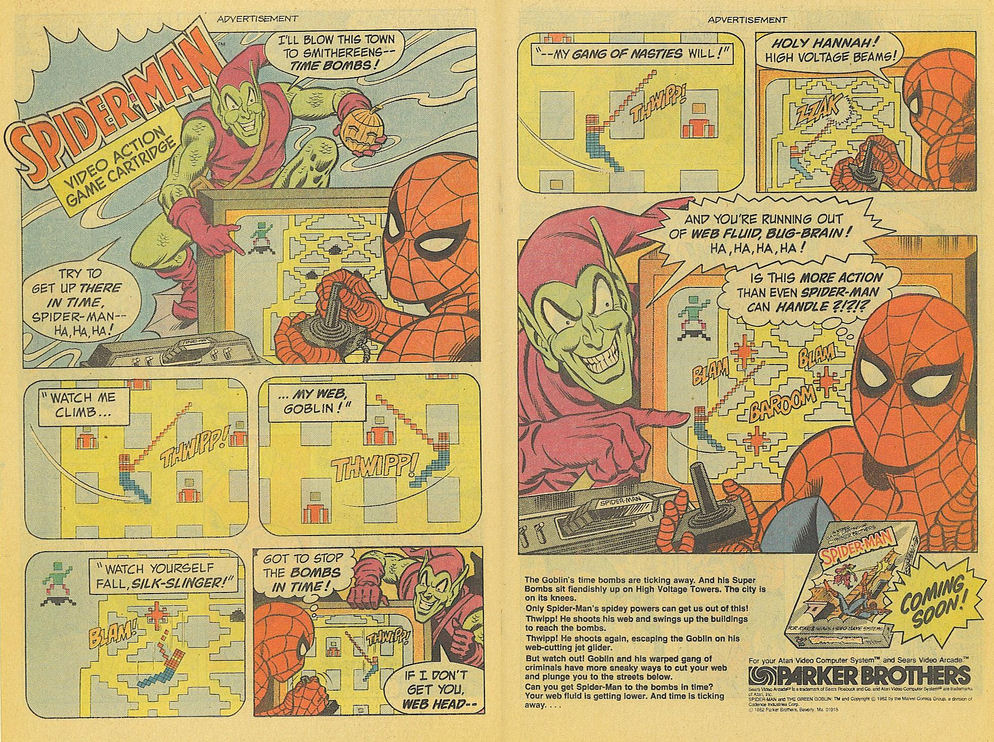
There are two additional panels -- one depicts more of Spidey's climbing action, dividing his voiceover across two panels, and there's an additional panel where Spider-Man reacts to the high voltage beams ("Holy Hannah!") that are only implied by the text of the one-page version. This version also lists the game as "COMING SOON!" where the magazine version assumes it's already available.
Was it "more action than even Spider-Man can handle?!?!?" Well, given that there's no way to actually beat the Green Goblin -- in the grand vintage game tradition, it just keeps getting more difficult -- I guess the answer has to be yes. It certainly provided enough action for lots of video gamers, and this early official Marvel Comics game adaptation set the bar pretty high; simple and primitive as it is, it would be quite a while before Activision's Spider-Man 3-D game did the wall-crawler better.
Saturday, July 2, 2011
Cover to Cover: Intellivision Spring 1986 Catalog (pp. 14-back cover)
Time to wrap up our most recent Cover to Cover series, with the final pages of Triton Products' spring 1986, late post-crash era, catalog of Intellivision products.
We're actually past all of the games, and page 14 presents a handful of completely unrelated products that, nevertheless, manage to give us a little bit of quaint, nostalgic humor. Triton's warehouse was full to bursting with discount technology from a bygone time -- a typewriter, a printing calculator, and a fancy cassette-based boom box:

Page 15, the inside back cover, gets us back into Intellivision territory, with the now-relatively-rare Intellivision System III console. This was basically a black-plastic version of the original Intellivision, and was more compatible with the existing Intellivision library than the interim model, the Intellivision II. It was selling for $64.95, which may have been a hard pitch to make with the base model Nintendo Entertainment System retailing in the $80-$90 range (though it only cost $4.00 to ship in 1986 dollars!) But if you were reading this catalog and still didn't have an Intellivision, or more likely wanted a replacement unit, there it is. The copy's reference to a "rich and growing" cartridge library was true, although the growth rate had slowed down tremendously -- and the console is "NEW!", which is technically accurate but a bit of an overstatement:

Finally, we arrive at the back cover, which no doubt shocked a few video gamers when their "BRAND-NEW INTELLIVISION CATALOG" dropped through their mail slots in 1986, as though spirited through a time warp from a few years earlier. The copy doesn't even promote the new games, just the quantity discount, but I would guess any interested party would have opened the catalog with all due haste. (Excuse the dust, I've redacted the original owner's name and address.)

And that's it for this one. The Intellivision was a fine system, powerful for its time with a 16-bit processor and a background graphics plane, though fast-action games were usually hamstrung by its unusual controller. I'm glad to know that Mattel's console eked out an existence during the NES era, and I'm sure fans of the system were grateful for Triton's continued support, however briefly it lasted.
We're actually past all of the games, and page 14 presents a handful of completely unrelated products that, nevertheless, manage to give us a little bit of quaint, nostalgic humor. Triton's warehouse was full to bursting with discount technology from a bygone time -- a typewriter, a printing calculator, and a fancy cassette-based boom box:

Page 15, the inside back cover, gets us back into Intellivision territory, with the now-relatively-rare Intellivision System III console. This was basically a black-plastic version of the original Intellivision, and was more compatible with the existing Intellivision library than the interim model, the Intellivision II. It was selling for $64.95, which may have been a hard pitch to make with the base model Nintendo Entertainment System retailing in the $80-$90 range (though it only cost $4.00 to ship in 1986 dollars!) But if you were reading this catalog and still didn't have an Intellivision, or more likely wanted a replacement unit, there it is. The copy's reference to a "rich and growing" cartridge library was true, although the growth rate had slowed down tremendously -- and the console is "NEW!", which is technically accurate but a bit of an overstatement:

Finally, we arrive at the back cover, which no doubt shocked a few video gamers when their "BRAND-NEW INTELLIVISION CATALOG" dropped through their mail slots in 1986, as though spirited through a time warp from a few years earlier. The copy doesn't even promote the new games, just the quantity discount, but I would guess any interested party would have opened the catalog with all due haste. (Excuse the dust, I've redacted the original owner's name and address.)

And that's it for this one. The Intellivision was a fine system, powerful for its time with a 16-bit processor and a background graphics plane, though fast-action games were usually hamstrung by its unusual controller. I'm glad to know that Mattel's console eked out an existence during the NES era, and I'm sure fans of the system were grateful for Triton's continued support, however briefly it lasted.
Friday, July 1, 2011
East vs. West: The Kung Fu / China Warrior (1987/1989)
When the PC Engine was in development, somebody at Hudson Soft realized that showing off its graphical abilities might be a fine way to move some machines. And thus, I speculate, was The Kung Fu born -- it's Volume 1 in Hudson's own numbered series of games for the machine it co-created with NEC, a premier title in both senses of the word. It debuted as a launch title for the PC Engine in 1987, and when the console came to the US as the TurboGrafx-16 in 1989, it was used to launch the system in North America as China Warrior.
The title screen underwent more than the usual amount of modification for its US release, though with no apparent reason -- here's the Japanese original:


The gameplay is otherwise identical in both versions, with the same sprites and background music. Even the slightly graphic wear-and-tear as our hero's health gets worn down is retained for the more squeamish (at the time) US market -- note the bleeding about the eye, mouth, and abdomen:

The big attraction here, obviously, is the very large character sprites -- these guys stand more than half the screen tall, with detailed and colorful artwork depicting the hero's rightward journey as he battles the left-leaning forces of evil. The game's definition of "forces of evil" is, apparently, broad enough to include tossed bowls, rolling rocks, moths, and sticks. Most of our "enemies" are passive, hooded monks who seem to walk right into the Kung Fu master's fists; more powerful versions duck or survive for more than one hit, but I always feel bad about beating them up, as they seem more like innocent pedestrians than actual foes.

The big drawback here, obviously, is the very large character sprites -- there's not much room for actual gameplay left over, as these monstrous figures lumber across the screen, obscuring the background and anything like an interesting or varied objective. The Kung Fu ultimately plays like Irem's Kung Fu Master, without the fluidity and fun. The main character punches and kicks, but with limitations -- when jumping, he can only kick, and when kneeling, only punches are available. He's also not very maneuverable -- he's forced to march along at a steady pace, and while we can move him from side to side within the scrolling screen, he resolutely faces rightward and has no ability to attack anything that gets past him. Fortunately, the bounding box of his attacks is fairly generous -- he can appear to miss a moth visually, but knocks it out with what seems to be the sheer force of the wind generated by his fists.
At least, and at last, at the end of each substage we get to face off against an enemy with a greater degree of enmity, like Mr. Mustache Camo Dude:

And there are bonus rounds at the end of each three-stage level, where we get to attack innocent pottery, using a weapon that would be awfully handy if it were available during the game proper:

With the big sprites to deal with, this HuCard-format game doesn't really have enough space for varied graphics or smooth animation, and it's painfully clear that graphical horsepower without the storage to support it makes for a poor result. The game's background music does not change from level to level, and many "new" enemies are just palette-shifted versions of characters we've already dealt with many times:


When this game came to the US, I recall that video game critics were pretty lukewarm about it; the novelty of the graphics was clearly compromised by the limited gameplay. Still, those big sprites looked mighty fine in the marketing materials, once upon a time, and the game is fairly common today. A lot of people must have bought The Kung Fu or China Warrior despite the middling reviews, just to show off what their new console could do. Mission accomplished for Hudson Soft!


The Kung Fu is pretty easy to find -- it sold well to the early adopters, those folks anxious to show off the new machine's capabilities even if they weren't really having much fun with it when their friends were not around to ooh and aah. You may be able to pick up a copy of the Japanese original here.
The title screen underwent more than the usual amount of modification for its US release, though with no apparent reason -- here's the Japanese original:
The US version contains almost exactly the same elements, but for some reason has been rearranged quite a bit:
The gameplay is otherwise identical in both versions, with the same sprites and background music. Even the slightly graphic wear-and-tear as our hero's health gets worn down is retained for the more squeamish (at the time) US market -- note the bleeding about the eye, mouth, and abdomen:
The big attraction here, obviously, is the very large character sprites -- these guys stand more than half the screen tall, with detailed and colorful artwork depicting the hero's rightward journey as he battles the left-leaning forces of evil. The game's definition of "forces of evil" is, apparently, broad enough to include tossed bowls, rolling rocks, moths, and sticks. Most of our "enemies" are passive, hooded monks who seem to walk right into the Kung Fu master's fists; more powerful versions duck or survive for more than one hit, but I always feel bad about beating them up, as they seem more like innocent pedestrians than actual foes.
The big drawback here, obviously, is the very large character sprites -- there's not much room for actual gameplay left over, as these monstrous figures lumber across the screen, obscuring the background and anything like an interesting or varied objective. The Kung Fu ultimately plays like Irem's Kung Fu Master, without the fluidity and fun. The main character punches and kicks, but with limitations -- when jumping, he can only kick, and when kneeling, only punches are available. He's also not very maneuverable -- he's forced to march along at a steady pace, and while we can move him from side to side within the scrolling screen, he resolutely faces rightward and has no ability to attack anything that gets past him. Fortunately, the bounding box of his attacks is fairly generous -- he can appear to miss a moth visually, but knocks it out with what seems to be the sheer force of the wind generated by his fists.
At least, and at last, at the end of each substage we get to face off against an enemy with a greater degree of enmity, like Mr. Mustache Camo Dude:
And there are bonus rounds at the end of each three-stage level, where we get to attack innocent pottery, using a weapon that would be awfully handy if it were available during the game proper:
With the big sprites to deal with, this HuCard-format game doesn't really have enough space for varied graphics or smooth animation, and it's painfully clear that graphical horsepower without the storage to support it makes for a poor result. The game's background music does not change from level to level, and many "new" enemies are just palette-shifted versions of characters we've already dealt with many times:
When this game came to the US, I recall that video game critics were pretty lukewarm about it; the novelty of the graphics was clearly compromised by the limited gameplay. Still, those big sprites looked mighty fine in the marketing materials, once upon a time, and the game is fairly common today. A lot of people must have bought The Kung Fu or China Warrior despite the middling reviews, just to show off what their new console could do. Mission accomplished for Hudson Soft!
The Kung Fu is pretty easy to find -- it sold well to the early adopters, those folks anxious to show off the new machine's capabilities even if they weren't really having much fun with it when their friends were not around to ooh and aah. You may be able to pick up a copy of the Japanese original here.
Subscribe to:
Posts (Atom)


 Posts
Posts

