
This week, we take a look back at Trilobyte, creators of The 7th Guest.
(I've learned recently that some RSS readers -- like the one that updates the Gaming After 40 Facebook page -- can't see the embedded video in this post, so from now on I will also include a direct link to the YouTube video here.)
Wednesday, April 7, 2010


Tuesday, April 6, 2010
Adventure of the Week: Pharaoh (1979? 1983?)
This week, we take a look at one of the most obscure and weirdly D&D-related adventure games I have ever encountered. I've already taken a speed run through the entire Pharaoh trilogy in a recent video podcast, but the blog medium allows for a lot more detail. If you've seen the podcast, you can skip down to the SPOILERS section for the new material.

Pharaoh was written in BASIC for the TRS-80 Model I by one Brian Nash, who is credited as the creator and debugger on a scroll found within the game. No copyright or other dates are cited; the only source I've been able to find dates a game called The Pharaoh as a 1979 release from Simutek, a small early home computer software publisher that's actually still in business as an Apple dealer. But I don't think this is that game.
What's very odd about Pharaoh is that it's the first part of a trilogy that also includes White Palm and Martec's Lost Tomb. The titles bear a striking resemblance to a series of Egyptian-themed Advanced Dungeons & Dragons modules created by Tracy and Laura Hickman, entitled Pharaoh, Oasis of the White Palm, and The Lost Tomb of Martek. These were created in 1977, published in 1979 in very small quantities by a company called Daystar West, and republished as official AD&D modules with significant revisions by TSR in 1982. In 1987, they were combined into one larger set under the title Desert of Desolation. The opening text for the Pharaoh adventure trilogy mentions the "Desolation Desert" -- and features a number of grammatical oddities and misspellings:
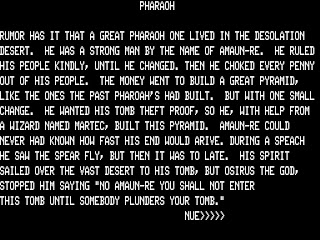
The specific references to White Palm and Martec/Martek do not seem to be part of canonical Egyptian lore, and the Pharaoh Amon-Ra is referred to by Nash as Aumen-Re, and by the Hickmans as Amun-Re. So assuming this is all not just incredible coincidence, and blatant plagiarism is behind the similarities, we are left with a timing conundrum. Either Nash knew the Hickmans and played the paper-and-pencil RPG games in or prior to 1979, or wrote these three adventures later than is believed, i.e., 1982 or later, based on the TSR editions. OR the Hickmans somehow encountered these computer games and wrote their modules based on them.
I am inclined to speculate that the Hickmans' work came first, if only because Tracy Hickman has a long and distinguished career in RPG design and writing, and Brian Nash seems to have disappeared after putting these three games together. And Pharaoh on the TRS-80 has an incomplete, slapdash feel about it, with lots of red herrings that may have been based on the AD&D game but play no useful role in the adventure.
So my conclusion is that the Pharaoh game published by Simutek is actually a different game than this one by Brian Nash, and that Nash's Pharaoh trilogy may never have been officially published. It feels like a hobbyist project that happens to have survived, and is still floating around in interactive fiction collections on disk images available today. One-word titles are notorious for creating confusion, and another source lists this trilogy as a 19XX release, exact year unknown. The whole story remains an interesting archaeological mystery, which seems appropriate given the subject matter of both trilogies. I'd like to know if the Hickmans even know these games exist. But it seems most logical to conclude that this Pharaoh game and its sequels were patterned after the D&D modules, and not the other way around.
At any rate, it's time to move on to the adventure at hand, as we break into the Pharaoh's tomb to liberate his treasures. I will discuss the game's content in a general vein, and conclude with a full walkthrough -- I haven't seen one published anywhere, although the game is simple enough that few should have any problems completing it.
***** BEWARE ALL YE WHO ENTER HERE -- SPOILERS AHEAD! *****
The game gets off on an amateurish foot with a number of misspellings on the introductory screen -- OSIRUS, SPEACH, ARIVE. And the menu requires that an uppercase keyboard character be pressed to select a game, which tripped me up for a moment on my lowercase-enabled TRS-80 emulator. Grammatical sloppiness abounds -- one room description begins with I AM IN AT THE END OF A HALLWAY TORCHES LINE THE WALLS.
There are no startup credits displayed, but the wizard's room contains a scroll that can be freely taken, unlike the magic book guarded by the evil wizard. We can READ SCROLL to learn: THIS ADVENTURE CREATED AND DEBUGGED BY BRIAN NASH. WATCH FOR MORE ADVENTURES!
Pharaoh's parser is very simple, with a limited dictionary. TAKE does not work, only GET does; there's no EXAMINE verb, but LOOK works.
The game's handling of dark areas is a bit buggy -- we can navigate safely in the dark, without fear of neck-breaking stumbles, but one of the rooms we can see once we have a light source in hand has TORCHES ON THE WALL, yet remains dark if we don't have the glowing helmet in hand.
There are also some discovery bugs at large. We can LOOK DISPLAY to find a cross in the museum, and GET CROSS to put it in inventory (where it appears as a treasure, * A HOLY CROSS.) But if we LOOK DISPLAY again, it disappears from inventory and we must re-GET it. The same happens with the metal vial found on the King's bed.
The museum also contains a semi-hidden trap door, which can be found easily with a quick LOOK, and leads to a traditional treasure storage room upstairs. I knew there had to be such a room, as I tried SCORE with a few treasures in hand before finding it and was told YOU CAN'T DO THAT HERE! The approach is a bit non-standard -- we're not supposed to bring the treasures to this room, drop them, and SAY SCORE; we're supposed to have all seven treasures in inventory. SCORE actually returns YOU CAN'T DO THAT HERE! even when we're in the treasure room. And if we SAY SCORE prematurely, the game tallies up our successes and immediately ends. There aren't any other fatal scenarios that I was able to find, so this caught me by surprise, especially as there's no save-game support.
Mr. Nash appears to have implemented a WEAR verb, but the only thing that I could wear was a suit of armor which serves no actual purpose in the game. We find a helmet at the very beginning of the game, but WEAR HELMET produces YOU CAN'T WEAR THAT!
The SAY verb is used for three key words, but the game will gladly SAY anything we ask it to, echoing all manner of nastiness if we so desire.
One gets the impression Brian Nash was fairly young when this game was created. In the wizard's room, we can READ BOOK to learn that IT SAYS 'WHATS ONE THING ALL KIDS HATE. We can then SAY SCHOOL, and THE WIZARD IS SUPRISED [sic] AT THE CORRECT ANSWER FROM THE BOOK AND GIVES IT TO YOU! Aside from his description as an evil wizard, the wizard fails to ooze even a drop of malevolence here. In case we haven't guessed the riddle, some runes in the Throne Room read SCHOOL.
The GET verb is a little lazy -- GET [anything] when inventory is full yields I CAN'T CARRY MORE! If the player has room in inventory, using random words always yields I CAN'T PICK THAT UP! And SOME NORMAL WATER found in the King's lavatory can be picked up and dropped like any solid object -- no special container or handling required.
The DROP implementation, however, is even lazier -- game-breakingly so. I didn't discover this until I was playing one of the later games in the trilogy, but Pharaoh's game logic doesn't actually check to see if the player possesses any item he or she is attempting to DROP. So if the player knows, or even suspects, that a particular item exists somewhere in the game, doing a simple DROP [item] will cause it to materialize! The spell book can't be obtained this way -- we can DROP it, but not GET it, so we still have to visit the wizard and solve the related puzzle. But everything else can be easily obtained in two steps at most.
The game's only real puzzle involves finding a light source. As it turns out, we can RUB HELMET and IT GLOWS BRIGHT! Everything else we encounter that isn't a treasure is a red herring -- the straight arrow and bow are not used, the shield, sword and full suit of armor can be left in place, the interestingly-named "normal pencil" and "normal water" play no part in the story's development.
More parser oddness -- when we reach the tomb of the Pharaoh, the room description tells us there's writing on the door. But we can't READ WRITING or READ DOOR; when we try to OPEN DOOR, the game again informs us that THERE'S WRITING IN [sic] IT! We have to SAY OSIRUS [sic] and the door opens. We can do this repeatedly, with the door opening again and again, without ever being described as already open.
Inside the tomb is a rope, a pit (which we cannot examine or enter), and a coffin. When we OPEN COFFIN, we get a plug for the next game -- IT OPENS AND A DJINNI FLIES OUT TO DESTROY WORLD! CLUE:WHITE PALM'S NEXT! But the world-destroying doesn't come into play during this game (nor, really, in the later ones, except as window dressing.)
There are seven treasures to find, but we actually only really have to find five; * A LANCE AND HORSE and * A LARGE BRASS BRAIZER [sic] are already sitting in the treasure room when we get there.
Some treasures and items are hidden -- we have to RUB the tarnished tray found in the jail cell to reveal it as a valuable * SILVER TRAY. And if we try to GET SKELETON, THE BONES FALL APART AND YOU FIND A KEY, which goes straight to inventory as a SKELETON KEY. But there's nothing in the game that requires unlocking, so the gag kind of falls flat.
Once we have all seven treasures in inventory, victory is ours with the author's congradulations [sic]:

But there's one final mystery to resolve. The game ends with this cryptic phrase:
It's been a while since I've used TRS-80 BASIC, but I was able to find these lines in the source code:
1610 PRINT"THESE PEOPLE HAVE ALSO SOLVED IT!!! (1620)
1620 'REM IF YOU SOLVE IT PUT YOUR NAME HERE AND RESAVE
A little quick surgery on line 1620, and we're up in lights for anyone else who plays our copy:

I found Pharaoh entertaining, if for the wrong reasons, but it's way too brief to be a serious challenge. The abundant red herrings imply there were more puzzles planned than could be fit into the game, or that the Hickman source material was a lot richer than Nash's game could incorporate. There's a lot of stuff that can be safely ignored, and the entire game can be finished in a scant 37 moves... and that's WITHOUT any exploitation of the game's DROP bug. To wit...
WALKTHROUGH:
GET HELMET
N
E
RUB HELMET
GET TRAY
RUB TRAY
w
N
E
LOOK BED
GET VIAL
W
N
N
E
E
N
SAY OSIRUS
N
OPEN COFFIN
GET MIRROR
S
S
W
W
S
S
W
SAY SCHOOL
W
LOOK DISPLAY
GET CROSS
LOOK
U
GET HORSE
GET BRAIZER
SAY SCORE

Pharaoh was written in BASIC for the TRS-80 Model I by one Brian Nash, who is credited as the creator and debugger on a scroll found within the game. No copyright or other dates are cited; the only source I've been able to find dates a game called The Pharaoh as a 1979 release from Simutek, a small early home computer software publisher that's actually still in business as an Apple dealer. But I don't think this is that game.
What's very odd about Pharaoh is that it's the first part of a trilogy that also includes White Palm and Martec's Lost Tomb. The titles bear a striking resemblance to a series of Egyptian-themed Advanced Dungeons & Dragons modules created by Tracy and Laura Hickman, entitled Pharaoh, Oasis of the White Palm, and The Lost Tomb of Martek. These were created in 1977, published in 1979 in very small quantities by a company called Daystar West, and republished as official AD&D modules with significant revisions by TSR in 1982. In 1987, they were combined into one larger set under the title Desert of Desolation. The opening text for the Pharaoh adventure trilogy mentions the "Desolation Desert" -- and features a number of grammatical oddities and misspellings:

The specific references to White Palm and Martec/Martek do not seem to be part of canonical Egyptian lore, and the Pharaoh Amon-Ra is referred to by Nash as Aumen-Re, and by the Hickmans as Amun-Re. So assuming this is all not just incredible coincidence, and blatant plagiarism is behind the similarities, we are left with a timing conundrum. Either Nash knew the Hickmans and played the paper-and-pencil RPG games in or prior to 1979, or wrote these three adventures later than is believed, i.e., 1982 or later, based on the TSR editions. OR the Hickmans somehow encountered these computer games and wrote their modules based on them.
I am inclined to speculate that the Hickmans' work came first, if only because Tracy Hickman has a long and distinguished career in RPG design and writing, and Brian Nash seems to have disappeared after putting these three games together. And Pharaoh on the TRS-80 has an incomplete, slapdash feel about it, with lots of red herrings that may have been based on the AD&D game but play no useful role in the adventure.
So my conclusion is that the Pharaoh game published by Simutek is actually a different game than this one by Brian Nash, and that Nash's Pharaoh trilogy may never have been officially published. It feels like a hobbyist project that happens to have survived, and is still floating around in interactive fiction collections on disk images available today. One-word titles are notorious for creating confusion, and another source lists this trilogy as a 19XX release, exact year unknown. The whole story remains an interesting archaeological mystery, which seems appropriate given the subject matter of both trilogies. I'd like to know if the Hickmans even know these games exist. But it seems most logical to conclude that this Pharaoh game and its sequels were patterned after the D&D modules, and not the other way around.
At any rate, it's time to move on to the adventure at hand, as we break into the Pharaoh's tomb to liberate his treasures. I will discuss the game's content in a general vein, and conclude with a full walkthrough -- I haven't seen one published anywhere, although the game is simple enough that few should have any problems completing it.
***** BEWARE ALL YE WHO ENTER HERE -- SPOILERS AHEAD! *****
The game gets off on an amateurish foot with a number of misspellings on the introductory screen -- OSIRUS, SPEACH, ARIVE. And the menu requires that an uppercase keyboard character be pressed to select a game, which tripped me up for a moment on my lowercase-enabled TRS-80 emulator. Grammatical sloppiness abounds -- one room description begins with I AM IN AT THE END OF A HALLWAY TORCHES LINE THE WALLS.
There are no startup credits displayed, but the wizard's room contains a scroll that can be freely taken, unlike the magic book guarded by the evil wizard. We can READ SCROLL to learn: THIS ADVENTURE CREATED AND DEBUGGED BY BRIAN NASH. WATCH FOR MORE ADVENTURES!
Pharaoh's parser is very simple, with a limited dictionary. TAKE does not work, only GET does; there's no EXAMINE verb, but LOOK works.
The game's handling of dark areas is a bit buggy -- we can navigate safely in the dark, without fear of neck-breaking stumbles, but one of the rooms we can see once we have a light source in hand has TORCHES ON THE WALL, yet remains dark if we don't have the glowing helmet in hand.
There are also some discovery bugs at large. We can LOOK DISPLAY to find a cross in the museum, and GET CROSS to put it in inventory (where it appears as a treasure, * A HOLY CROSS.) But if we LOOK DISPLAY again, it disappears from inventory and we must re-GET it. The same happens with the metal vial found on the King's bed.
The museum also contains a semi-hidden trap door, which can be found easily with a quick LOOK, and leads to a traditional treasure storage room upstairs. I knew there had to be such a room, as I tried SCORE with a few treasures in hand before finding it and was told YOU CAN'T DO THAT HERE! The approach is a bit non-standard -- we're not supposed to bring the treasures to this room, drop them, and SAY SCORE; we're supposed to have all seven treasures in inventory. SCORE actually returns YOU CAN'T DO THAT HERE! even when we're in the treasure room. And if we SAY SCORE prematurely, the game tallies up our successes and immediately ends. There aren't any other fatal scenarios that I was able to find, so this caught me by surprise, especially as there's no save-game support.
Mr. Nash appears to have implemented a WEAR verb, but the only thing that I could wear was a suit of armor which serves no actual purpose in the game. We find a helmet at the very beginning of the game, but WEAR HELMET produces YOU CAN'T WEAR THAT!
The SAY verb is used for three key words, but the game will gladly SAY anything we ask it to, echoing all manner of nastiness if we so desire.
One gets the impression Brian Nash was fairly young when this game was created. In the wizard's room, we can READ BOOK to learn that IT SAYS 'WHATS ONE THING ALL KIDS HATE. We can then SAY SCHOOL, and THE WIZARD IS SUPRISED [sic] AT THE CORRECT ANSWER FROM THE BOOK AND GIVES IT TO YOU! Aside from his description as an evil wizard, the wizard fails to ooze even a drop of malevolence here. In case we haven't guessed the riddle, some runes in the Throne Room read SCHOOL.
The GET verb is a little lazy -- GET [anything] when inventory is full yields I CAN'T CARRY MORE! If the player has room in inventory, using random words always yields I CAN'T PICK THAT UP! And SOME NORMAL WATER found in the King's lavatory can be picked up and dropped like any solid object -- no special container or handling required.
The DROP implementation, however, is even lazier -- game-breakingly so. I didn't discover this until I was playing one of the later games in the trilogy, but Pharaoh's game logic doesn't actually check to see if the player possesses any item he or she is attempting to DROP. So if the player knows, or even suspects, that a particular item exists somewhere in the game, doing a simple DROP [item] will cause it to materialize! The spell book can't be obtained this way -- we can DROP it, but not GET it, so we still have to visit the wizard and solve the related puzzle. But everything else can be easily obtained in two steps at most.
The game's only real puzzle involves finding a light source. As it turns out, we can RUB HELMET and IT GLOWS BRIGHT! Everything else we encounter that isn't a treasure is a red herring -- the straight arrow and bow are not used, the shield, sword and full suit of armor can be left in place, the interestingly-named "normal pencil" and "normal water" play no part in the story's development.
More parser oddness -- when we reach the tomb of the Pharaoh, the room description tells us there's writing on the door. But we can't READ WRITING or READ DOOR; when we try to OPEN DOOR, the game again informs us that THERE'S WRITING IN [sic] IT! We have to SAY OSIRUS [sic] and the door opens. We can do this repeatedly, with the door opening again and again, without ever being described as already open.
Inside the tomb is a rope, a pit (which we cannot examine or enter), and a coffin. When we OPEN COFFIN, we get a plug for the next game -- IT OPENS AND A DJINNI FLIES OUT TO DESTROY WORLD! CLUE:WHITE PALM'S NEXT! But the world-destroying doesn't come into play during this game (nor, really, in the later ones, except as window dressing.)
There are seven treasures to find, but we actually only really have to find five; * A LANCE AND HORSE and * A LARGE BRASS BRAIZER [sic] are already sitting in the treasure room when we get there.
Some treasures and items are hidden -- we have to RUB the tarnished tray found in the jail cell to reveal it as a valuable * SILVER TRAY. And if we try to GET SKELETON, THE BONES FALL APART AND YOU FIND A KEY, which goes straight to inventory as a SKELETON KEY. But there's nothing in the game that requires unlocking, so the gag kind of falls flat.
Once we have all seven treasures in inventory, victory is ours with the author's congradulations [sic]:

But there's one final mystery to resolve. The game ends with this cryptic phrase:
THESE PEOPLE HAVE ALSO SOLVED IT!!! (1620)
It's been a while since I've used TRS-80 BASIC, but I was able to find these lines in the source code:
1610 PRINT"THESE PEOPLE HAVE ALSO SOLVED IT!!! (1620)
1620 'REM IF YOU SOLVE IT PUT YOUR NAME HERE AND RESAVE
A little quick surgery on line 1620, and we're up in lights for anyone else who plays our copy:

I found Pharaoh entertaining, if for the wrong reasons, but it's way too brief to be a serious challenge. The abundant red herrings imply there were more puzzles planned than could be fit into the game, or that the Hickman source material was a lot richer than Nash's game could incorporate. There's a lot of stuff that can be safely ignored, and the entire game can be finished in a scant 37 moves... and that's WITHOUT any exploitation of the game's DROP bug. To wit...
WALKTHROUGH:
GET HELMET
N
E
RUB HELMET
GET TRAY
RUB TRAY
w
N
E
LOOK BED
GET VIAL
W
N
N
E
E
N
SAY OSIRUS
N
OPEN COFFIN
GET MIRROR
S
S
W
W
S
S
W
SAY SCHOOL
W
LOOK DISPLAY
GET CROSS
LOOK
U
GET HORSE
GET BRAIZER
SAY SCORE
Monday, April 5, 2010
The LoadDown - 04/05/2010
Another week of downloadable news...
WiiWare -- 2 games this week, neither of which is likely to excite hardcore gamers. Fishie Fishie is a casual one-button game similar in concept to Feeding Frenzy, with local multiplayer support. Learning with the Poo-Yoos: Episode 2 continues the educational series for 3-6 year olds, focusing on basic skills like numbers, letters and colors.
Wii Virtual Console -- An interesting and unusual release this week, Saurus' relatively obscure and reportedly impressive 2-D shooter IRONCLAD, for the Neo-Geo.
DSiWare -- 4 titles this week, which also marks the first anniversary of the DSiWare service. Three are classic Nintendo handhelds recreated for the DSi - Game & Watch: Manhole, Game & Watch: Helmet and Game & Watch: Vermin. Namco's Mr. Driller: Drill Till You Drop brings the Dig Dug-inspired puzzle/action series to the DSi.
XBox Live Arcade -- Capcom's Mega Man 10 arrived on the XBox 360 last week, so this 8-bit-style sequel is now available on all three current-gen consoles. With achievements in this case, of course.
Game Room -- After a strong lineup out of the gate, it appears no new content will be available on Microsoft's retro gaming service until late April. Hopefully this isn't a sign of sporadic releases to come.
PS3 on PSN -- Last week saw Tecmo's NBA Unrivaled hit the PS3 -- it's a retro-styled over-the-top 2D basketball game that owes more than a small debt to Midway's 1990's coin-op hit NBA Jam.
WiiWare -- 2 games this week, neither of which is likely to excite hardcore gamers. Fishie Fishie is a casual one-button game similar in concept to Feeding Frenzy, with local multiplayer support. Learning with the Poo-Yoos: Episode 2 continues the educational series for 3-6 year olds, focusing on basic skills like numbers, letters and colors.
Wii Virtual Console -- An interesting and unusual release this week, Saurus' relatively obscure and reportedly impressive 2-D shooter IRONCLAD, for the Neo-Geo.
DSiWare -- 4 titles this week, which also marks the first anniversary of the DSiWare service. Three are classic Nintendo handhelds recreated for the DSi - Game & Watch: Manhole, Game & Watch: Helmet and Game & Watch: Vermin. Namco's Mr. Driller: Drill Till You Drop brings the Dig Dug-inspired puzzle/action series to the DSi.
XBox Live Arcade -- Capcom's Mega Man 10 arrived on the XBox 360 last week, so this 8-bit-style sequel is now available on all three current-gen consoles. With achievements in this case, of course.
Game Room -- After a strong lineup out of the gate, it appears no new content will be available on Microsoft's retro gaming service until late April. Hopefully this isn't a sign of sporadic releases to come.
PS3 on PSN -- Last week saw Tecmo's NBA Unrivaled hit the PS3 -- it's a retro-styled over-the-top 2D basketball game that owes more than a small debt to Midway's 1990's coin-op hit NBA Jam.
Sunday, April 4, 2010
Roland Will Rock You OUT OF YOUR MIND
Sometimes I think I could write a whole blog about video and computer game products purportedly designed to drive the purchaser out of his or her mind. It's certainly a common theme in vintage magazine ads, giving the impression that ad execs thought gamers were more-or-less the same as drug addicts.
Even Roland, the music synthesizer company whose MT-32 was the standard for computer game music in the late 1980's, was capable of resorting to a little hyperbole when the new LAPC-1 card was ready to ship (and no, Wikipedia, the actual name of the card was not the LAPC-I -- at least if it was, nobody told the marketing department):

There's no question the Roland MIDI synthesizers sounded great, even by today's standards -- they were sample-based, finely tuned machines intended for professional musicians, and they made games sound fantastic, especially as compared to the IBM PC's weedy internal speaker.
But sound waves, based on all available evidence, are not capable of transforming mild-mannered gaming geeks into colorful cartoon psychotics.
That takes something more -- like, say, a corrupted game save about forty hours in.
Even Roland, the music synthesizer company whose MT-32 was the standard for computer game music in the late 1980's, was capable of resorting to a little hyperbole when the new LAPC-1 card was ready to ship (and no, Wikipedia, the actual name of the card was not the LAPC-I -- at least if it was, nobody told the marketing department):

There's no question the Roland MIDI synthesizers sounded great, even by today's standards -- they were sample-based, finely tuned machines intended for professional musicians, and they made games sound fantastic, especially as compared to the IBM PC's weedy internal speaker.
But sound waves, based on all available evidence, are not capable of transforming mild-mannered gaming geeks into colorful cartoon psychotics.
That takes something more -- like, say, a corrupted game save about forty hours in.
Saturday, April 3, 2010
Job Security Not Included
Back in the heady days of the Atari 2600, everyone was jumping on the video game bandwagon. Even the venerable toy company Fisher-Price was ready to get in on the action, running this small black-and-white Help Wanted ad in Electronic Games magazine:

I had always thought that Fisher-Price never published any videogames under its own name during the 2600 era, though they did publish a number of titles for the Nintendo Entertainment System several years later. But I had a vague recollection that they were somehow involved with a title or two published by U.S. Games (Gopher, perhaps), its sister company at the time under the same corporate parent, Quaker Oats. And a bit of Google searching establishes that two other titles, Fisher Price Fishing Derby and Memory Manor, may have seen the light of day before the industry crashed and took most companies' brand-new videogame divisions with it.
So I'd like to think that whoever answered this ad enjoyed the sensational salary and profit sharing mentioned.
But it would be even nicer to think that the new hire was not subject to a career that promises to be the industry future. Because that future was looking bleak indeed, almost nonexistent, about 18 months after this ad ran.

I had always thought that Fisher-Price never published any videogames under its own name during the 2600 era, though they did publish a number of titles for the Nintendo Entertainment System several years later. But I had a vague recollection that they were somehow involved with a title or two published by U.S. Games (Gopher, perhaps), its sister company at the time under the same corporate parent, Quaker Oats. And a bit of Google searching establishes that two other titles, Fisher Price Fishing Derby and Memory Manor, may have seen the light of day before the industry crashed and took most companies' brand-new videogame divisions with it.
So I'd like to think that whoever answered this ad enjoyed the sensational salary and profit sharing mentioned.
But it would be even nicer to think that the new hire was not subject to a career that promises to be the industry future. Because that future was looking bleak indeed, almost nonexistent, about 18 months after this ad ran.
Friday, April 2, 2010
Cheap Thrills: GhostSlayer (WiiWare, 2010)
I have a fondness for downloadable games, because they tend to be inexpensive and simple; they appeal to the retro fan in me while giving me something arguably new to experience. So I'm inaugurating a new Cheap Thrills feature, in which I will present informal reviews of these kinds of under-$10 titles. I picked up Gevo Entertainment's GhostSlayer for the Wii a few weeks back, a sword-fighting game pitting the player against a series of creepy ghost warriors in deserted villages, forests and canyons. It's a quality effort, and with all the rising from the dead on view, it's a reasonable choice for this Good Friday post.
I'm not saying Ghostslayer is a GREAT game. It's not a technological showpiece, even by Wii standards -- it's in fully-rendered 3-D, but the enemy models are repetitive and the generic, muddy background textures call too many early Playstation games to mind. And it's hardly a deep experience -- it's on rails, with the player guided automatically through the game's eight levels, so it's more of a ride than a game as far as exploration goes. There are some power-ups like new swords and additional hit points that can be earned by completing levels, but the gameplay is pretty much the same throughout. And there's no real story -- just a series of threatening spirits to dispatch from whence they came, using a sword, in a series of varied but generally bland environments.
Still, GhostSlayer costs 600 Wii points, approximately US$6.00, and provides three or four hours of entertainment. That seems pretty reasonable to me, because it's the kind of game best played for twenty or thirty minutes at a time, then put away until the urge strikes again.
What particularly tickles me about GhostSlayer is that it's exactly the kind of game experience we were always being promised, but that the technology simply couldn't deliver, back in the 1980's. Just like in those vintage ads, we're finally wielding what feels like an actual sword against 3-D ghost warriors who rise from the ground and emerge from the fog -- and we're doing it with Wii Motion-Plus controls, so the sword swinging and blocking of enemy blows feels pretty natural (aside from having to hold a "block button" to switch from offense to defense.) The enemies react differently depending on where and how hard we hit them, and there's a palpable sense of tension as we hold our sword at the ready, preparing to take on the next foe.
The game doesn't deliver much more than that, but it really doesn't need to -- it's simply fun to knock creepy ghosts down with a sword. The Wii experience at its best is virtual reality on the cheap, and many would gladly have paid a dollar a go for this privilege in arcades of the past. For six bucks, GhostSlayer delivers straightforward entertainment that's easy to pick up and play.
I'm not saying Ghostslayer is a GREAT game. It's not a technological showpiece, even by Wii standards -- it's in fully-rendered 3-D, but the enemy models are repetitive and the generic, muddy background textures call too many early Playstation games to mind. And it's hardly a deep experience -- it's on rails, with the player guided automatically through the game's eight levels, so it's more of a ride than a game as far as exploration goes. There are some power-ups like new swords and additional hit points that can be earned by completing levels, but the gameplay is pretty much the same throughout. And there's no real story -- just a series of threatening spirits to dispatch from whence they came, using a sword, in a series of varied but generally bland environments.
Still, GhostSlayer costs 600 Wii points, approximately US$6.00, and provides three or four hours of entertainment. That seems pretty reasonable to me, because it's the kind of game best played for twenty or thirty minutes at a time, then put away until the urge strikes again.
What particularly tickles me about GhostSlayer is that it's exactly the kind of game experience we were always being promised, but that the technology simply couldn't deliver, back in the 1980's. Just like in those vintage ads, we're finally wielding what feels like an actual sword against 3-D ghost warriors who rise from the ground and emerge from the fog -- and we're doing it with Wii Motion-Plus controls, so the sword swinging and blocking of enemy blows feels pretty natural (aside from having to hold a "block button" to switch from offense to defense.) The enemies react differently depending on where and how hard we hit them, and there's a palpable sense of tension as we hold our sword at the ready, preparing to take on the next foe.
The game doesn't deliver much more than that, but it really doesn't need to -- it's simply fun to knock creepy ghosts down with a sword. The Wii experience at its best is virtual reality on the cheap, and many would gladly have paid a dollar a go for this privilege in arcades of the past. For six bucks, GhostSlayer delivers straightforward entertainment that's easy to pick up and play.
Thursday, April 1, 2010
Unreleased: Shaun Cassidy's Teeny Bopper
Back in the late 1970's, Shaun Cassidy was the hottest male pop star, television actor and locker pinup around. So it's no surprise that K-Tel's Xonox label licensed his name and sort-of-likeness for an Atari 2600 videogame, slated for release in the summer of 1983.
Shaun Cassidy's Teeny Bopper was finished but never released, mostly due to bad timing -- Cassidy's last pop hit was released in 1980, his Hardy Boys television series wrapped up that same year, and Data Age's Journey Escape was already on the market and not doing particularly well. The game was planned as a girl-friendly counterpart to Chuck Norris Superkicks for one of Xonox's odd "double-ender" cartridges, but was replaced at the last minute with Artillery Duel. The game was believed lost for many years, until a prototype ROM recently surfaced at an Ohio record collectors' auction.
If anything, the game was too realistic, seemingly inspired by Cassidy's real life as opposed to his celebrity image. The actor/singer married in 1979, which may explain why the gameplay was similar to whack-a-mole, with a mallet-wielding Cassidy fending off the advances of his adoring teen-aged fans as they rose, zombie-like, from holes in the ground:

Points were earned for every broken heart, with the game speeding up as play progressed. Higher difficulty levels forced Cassidy to dodge critical brickbats dropped from above; a rumored Parker Stevenson sprite is nowhere to be seen in the final build. The game also features background music, a rarity on the 2600; unfortunately, it's an annoying one-note rendition of the chorus from Cassidy's first pop hit, a cover of Da Doo Ron Ron, played ad nauseam on a short loop.
It's possible that a Shaun Cassidy game could have been a hit if it had come to market when the 2600 was also young and entrancing. But the hardware could muster only a faint, muddy likeness of Cassidy's bucktoothed grin, feathered hairdo, and caterpillar eyebrows, and by the time the idea came to fruition, pop culture had moved on.
It's a pity, really; almost like a sad April Fool's joke.
Don't you think?
Shaun Cassidy's Teeny Bopper was finished but never released, mostly due to bad timing -- Cassidy's last pop hit was released in 1980, his Hardy Boys television series wrapped up that same year, and Data Age's Journey Escape was already on the market and not doing particularly well. The game was planned as a girl-friendly counterpart to Chuck Norris Superkicks for one of Xonox's odd "double-ender" cartridges, but was replaced at the last minute with Artillery Duel. The game was believed lost for many years, until a prototype ROM recently surfaced at an Ohio record collectors' auction.
If anything, the game was too realistic, seemingly inspired by Cassidy's real life as opposed to his celebrity image. The actor/singer married in 1979, which may explain why the gameplay was similar to whack-a-mole, with a mallet-wielding Cassidy fending off the advances of his adoring teen-aged fans as they rose, zombie-like, from holes in the ground:

Points were earned for every broken heart, with the game speeding up as play progressed. Higher difficulty levels forced Cassidy to dodge critical brickbats dropped from above; a rumored Parker Stevenson sprite is nowhere to be seen in the final build. The game also features background music, a rarity on the 2600; unfortunately, it's an annoying one-note rendition of the chorus from Cassidy's first pop hit, a cover of Da Doo Ron Ron, played ad nauseam on a short loop.
It's possible that a Shaun Cassidy game could have been a hit if it had come to market when the 2600 was also young and entrancing. But the hardware could muster only a faint, muddy likeness of Cassidy's bucktoothed grin, feathered hairdo, and caterpillar eyebrows, and by the time the idea came to fruition, pop culture had moved on.
It's a pity, really; almost like a sad April Fool's joke.
Don't you think?
Subscribe to:
Posts (Atom)


 Posts
Posts

