
What's the Tennokoe Bank Card? This episode's little cartoon won't really enlighten you.
(Yes, I know the date on this episode is 01/19/2011 and it's been posted on 01/12; I ran into some technical difficulties and expected this one to get pushed into next week, but was able to find a workaround and get it out "early.")
Wednesday, January 12, 2011


Tuesday, January 11, 2011
Adventure of the Week: Dateline Titanic (1982)
This week, we're looking at a 1982 text adventure published by SoftSide Publications, called Dateline Titanic. The game was likely published as a BASIC language type-in program in SoftSide Magazine or on its disk-based equivalent, but I haven't been able to track down its number within the long-running SoftSide series. It runs on the Atari 400/800 computers, but I've been unable to track down the author's name, which is a shame, as this is a fun and funny little adventure.
The title screen opens with an audio background of white noise and buzzing, suggesting the ocean and warning klaxons.

We find ourselves on the bridge of the Titanic, as the ill-fated captain of the ship. If we LOOK WINDOW, we learn that You see something large and white. So, yes, we're aboard THAT Titanic.
And before I say anything else, let me warn you, as always, that if you wish to play Dateline Titanic on your own, you ought to go and do so now. Because there are...
***** ICEBERGS AND SPOILERS AHEAD! *****
Dateline Titanic definitely has a sense of humor. The opening is a bit of a set piece -- we're not allowed to leave the helm, though once we realize we're heading straight for the iceberg, we can TURN WHEEL. This leads to what appears to be a swift and honorable conclusion -- we have apparently altered the course of the ship, and history, within a few moves. So now what? The game soon tells us: OH MY GOD! You hit another one! And we're right back where history tells us we should be:

We must now try to save as many people as we can and put them in lifeboats, collect valuables, and save ourselves to attain the maximum possible score.
The interface is old-fashioned -- there are no windows or status lines, just scrolling text that occasionally resets when we enter a new room or take a LOOK. If we type beyond the first onscreen line and try to backspace, the engine picks up the onscreen prompt What do you want to do? as part of the typed command. LOOK [anything] returns You see nothing special, even if the referenced object does not exist in the game; in general, the parser design tends to give default responses for non-existent objects, and never admits it doesn't know what something is, which can be misleading on occasion.
The game design is fairly open -- the puzzles aren't very intertwined, so we can explore and solve them at leisure; there's no actual time pressure involved, despite the sinking ship. Most of the puzzles involve accessing locked cabins by finding the appropriate keys, then convincing the passengers to get aboard one of the lifeboats. A puppy dog wandering randomly around the boat has a collar; LOOK COLLAR reveals a key. (There's no EXAMINE verb here, but LOOK works with both rooms and objects). An attempt to GET KEY initially yields OUCH! Puppy bites, so that's a puzzle we must overcome.
The radio room near the helm contains a CODE KEY that we can't take with us, but we can use it to SEND MESSAGE to summon a rescue ship. And the captain's room contains a safe, yet when we try to OPEN SAFE, we are told You can't remember the combination; it's nice to see an adventure game explicitly acknowledge the mysterious amnesia that so often afflicts the protagonist. I had to come back to this puzzle later in the game, and it stumped me for a while until I tried to MOVE SAFE -- I had been picturing a wall safe, but apparently it's a floor model. Moving it reveals a PAPER NOTE with the combination written down by our absent-minded character. We can then READ NOTE and OPEN SAFE to find some valuable JEWELRY.
We will encounter a FRANTIC PASSENGER at some point, and the first time we LOOK PASSENGER the game reveals CABIN KEY #101. We can only GET KEY when the puppy is not present, as the parser seems to assume we're referring to the key on his collar first, and GET CABIN KEY is not a recognized clarification. Once we are canine-free, it tells us Say again & use number, so in this case we have to GET 101.
Fortunately, the ship has a number of lifeboats, already in the water and ready to go, positioned at regular intervals along the Main Deck. Each boat has 4 seats, and if we LOOK LIFEBOAT the game will tell us how many empty seats remain -- until all are occupied, at which point we no longer see anything special. This is an important detail to track, because if we overload a lifeboat, it and all its passengers go straight to Davey Jones' Locker.
The waiter in the shipboard restaurant must be rescued, but not before we conduct a little business. ORDER DRINK oddly yields Waiter says, You can't. But ORDER COFFEE works.
The puzzles aren't particularly realistic, but they are entertaining. A DRUNK LADY in one of the cabins proves difficult to rescue, as She staggers all over the place! You can't catch her! If we give her the coffee, however, she becomes the much more cooperative SOBER LADY.
Another cabin has (anachronistically) loud music blasting from the bathroom, so that the lady inside can't hear your calls! Resolving this requires us to find the fuse box near the ship's engine room, and we need something to CUT WIRE (GET WIRE responds There's no "WIRE" here, but CUT recognizes it successfully.) The chandelier in the Grand Ballroom falls on our second visit, barely misses you... and leaves some useful broken bulbs in its wake, which prove sharp enough to cut the wire. Now we can rescue the ANGRY LADY who was blasting her music earlier, though we can't get into her locked bathroom under any circumstances, it seems.
Yet another cabin gives us the mysterious clue, Mrs. Vanderbilt's cabin is empty! This famous and wealthy passenger is, we discover, hiding out in the kitchen, underneath a table; the only clue to her whereabouts is that a soup bowl on the table turns out to be a valuable antique upon closer examination. I happened to find her just because I tried to MOVE TABLE.
In another cabin, a baby lies abandoned in its crib. If we MOVE CRIB after rescuing the baby, we find a HEARING AID. This puzzled me for a while -- we can't USE or WEAR it. EMPLOY AID appeared to work when I tried it, but then I realized the parser was just dropping it, apparently treating EMP (empty?) as a synonym for DROP. Later, I met a hard-of-hearing passenger who refused to leave the ship until I could GIVE AID, so she would listen to reason instead of defending herself with a knife.
Some of the keys are difficult to come by. It was only by accident I discovered that entering the ship's furnace room with the ice cube in hand reveals that Something melts..., leaving a cabin key behind.
It's probably best that this is not an illustrated adventure, because we find a lady taking a bath in another room. When we try to GET LADY, we learn that Her toe's stuck in the drainhole. I guessed correctly that some margarine from the kitchen would be applicable here, but I couldn't USE, APPLY, PUT or GIVE it to any effect. At last I figured out that if we RUB MARGARINE, the game acknowledges the action with a simple Ok!; now if we GET LADY, we are informed that Margarine helped... and we can get her into a lifeboat, naked but alive.
The ship's Library contains shelves, a desk, and a newspaper; the librarian sitting at the desk isn't immediately mentioned until we LOOK DESK, but we do need to rescue this character as well. We can't SEARCH SHELVES or GET BOOK or READ BOOKS... but we can LOOK BOOK to find a dictionary. GET DICTIONARY works now, and the item in inventory is revealed as a CHINESE-ENGLISH DICTIONARY. READ DICTIONARY establishes that You now know how to say, "the boat is sinking" in Chinese.
This matters because the CHINESE LADY in another cabin proves vexing -- she doesn't understand why we are trying to escort her out of her room, and the game tell us that She's an expert in karate and threatens you with a convincing demonstration! Once we have read the dictionary, she will allow us to escort her to safety.
The valuable bowl in the kitchen has a functional use -- it contains hot alphabet soup. But some patience is called for -- we can't GET BOWL, because You might spill the soup! We can't EAT SOUP either, at least at first, because it's reportedly Too hot. I tried to DROP CUBE, to see if the ice might be used to cool the soup, but that had no effect. After some time has passed, however, things change, and EAT SOUP yields It's cooled now hmm...delicious..., and reveals another key, formerly concealed at the bottom of the bowl.
Another cabin contains a CRYING CHILD; when we try to GET CHILD, the poor non-gender-specific thing sobs, "Find me my puppy dog." If we track down the wandering puppy and give it the soup bone from the kitchen, we can GET KEY from his collar, and also GET PUPPY. Returning the little dog to the child transforms him or her into a HAPPY CHILD WITH PUPPY, suitable for immediate rescue.
One of the more involved puzzles involves a tiny crack under a cabin door in the southwest corner of the ship (yes, this is a shipboard game, but the map does not reference port, starboard, fore or aft). We can LOOK KEYHOLE to see that there's a key inserted on the other side, and then SLIDE NEWSPAPER, POKE KEYHOLE (PUSH does not work, though it seems like it should), and GET NEWSPAPER. Now we have CABIN KEY #106, and can enter the cabin, where we find the ship's steward sleeping in bed; we can't wake him, but we can GET STEWARD manhandle him into a lifeboat without disturbing him.
There's no need to LAUNCH or RELEASE any of the lifeboats, and we can GO LIFEBOAT safely ourselves even all four seats are already occupied. I discovered early on that as soon as we GO LIFEBOAT, the game concludes that we have decided to save ourselves, and the adventure is over; my first "complete" game thus ended with a score of 0 out of a possible 3175. We don't have to enter the lifeboats to drop off passengers -- we can just PUT the person in any room with a lifeboat available, and they'll end up in the boat.
There's a vacuum cleaner on the ship; I couldn't figure out what to do with it until I decided to DROP VACUUM, revealing that Something falls out. The contents proved to be DIRT and a DIAMOND RING; LOOK DIRT yields CABIN KEY #105.
Some passengers don't require any additional coaxing, once we can get into their cabins; a YOUNG GIRL and one DAISY SMITH go readily to the lifeboats. There are a number of FRANTIC PASSENGERS at large, but only one appears at a time; most of the lifeboat slots will be filled with these randomly-appearing people. Once they have all been rescued, they stop appearing, but it's hard to be sure we've got them all unless we use the SCORE command to see how we're doing, after solving all of the other puzzles. This is the game's only major weak spot, in my opinion -- rescuing these passengers becomes far too random and repetitive.
There are no real death scenarios in Dateline Titanic -- at worst, we can end the game prematurely without scoring all of the possible 3175 points. But while working my way through the game, I actually managed to score excess points, finishing my first serious attempt with 3500 out of a possible 3175. I think this happens because the game code stores the score in a variable that does not get reset to zero when we RUN the program again after ending the game; the problem does not turn up with a clean reset.
When we are ready to finish up, GO LIFEBOAT wraps up the story:

Score aside, there are two possible endings -- if we neglected to send an SOS message from the Radio Room, even if we have scored all available points, we find ourselves floating in the ocean with no real hope of seeing dry land again. The best ending features the arrival of a rescue ship:

I enjoyed Dateline Titanic -- it's not meant to be a realistic presentation of the luxury liner's last hours, so it's free to have lots of goofy fun with the setting, and the author clearly enjoyed doing so. I did not find a published walkthrough anywhere for this game, so I have provided mine below the fold, and have also uploaded it to the CASA Solution Archive.
***** WALKTHROUGH *****
The title screen opens with an audio background of white noise and buzzing, suggesting the ocean and warning klaxons.

We find ourselves on the bridge of the Titanic, as the ill-fated captain of the ship. If we LOOK WINDOW, we learn that You see something large and white. So, yes, we're aboard THAT Titanic.
And before I say anything else, let me warn you, as always, that if you wish to play Dateline Titanic on your own, you ought to go and do so now. Because there are...
***** ICEBERGS AND SPOILERS AHEAD! *****
Dateline Titanic definitely has a sense of humor. The opening is a bit of a set piece -- we're not allowed to leave the helm, though once we realize we're heading straight for the iceberg, we can TURN WHEEL. This leads to what appears to be a swift and honorable conclusion -- we have apparently altered the course of the ship, and history, within a few moves. So now what? The game soon tells us: OH MY GOD! You hit another one! And we're right back where history tells us we should be:

We must now try to save as many people as we can and put them in lifeboats, collect valuables, and save ourselves to attain the maximum possible score.
The interface is old-fashioned -- there are no windows or status lines, just scrolling text that occasionally resets when we enter a new room or take a LOOK. If we type beyond the first onscreen line and try to backspace, the engine picks up the onscreen prompt What do you want to do? as part of the typed command. LOOK [anything] returns You see nothing special, even if the referenced object does not exist in the game; in general, the parser design tends to give default responses for non-existent objects, and never admits it doesn't know what something is, which can be misleading on occasion.
The game design is fairly open -- the puzzles aren't very intertwined, so we can explore and solve them at leisure; there's no actual time pressure involved, despite the sinking ship. Most of the puzzles involve accessing locked cabins by finding the appropriate keys, then convincing the passengers to get aboard one of the lifeboats. A puppy dog wandering randomly around the boat has a collar; LOOK COLLAR reveals a key. (There's no EXAMINE verb here, but LOOK works with both rooms and objects). An attempt to GET KEY initially yields OUCH! Puppy bites, so that's a puzzle we must overcome.
The radio room near the helm contains a CODE KEY that we can't take with us, but we can use it to SEND MESSAGE to summon a rescue ship. And the captain's room contains a safe, yet when we try to OPEN SAFE, we are told You can't remember the combination; it's nice to see an adventure game explicitly acknowledge the mysterious amnesia that so often afflicts the protagonist. I had to come back to this puzzle later in the game, and it stumped me for a while until I tried to MOVE SAFE -- I had been picturing a wall safe, but apparently it's a floor model. Moving it reveals a PAPER NOTE with the combination written down by our absent-minded character. We can then READ NOTE and OPEN SAFE to find some valuable JEWELRY.
We will encounter a FRANTIC PASSENGER at some point, and the first time we LOOK PASSENGER the game reveals CABIN KEY #101. We can only GET KEY when the puppy is not present, as the parser seems to assume we're referring to the key on his collar first, and GET CABIN KEY is not a recognized clarification. Once we are canine-free, it tells us Say again & use number, so in this case we have to GET 101.
Fortunately, the ship has a number of lifeboats, already in the water and ready to go, positioned at regular intervals along the Main Deck. Each boat has 4 seats, and if we LOOK LIFEBOAT the game will tell us how many empty seats remain -- until all are occupied, at which point we no longer see anything special. This is an important detail to track, because if we overload a lifeboat, it and all its passengers go straight to Davey Jones' Locker.
The waiter in the shipboard restaurant must be rescued, but not before we conduct a little business. ORDER DRINK oddly yields Waiter says, You can't. But ORDER COFFEE works.
The puzzles aren't particularly realistic, but they are entertaining. A DRUNK LADY in one of the cabins proves difficult to rescue, as She staggers all over the place! You can't catch her! If we give her the coffee, however, she becomes the much more cooperative SOBER LADY.
Another cabin has (anachronistically) loud music blasting from the bathroom, so that the lady inside can't hear your calls! Resolving this requires us to find the fuse box near the ship's engine room, and we need something to CUT WIRE (GET WIRE responds There's no "WIRE" here, but CUT recognizes it successfully.) The chandelier in the Grand Ballroom falls on our second visit, barely misses you... and leaves some useful broken bulbs in its wake, which prove sharp enough to cut the wire. Now we can rescue the ANGRY LADY who was blasting her music earlier, though we can't get into her locked bathroom under any circumstances, it seems.
Yet another cabin gives us the mysterious clue, Mrs. Vanderbilt's cabin is empty! This famous and wealthy passenger is, we discover, hiding out in the kitchen, underneath a table; the only clue to her whereabouts is that a soup bowl on the table turns out to be a valuable antique upon closer examination. I happened to find her just because I tried to MOVE TABLE.
In another cabin, a baby lies abandoned in its crib. If we MOVE CRIB after rescuing the baby, we find a HEARING AID. This puzzled me for a while -- we can't USE or WEAR it. EMPLOY AID appeared to work when I tried it, but then I realized the parser was just dropping it, apparently treating EMP (empty?) as a synonym for DROP. Later, I met a hard-of-hearing passenger who refused to leave the ship until I could GIVE AID, so she would listen to reason instead of defending herself with a knife.
Some of the keys are difficult to come by. It was only by accident I discovered that entering the ship's furnace room with the ice cube in hand reveals that Something melts..., leaving a cabin key behind.
It's probably best that this is not an illustrated adventure, because we find a lady taking a bath in another room. When we try to GET LADY, we learn that Her toe's stuck in the drainhole. I guessed correctly that some margarine from the kitchen would be applicable here, but I couldn't USE, APPLY, PUT or GIVE it to any effect. At last I figured out that if we RUB MARGARINE, the game acknowledges the action with a simple Ok!; now if we GET LADY, we are informed that Margarine helped... and we can get her into a lifeboat, naked but alive.
The ship's Library contains shelves, a desk, and a newspaper; the librarian sitting at the desk isn't immediately mentioned until we LOOK DESK, but we do need to rescue this character as well. We can't SEARCH SHELVES or GET BOOK or READ BOOKS... but we can LOOK BOOK to find a dictionary. GET DICTIONARY works now, and the item in inventory is revealed as a CHINESE-ENGLISH DICTIONARY. READ DICTIONARY establishes that You now know how to say, "the boat is sinking" in Chinese.
This matters because the CHINESE LADY in another cabin proves vexing -- she doesn't understand why we are trying to escort her out of her room, and the game tell us that She's an expert in karate and threatens you with a convincing demonstration! Once we have read the dictionary, she will allow us to escort her to safety.
The valuable bowl in the kitchen has a functional use -- it contains hot alphabet soup. But some patience is called for -- we can't GET BOWL, because You might spill the soup! We can't EAT SOUP either, at least at first, because it's reportedly Too hot. I tried to DROP CUBE, to see if the ice might be used to cool the soup, but that had no effect. After some time has passed, however, things change, and EAT SOUP yields It's cooled now hmm...delicious..., and reveals another key, formerly concealed at the bottom of the bowl.
Another cabin contains a CRYING CHILD; when we try to GET CHILD, the poor non-gender-specific thing sobs, "Find me my puppy dog." If we track down the wandering puppy and give it the soup bone from the kitchen, we can GET KEY from his collar, and also GET PUPPY. Returning the little dog to the child transforms him or her into a HAPPY CHILD WITH PUPPY, suitable for immediate rescue.
One of the more involved puzzles involves a tiny crack under a cabin door in the southwest corner of the ship (yes, this is a shipboard game, but the map does not reference port, starboard, fore or aft). We can LOOK KEYHOLE to see that there's a key inserted on the other side, and then SLIDE NEWSPAPER, POKE KEYHOLE (PUSH does not work, though it seems like it should), and GET NEWSPAPER. Now we have CABIN KEY #106, and can enter the cabin, where we find the ship's steward sleeping in bed; we can't wake him, but we can GET STEWARD manhandle him into a lifeboat without disturbing him.
There's no need to LAUNCH or RELEASE any of the lifeboats, and we can GO LIFEBOAT safely ourselves even all four seats are already occupied. I discovered early on that as soon as we GO LIFEBOAT, the game concludes that we have decided to save ourselves, and the adventure is over; my first "complete" game thus ended with a score of 0 out of a possible 3175. We don't have to enter the lifeboats to drop off passengers -- we can just PUT the person in any room with a lifeboat available, and they'll end up in the boat.
There's a vacuum cleaner on the ship; I couldn't figure out what to do with it until I decided to DROP VACUUM, revealing that Something falls out. The contents proved to be DIRT and a DIAMOND RING; LOOK DIRT yields CABIN KEY #105.
Some passengers don't require any additional coaxing, once we can get into their cabins; a YOUNG GIRL and one DAISY SMITH go readily to the lifeboats. There are a number of FRANTIC PASSENGERS at large, but only one appears at a time; most of the lifeboat slots will be filled with these randomly-appearing people. Once they have all been rescued, they stop appearing, but it's hard to be sure we've got them all unless we use the SCORE command to see how we're doing, after solving all of the other puzzles. This is the game's only major weak spot, in my opinion -- rescuing these passengers becomes far too random and repetitive.
There are no real death scenarios in Dateline Titanic -- at worst, we can end the game prematurely without scoring all of the possible 3175 points. But while working my way through the game, I actually managed to score excess points, finishing my first serious attempt with 3500 out of a possible 3175. I think this happens because the game code stores the score in a variable that does not get reset to zero when we RUN the program again after ending the game; the problem does not turn up with a clean reset.
When we are ready to finish up, GO LIFEBOAT wraps up the story:

Score aside, there are two possible endings -- if we neglected to send an SOS message from the Radio Room, even if we have scored all available points, we find ourselves floating in the ocean with no real hope of seeing dry land again. The best ending features the arrival of a rescue ship:

I enjoyed Dateline Titanic -- it's not meant to be a realistic presentation of the luxury liner's last hours, so it's free to have lots of goofy fun with the setting, and the author clearly enjoyed doing so. I did not find a published walkthrough anywhere for this game, so I have provided mine below the fold, and have also uploaded it to the CASA Solution Archive.
***** WALKTHROUGH *****
Monday, January 10, 2011
The LoadDown - 01/10/2010
Another week, and most of our favorite platforms appear to be back up to speed...
WiiWare -- Two new titles and a free demo. Jelly Cars 2 is a racing/platform game with a neat graph-paper/kid's drawing art style. Soccer Bashi is a Breakout-Soccer hybrid. And there's a free demo of Art of Balance, a physics-based puzzler.
Wii Virtual Console -- Two classic Capcom coin-ops arrive: the full arcade version of Ghosts'n'Goblins, and the simple vertical shmup Exed Exes.
DSiWare -- Three new titles. Petz Catz Family brings Ubisoft'z (sorry) franchise to DSiWare. Surfacer+ is a unique stylus-controlled territory-claiming game. EJ Puzzles: Hooked is a fishing game with puzzle elements -- catch the fish in the right order to avoid breaking the line.
XBox Live Arcade -- One new game arrives officially (a "secret" website allowed early downloads) -- it's Ilomilo, a cute indie-style puzzle game for one or two players, and one of the first games available on Windows Live phones as well as the XBox 360.
Game Room -- Quiet again this week. Hmmmm.
PS3 on PSN -- Three new titles: MicroBot (a twin-stick shooter also recently on XBLA), Ricochet HD (another modern Breakout-style game), and Tetris (the genuine article).
PSOne Classics on PSN -- Two "new" games last week: RPG Arc the Lad III and bloody top-down action sequel Re-loaded.
WiiWare -- Two new titles and a free demo. Jelly Cars 2 is a racing/platform game with a neat graph-paper/kid's drawing art style. Soccer Bashi is a Breakout-Soccer hybrid. And there's a free demo of Art of Balance, a physics-based puzzler.
Wii Virtual Console -- Two classic Capcom coin-ops arrive: the full arcade version of Ghosts'n'Goblins, and the simple vertical shmup Exed Exes.
DSiWare -- Three new titles. Petz Catz Family brings Ubisoft'z (sorry) franchise to DSiWare. Surfacer+ is a unique stylus-controlled territory-claiming game. EJ Puzzles: Hooked is a fishing game with puzzle elements -- catch the fish in the right order to avoid breaking the line.
XBox Live Arcade -- One new game arrives officially (a "secret" website allowed early downloads) -- it's Ilomilo, a cute indie-style puzzle game for one or two players, and one of the first games available on Windows Live phones as well as the XBox 360.
Game Room -- Quiet again this week. Hmmmm.
PS3 on PSN -- Three new titles: MicroBot (a twin-stick shooter also recently on XBLA), Ricochet HD (another modern Breakout-style game), and Tetris (the genuine article).
PSOne Classics on PSN -- Two "new" games last week: RPG Arc the Lad III and bloody top-down action sequel Re-loaded.
Sunday, January 9, 2011
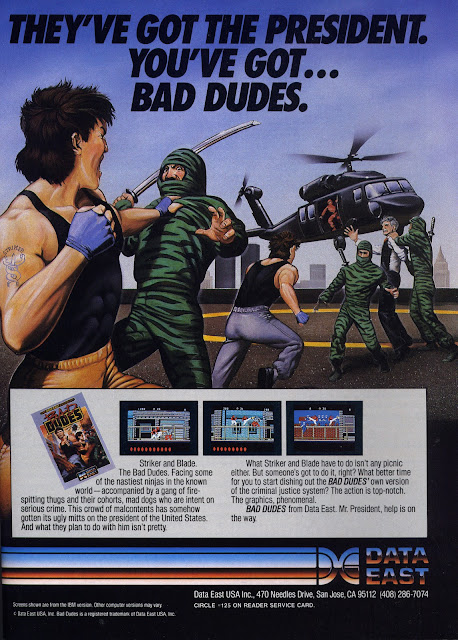
They've Got The President. You've Got... Bad Dudes.
I think this ad tagline is meant to communicate that the Bad Dudes are entirely capable of rescuing the President. But it doesn't quite read that way:
I can't think of too many real-world situations where Bad Dudes would be more useful than the President, but I guess I'll have to make do.
Data East's arcade beat-'em-up game Bad Dudes vs. Dragon Ninja has a certain degree of cheesy charm about it, but the concept never sounds so ludicrous as it does when it's spelled out in black and white, as in this ad for the home computer conversions. We are informed that the villains are "intent on serious crime," as though crime were their goal in and of itself, and that what they plan to do with the President "isn't pretty." So apparently there are no ransom or other specific political demands involved; these guys are just so evil that they want to kidnap the President and, I dunno, make him prance around in support hose and a Carmen Miranda hat on national television.
The ad also indicates that we will be "dishing out the BAD DUDES' own version of the criminal justice system," which as far as I can tell requires no judge or jury, and consists simply of summary execution of every person they meet.
Fortunately, the opposition is fairly incompetent. Notice how the foreground Ninja is armed with a sword that should have given him a superior attack range, yet he is somehow already helpless in the two-fisted grip of Striker (or Blade, the Dudes look identical.)
Man, what's with this itching? Uh-oh. I think I've got...
Bad Dudes.

I can't think of too many real-world situations where Bad Dudes would be more useful than the President, but I guess I'll have to make do.
Data East's arcade beat-'em-up game Bad Dudes vs. Dragon Ninja has a certain degree of cheesy charm about it, but the concept never sounds so ludicrous as it does when it's spelled out in black and white, as in this ad for the home computer conversions. We are informed that the villains are "intent on serious crime," as though crime were their goal in and of itself, and that what they plan to do with the President "isn't pretty." So apparently there are no ransom or other specific political demands involved; these guys are just so evil that they want to kidnap the President and, I dunno, make him prance around in support hose and a Carmen Miranda hat on national television.
The ad also indicates that we will be "dishing out the BAD DUDES' own version of the criminal justice system," which as far as I can tell requires no judge or jury, and consists simply of summary execution of every person they meet.
Fortunately, the opposition is fairly incompetent. Notice how the foreground Ninja is armed with a sword that should have given him a superior attack range, yet he is somehow already helpless in the two-fisted grip of Striker (or Blade, the Dudes look identical.)
Man, what's with this itching? Uh-oh. I think I've got...
Bad Dudes.
Saturday, January 8, 2011
Ultima V: The T-Shirt
This in-box promotional flyer from Richard Garriott's Origin Systems offered one of those bits of gaming ephemera that tend to fade away much faster than the games themselves -- the Ultima V T-Shirt. On the back, it says The wait is over... but the excitement has just begun. And it's sported here by a couple of vintage 1980s models:

Ultima V: Warriors of Destiny came out in 1988; a discount on the t-shirt was made available to buyers of Ultima I, recently remade in 1986, or the 1987 sci-fi RPG 2400 A.D., which didn't sell well.
Anybody out there still have one of these? Any Avatar could buy one of these in 1988 for $8.95, $4.95 with the discount.
Why aren't Microsoft and Richard Garriott teaming up to sell us virtual Ultima gear for our XBox Avatars? They could probably get $3.00 apiece, without having to do anything outdated like print actual t-shirts.

Ultima V: Warriors of Destiny came out in 1988; a discount on the t-shirt was made available to buyers of Ultima I, recently remade in 1986, or the 1987 sci-fi RPG 2400 A.D., which didn't sell well.
Anybody out there still have one of these? Any Avatar could buy one of these in 1988 for $8.95, $4.95 with the discount.
Why aren't Microsoft and Richard Garriott teaming up to sell us virtual Ultima gear for our XBox Avatars? They could probably get $3.00 apiece, without having to do anything outdated like print actual t-shirts.
Friday, January 7, 2011
Of Import: Valis IV (PC Engine)
This week, we follow up on a Japanese game series that gained a bit of a toehold in North America during the 16-bit era, but never really established itself as an enduring franchise here. The Valis series featured the adventures of Yuko, a Japanese-schoolgirl-turned-mighty-warrior-in-short-skirt who starred in a series of action platformers created by Sin-Nihon Laser Soft and Telenet Japan. Valis II and III were released on the TurboGrafx-CD in the US, complete with awkwardly-dubbed animated intermissions, and cartridge versions of Valis III were released for the Sega Genesis and Super NES. But 1991's Valis IV only reached our shores as a hobbled Super NES version entitled Super Valis IV. So I decided it was time to pick up a copy of the PC Engine Super CD and check it out for myself:

It's a pity this title never came out here, because even though it runs on the same memory-constrained 1.0 CD system card as the earlier PC Engine Valis games, and hence would have worked on the standard TurboGrafx-CD, Valis IV features a number of technical and gameplay improvements. The backgrounds feature quite a bit of parallax scrolling, a technique the console wasn't really designed to handle, and the intermissions feature larger images with more animation and better artwork.

Fortunately, it's not difficult to play this as an import title -- Japanese language skills aren't essential, as all of the critical onscreen text is in English. I couldn't fathom the storyline in any detail, of course, but the fully-voiced cutscenes are roughly self-explanatory; at least we can tell who the bad guys are, and how our heroines feel about the developing storyline.
Gameplay improvements over Valis II and III are also significant. This time, Yuko is out of the picture, so her spiritual descendant Rena must join forces with other characters of varying abilities to fight the demon generals who seek... something, probably the overthrow of all that is good and proper, in the standard videogame tradition. This means that the usual Valis gameplay -- run to the right, jumping and attacking with the Valis sword as necessary -- becomes something more sophisticated. Well, sophisticated may be too strong a word, but it's at least as tactically interesting as Super Mario Bros. 2. And the controls are much improved over the PC Engine version of Valis III -- we no longer have to reach for the controller's RUN button to slide under obstacles, as a more intuitive down/jump combination is implemented; the RUN button is used to switch between characters.
In the first level, we must alternate between Rena and her younger sister Amu. Amu's attack is weaker but reaches farther, as she sends her faithful bird companion flying at enemies boomerang-style; she can also jump considerably higher than Rena, with a double-jump capability handy for crossing wide gaps and leaping over obstacles:

The Valis series is somewhat unusual in its genre, in that power-ups are an important part of the gameplay -- we start out with few hit points and a low-powered version of the fabled Sword of Valis, and must acquire icons along the way to beef up our character's abilities. Ideally, we arrive at the end of each level a lot stronger than we started it, ready to face the boss. Some upgrades remain effective after we lose a life, but using a continue resets our powers to the baseline, and forces us back to the beginning of the current level, so it's important to stay healthy. Fortunately the game saves coarse-grained progress to the PC Engine's backup memory, so we can continue at the beginning of the current level next time we play.
The first boss is a knight of the flamboyantly-armored sort typical of the series -- after he prematurely announces our impending defeat at some length, the fight is on. We have to attack him, not his tiger steed, and if we stay focused and duck when the tiger runs at us, this guy is not hard to defeat:

The intermission finds an old friend from Valis III, Yuko's sister Valna, trussed up the old-fashioned way on a crucifix. The image unfortunately calls to mind the 2005 Valis X series, which put a long-out-of-work Yuko and company into officially-licensed hentai territory, but her dignity is in no such danger here:

After our heroines escape near-certain death at the hands of the local demon leader, we are introduced to a new ally, Asfar, who clearly uses the same tailor as the bad guys:

We can now switch to this third character from the second level onwards. Asfar is relatively slow and can't jump much at all, and he's taller than Rena and Amu, so he tends to take more damage from certain attacks. But he has a ground-hugging flaming wolf head attack that's great for taking out ground-based enemies.

The action is classic 16-bit material -- straightforward platforming combat, with the occasional leap of faith required in situations like this where we can't quite see the next safe landing spot:

The graphics are really quite good, much improved over the earlier games in the series. It appears that, given the standard PC Engine CD system's memory constraints, the designers opted for simpler, more repetitive background graphics within each stage, devoting more of the limited memory to colorful, well-animated sprites. The music is, of course, CD Redbook quality; it's not always memorable, but it keeps the action moving along at a fair clip, and the voice acting is solid throughout, putting the unfortunate American dubs of Valis II and III to shame.
My affection for the Valis series is hard to justify -- the action is competent but unspectacular, and the intermission segments, while nicely executed, are pretty standard shoujo demon battle fantasy stuff. I'd like to think it's not just the short skirts sported by the main characters; at any rate, I always enjoy spending a few hours in the Valis universe, and Valis IV is one of the best in the series. It's another small indictment of NEC's TurboGrafx release strategy that Valis II made it across the water, while Valis IV languished in Japanese limbo. The import game will run on an American TurboGrafx-CD system or TurboDuo, and is well worth seeking out.
Due to the series' popularity, the original Valis games are not always easy to come by, but they're not usually too expensive when they do turn up. Interested readers might be able to find a copy for sale here or here:


It's a pity this title never came out here, because even though it runs on the same memory-constrained 1.0 CD system card as the earlier PC Engine Valis games, and hence would have worked on the standard TurboGrafx-CD, Valis IV features a number of technical and gameplay improvements. The backgrounds feature quite a bit of parallax scrolling, a technique the console wasn't really designed to handle, and the intermissions feature larger images with more animation and better artwork.

Fortunately, it's not difficult to play this as an import title -- Japanese language skills aren't essential, as all of the critical onscreen text is in English. I couldn't fathom the storyline in any detail, of course, but the fully-voiced cutscenes are roughly self-explanatory; at least we can tell who the bad guys are, and how our heroines feel about the developing storyline.
Gameplay improvements over Valis II and III are also significant. This time, Yuko is out of the picture, so her spiritual descendant Rena must join forces with other characters of varying abilities to fight the demon generals who seek... something, probably the overthrow of all that is good and proper, in the standard videogame tradition. This means that the usual Valis gameplay -- run to the right, jumping and attacking with the Valis sword as necessary -- becomes something more sophisticated. Well, sophisticated may be too strong a word, but it's at least as tactically interesting as Super Mario Bros. 2. And the controls are much improved over the PC Engine version of Valis III -- we no longer have to reach for the controller's RUN button to slide under obstacles, as a more intuitive down/jump combination is implemented; the RUN button is used to switch between characters.
In the first level, we must alternate between Rena and her younger sister Amu. Amu's attack is weaker but reaches farther, as she sends her faithful bird companion flying at enemies boomerang-style; she can also jump considerably higher than Rena, with a double-jump capability handy for crossing wide gaps and leaping over obstacles:
The Valis series is somewhat unusual in its genre, in that power-ups are an important part of the gameplay -- we start out with few hit points and a low-powered version of the fabled Sword of Valis, and must acquire icons along the way to beef up our character's abilities. Ideally, we arrive at the end of each level a lot stronger than we started it, ready to face the boss. Some upgrades remain effective after we lose a life, but using a continue resets our powers to the baseline, and forces us back to the beginning of the current level, so it's important to stay healthy. Fortunately the game saves coarse-grained progress to the PC Engine's backup memory, so we can continue at the beginning of the current level next time we play.
The first boss is a knight of the flamboyantly-armored sort typical of the series -- after he prematurely announces our impending defeat at some length, the fight is on. We have to attack him, not his tiger steed, and if we stay focused and duck when the tiger runs at us, this guy is not hard to defeat:
The intermission finds an old friend from Valis III, Yuko's sister Valna, trussed up the old-fashioned way on a crucifix. The image unfortunately calls to mind the 2005 Valis X series, which put a long-out-of-work Yuko and company into officially-licensed hentai territory, but her dignity is in no such danger here:
After our heroines escape near-certain death at the hands of the local demon leader, we are introduced to a new ally, Asfar, who clearly uses the same tailor as the bad guys:
We can now switch to this third character from the second level onwards. Asfar is relatively slow and can't jump much at all, and he's taller than Rena and Amu, so he tends to take more damage from certain attacks. But he has a ground-hugging flaming wolf head attack that's great for taking out ground-based enemies.
The action is classic 16-bit material -- straightforward platforming combat, with the occasional leap of faith required in situations like this where we can't quite see the next safe landing spot:
The graphics are really quite good, much improved over the earlier games in the series. It appears that, given the standard PC Engine CD system's memory constraints, the designers opted for simpler, more repetitive background graphics within each stage, devoting more of the limited memory to colorful, well-animated sprites. The music is, of course, CD Redbook quality; it's not always memorable, but it keeps the action moving along at a fair clip, and the voice acting is solid throughout, putting the unfortunate American dubs of Valis II and III to shame.
My affection for the Valis series is hard to justify -- the action is competent but unspectacular, and the intermission segments, while nicely executed, are pretty standard shoujo demon battle fantasy stuff. I'd like to think it's not just the short skirts sported by the main characters; at any rate, I always enjoy spending a few hours in the Valis universe, and Valis IV is one of the best in the series. It's another small indictment of NEC's TurboGrafx release strategy that Valis II made it across the water, while Valis IV languished in Japanese limbo. The import game will run on an American TurboGrafx-CD system or TurboDuo, and is well worth seeking out.
Due to the series' popularity, the original Valis games are not always easy to come by, but they're not usually too expensive when they do turn up. Interested readers might be able to find a copy for sale here or here:
Thursday, January 6, 2011
At Random: K.C. Munchkin! (Odyssey 2, 1981)
I'm dipping back a little farther into videogame history for a random selection from my random collection, as I blindfold myself, run my fingers along the shelf, and come up with Magnavox's K.C. Munchkin! for the Odyssey^2 console. (Magnavox had a predilection for using exclamation points in its game titles, so please forgive the punctuational oddities in the following.)

K.C. Munchkin! is historically noteworthy as one of the first home videogames "inspired by" an established coin-op title, without benefit of appropriate licensing, to become the subject of related legal action. Namco and Midway owned the arcade game that clearly provided the Munchkin's core concept, but it was actually Atari who brought suit after paying big bucks for the console rights to Pac-Man.
The lawsuit was closely followed in the industry, as Magnavox/North American Philips argued successfully, at first, that their game was significantly different from Pac-Man, then lost the case on appeal. The final verdict established that game images and sounds can be copyrighted as distinct elements from the underlying source code -- essentially, the court confirmed that K.C. Munchkin! looks and plays an awful lot like Pac-Man, and ordered it off the market, even though the game's programming by Ed Averett was completely original work.
Of course, Magnavox had already managed to sell quite a few of its cartridges during the time it took to settle the matter, and despite being yanked unceremoniously from the shelves, K.C. Munchkin! is hardly rare today. It's a decent game, too, a standout title in the limited Odyssey^2 library that provides good, solid maze game action while taking advantage of the console's unique capabilities.
How is K.C. Munchkin! different from Pac-Man? Well, it foreshadows Ms. Pac-Man by providing more than one basic maze -- there are four preset configurations, with random and invisible-maze variations. The rotating center block also changes the gameplay -- with careful strategy and timing, the player can trap the monsters safely out of the way for a while.
There's even a programmable mode that allows the player (using the Odyssey^2 keyboard) to configure the maze directly, turning walls on and off, and even creating impossible configurations, though there's no way to save the results:

Pac-Man scoring is altered to fit this game's 4-digit score limit, though it follows a similar pattern with escalating point values for quickly eating multiple monsters. The gameplay is also altered -- there are only a dozen pellets to consume, but they move freely around the board and must be chased down, and they move faster as their numbers are reduced. The three opposing monsters (not four as in Namco's game) don't really change their patterns when they're in "scared" mode, and they still look insectoid until they become ghosts (resembling Namco's graphics more directly) when the player actually contacts them. Then they have to return to the rotating center block to recharge, and often end up chasing the entrance for a while before they can actually get in and return to their normal lethal state. It's entirely possible, at least early on, to finish the level with all three enemies stuck in ghost mode:

The monsters aren't as smart as Namco's originals, and they don't work together to any great degree, but they are capable of chasing the player into a dead end on occasion. There are also invisible maze modes, where the actual map is only displayed when the player stops moving, providing additional challenge when the monsters start to seem brain-dead.

K.C. Munchkin! was not an innovative game, and is remembered today mostly because of the accompanying legal fracas. But its gameplay holds up fairly well almost thirty years later; maze chases were a dime a dozen at the time, but at least Magnavox and N.A.P. tried to do something different within the genre. It just wasn't different enough.
This one is fairly readily available today, and can usually be found for sale here:

K.C. Munchkin! is historically noteworthy as one of the first home videogames "inspired by" an established coin-op title, without benefit of appropriate licensing, to become the subject of related legal action. Namco and Midway owned the arcade game that clearly provided the Munchkin's core concept, but it was actually Atari who brought suit after paying big bucks for the console rights to Pac-Man.
The lawsuit was closely followed in the industry, as Magnavox/North American Philips argued successfully, at first, that their game was significantly different from Pac-Man, then lost the case on appeal. The final verdict established that game images and sounds can be copyrighted as distinct elements from the underlying source code -- essentially, the court confirmed that K.C. Munchkin! looks and plays an awful lot like Pac-Man, and ordered it off the market, even though the game's programming by Ed Averett was completely original work.
Of course, Magnavox had already managed to sell quite a few of its cartridges during the time it took to settle the matter, and despite being yanked unceremoniously from the shelves, K.C. Munchkin! is hardly rare today. It's a decent game, too, a standout title in the limited Odyssey^2 library that provides good, solid maze game action while taking advantage of the console's unique capabilities.
How is K.C. Munchkin! different from Pac-Man? Well, it foreshadows Ms. Pac-Man by providing more than one basic maze -- there are four preset configurations, with random and invisible-maze variations. The rotating center block also changes the gameplay -- with careful strategy and timing, the player can trap the monsters safely out of the way for a while.
There's even a programmable mode that allows the player (using the Odyssey^2 keyboard) to configure the maze directly, turning walls on and off, and even creating impossible configurations, though there's no way to save the results:

Pac-Man scoring is altered to fit this game's 4-digit score limit, though it follows a similar pattern with escalating point values for quickly eating multiple monsters. The gameplay is also altered -- there are only a dozen pellets to consume, but they move freely around the board and must be chased down, and they move faster as their numbers are reduced. The three opposing monsters (not four as in Namco's game) don't really change their patterns when they're in "scared" mode, and they still look insectoid until they become ghosts (resembling Namco's graphics more directly) when the player actually contacts them. Then they have to return to the rotating center block to recharge, and often end up chasing the entrance for a while before they can actually get in and return to their normal lethal state. It's entirely possible, at least early on, to finish the level with all three enemies stuck in ghost mode:

The monsters aren't as smart as Namco's originals, and they don't work together to any great degree, but they are capable of chasing the player into a dead end on occasion. There are also invisible maze modes, where the actual map is only displayed when the player stops moving, providing additional challenge when the monsters start to seem brain-dead.

K.C. Munchkin! was not an innovative game, and is remembered today mostly because of the accompanying legal fracas. But its gameplay holds up fairly well almost thirty years later; maze chases were a dime a dozen at the time, but at least Magnavox and N.A.P. tried to do something different within the genre. It just wasn't different enough.
This one is fairly readily available today, and can usually be found for sale here:
Subscribe to:
Posts (Atom)


 Posts
Posts

