Friday, November 11, 2011

East vs. West: Veigues Tactical Gladiator (1990)

I never owned Veigues Tactical Gladiator for the TurboGrafx-16 back in the day -- if I recall correctly, the preview video at Babbage's put me off the game at its original $49.99 retail price -- but I recently imported the PC Engine version.  This HuCard-format mech-themed scrolling shooter was developed by Game Arts (of Thexder fame) and Victor Musical Industries, and brought to the West by NEC.  There's nothing really Tactical about the gameplay -- it's a straightforward side-scroller -- but there are some strategic RPG-lite options available as we decide how to upgrade our mech between levels.

There aren't many differences between the Japanese and North American versions -- the same title was used in both territories, although the original Japanese logo is a little more stylish and friendly than the "serious" one imposed on the US version:


Note that the US version did not fix the typo on "PROGRAMED BY BITS", even though a new font was employed:


Beyond the title screen, the only difference is that the Japanese text used to display alert messages has been replaced with English text; this stands out only because most of the game's text is already in English.  And the US translation leaves much to be desired, perhaps because of limited message display space -- when our Veigues mech is too damaged to continue and blows up, the evacuation alert is a bit terse:


The visuals are repetitive -- likely due to cartridge space limitations -- but solid, with no flicker and impressive parallax background scrolling (up to five layers, though only a few planes ever overlap, and during the mech's brief vertical leaps the illusion of depth is compromised.)  The chiptune music is pleasant and appropriate -- there's an intentionally beepy/boopy pure-sine-wave character about some of the instrumentation that fits the robot theme well, and several tunes are memorably catchy.

What's unusual about this release is that this quintessentially Japanese game came to the US in such unadulterated form, with its lumbering red-and-silver mech fighting robotic koala bears:


Veigues Tactical Gladiator does a good job of reminding the player that a giant robot is an unwieldy fighting machine -- we can leap up into the air by pressing up on the D-pad, but these jumps are brief and we plummet back to earth almost immediately.  Unfortunately, this philosophy extends to all the controls -- we can't crouch, because turning left and right requires pressing down on the D-pad to face the other way.  We have two types of weapons, a long-range bullet and a short-range cannon, each assigned to one of the PC Engine's two fire buttons -- but both only fire straight ahead and are not much use against many of the enemies we encounter.  We're out of buttons, so firing our weak auxiliary guns requires pressing both fire buttons simultaneously -- we begin firing at a downward angle, but can press up and down while holding both fire buttons to change the aim.  It's suitably challenging for those inclined to master the controls, but it tends to feel like we've brought a tank to a knife fight a lot of the time -- and the knives are winning.

The game's serious mech theme extends to its damage model -- we can lose the Tactical Gladiator's head and one or both of its arms if they sustain too much damage.  But there's no way to recover these lost components mid-level -- we can fight a boss headless easily enough, but if our arm-mounted weapons are lost we're severely handicapped.


Conserving energy during play earns points which can be used to upgrade various aspects of our mech between levels -- it costs more to upgrade our weapons, less to upgrade our shields, and this does provide for some strategic elements.


But Veigues Tactical Gladiator's controls and gameplay are on the unforgiving side, and the level designs are repetitive.  We march from left to right, dealing out damage as best we can and taking it in turn.  And eventually it's time to put the mech back into storage -- there's no continue mechanism after we lose our one and only mech for good, so once we're down, we're done:


I don't expect to see a revival of interest in Veigues Tactical Gladiator any time soon -- it's not a forgotten classic, by any means, and after a few hours with it I wasn't making much progress, nor was I having enough fun to continue battling the controls.  But it is an example of a certain era in videogame technology and Japanese pop culture, and notable as one of the more unusual PC Engine titles NEC (in its finite wisdom) brought to the US TurboGrafx-16.


Veigues Tactical Gladiator is reasonably affordable if your collection needs an example of early-90s Japanese mech gaming.  You may be able to find a copy for purchase here:

Veigues PC-Engine Hu

Thursday, November 10, 2011

The LoadDown - 11/10/2011

The big Thanksgiving release season is upon us, but even as new retail titles hit the shelves, new downloadables continue to arrive.  This week's releases...


WiiWare -- One new title this week, and it's not really a game: Step Up! is a step-aerobics training program with serious intent behind it.  It works with or without the Wii Balance Board, and oddly substitutes its own avatar system for the traditional Miis.


Wii Virtual Console -- Going three times... nearly gone, though of course I will reinstate it should anything actually start happening on this platform again.

DSiWare -- Two new games this week.  Castle Conqueror - Heroes is a sequel to October's Castle Conqueror - Revolution, set in the same universe with more focus on strategy/simulation and less on the RPG aspects.  Bloons TD is a cute tower defense game in which dart-blowing monkeys must try to pop all the balloons before they escape.  (And I pause here to note that "tower defense" is now being abbreviated in titles as TD, so it must now be an official game type.  So unusual to witness the birth of a new videogame genre in this decade!)


3DS eShop -- The 3DS gets the DSiWare titles above, of course, plus something called Freakyforms: Your Creations, Alive!  This is a creativity tool/game that allows players to create 2-D animated characters and environments, and uses simple physics and motivational AI to bring them to life.  It also has save/trade features using the Streetpass system.  Neat little idea.


XBox Live Arcade -- Just one new game this week, as Call of Duty: Modern Warfare 3 rolls over everything in its path.  XBLA gamers can pick up Fusion: Genesis, a sci-fi starship-based MMO of sorts, with solo and online co-op and competitive quests.


PS3 on PSN -- Oddly, there's nothing here this week, but again it's CoD:MW3 week.  I will note that there are now PS2 Classics showing up for download on the PS3; I haven't been tracking these or the XBox Originals available for download on the 360 platform, but perhaps I should be.


PSOne Classics -- Sigh.  Again I have missed some recent activity.  This week brings Square-Enix's Chrono Cross to the platform, PSX sequel to the classic SNES RPG Chrono Trigger.  And the past few weeks saw fishing game Monster Bass!, Data East's Arcade Hits: Magical Drop, and shoot-'em-up construction kit (all in Japanese!) Dezaemon Kids! turn up.

Tuesday, November 8, 2011

Adventure of the Week: Germany 1942 (1983)

Without necessarily setting out to do so, I've been playing through Anthony Wood's short series of adventure games published for the TRS-80 Model I/III computers.  Wood put out four such adventures in 1983, using his own game engine; the title screen for Germany 1942 establishes that he was based in Houston, Texas at the time.


Wood's games are generally pretty straightforward, but they're well-designed with enough detail to help the observant player to success, so they're fine introductory adventure games.  This one is a World War II adventure -- cast as a gunner in Britain's Royal Air Force, we have been shot down over Germany and must find a way to return safely to England (so this one will presumably be a bit larger geographically than most adventure games!)  There were a number of WWII escape-the-Nazis games published back in the day, but they were more popular in the UK, and this homegrown US title is something of a rarity.

As always, I encourage interested gamers to try Germany 1942 out before proceeding here -- my documentation of the experience is likely to ruin some of the fun of discovering its quirks and secrets for yourself, and Mr. Wood has graciously made his games freely available for play.  Beyond this point, there are certain to be...

***** SPOILERS AHEAD! *****

As the story begins, we have parachuted into a clearing in an old forest; the engine tells us I am carrying something and I or INVENTORY reveals a COLT 45, some RATIONS and a UNIFORM.  Examining the used parachute discovers that A flare was tied to the parachute, which may come in handy should we encounter any friendly forces later on.

But a little exploration is our first order of business.  There's a narrow dirt road in the forest, but we can't just DIG in this game -- I can't dig with my hands! -- so we will probably need a shovel.  There's a gas station in a village to the east -- but we're in enemy territory, and if we venture out of the woods unprepared, then Oh no.. I'm caught by a German patrol.  Somehow they knew that I was here!  I took this to mean that we need to get rid of our RAF uniform, but we can't DROP UNIFORM -- I'm not going to stand here naked!  So we will have to hide out in the woods a while longer.

There's an old bucket in a pile of leaves in an overgrown area south of our landing site, and an old abandoned airfield contains a HANGER [sic], which is in fact a hangar, but its door is locked.

An old hermit occupies a location down a side trail, with a makeshift shelter and tattered bag.  His only function seems to be to prevent us from looking in his tattered bag; we can't otherwise engage him, but at least he's not about to raise any alarms for the soldiers.  If we GIVE RATIONS, then The hermit gulps the rations down and falls asleep, and we can discover that the bag contains some old clothes.  Now we can WEAR CLOTHES and get rid of our uniform, and steal the hermit's axe from his lean-to shelter -- later events will confirm, as expected, that it's AN axe and not SOME Axe Deodorant Body Spray, as we're playing a game written in 1983 and set in 1942.  I hope the rations were a fair trade for the clothes and axe, as otherwise we've rather exploited this gentleman.

Now we should be able to safely enter town and visit the gas station... except, no, we still get caught by the German patrol.  Dropping the colt and the flare doesn't help, and even with just the old clothes on our back we are immediately suspect.  Firing off the flare doesn't help -- it makes it a USED FLARE, but we still get caught by the undistracted Germans.  Can we hide the parachute somehow?  Yes, if we go to the overgrown area where we found the bucket, HIDE PARACHUTE yields I cover it with leaves.  We can also HIDE UNIFORM and other objects in the leaves -- and if we LOOK LEAVES, we rediscover them.  I was impressed by the implementation here, it's unusual to see a truly functional HIDE verb in these early games and works well for this puzzle.  We have to conceal the evidence of our arrival in order to enter town unnoticed.

Now we can get to the gas station, where The attendant says "Heil Hitler."  If we SHOOT ATTENDANT then we are captured by a German patrol.  If we fail to SAY HEIL in response then the attendant shoots us.  So we will have to go along with the Nazis for a moment -- it's a surprisingly uncomfortable bit of interactive moral compromise.

An old house further down the road has a front porch, and a front door that is NOT locked, and the house takes up a good portion of the map.  In a desk drawer in the study we find a rat trap, and a map indicating something is buried down the road to the east.  There's a step ladder in the closet, and a piece of cheese in the kitchen cupboard.

The house has a backyard with an oak tree and some long grass and weeds, concealing a shovel.  We can't CLIMB TREE, but we can use the axe to CHOP TREE and find a gas coupon in a chipmunk's nest.  There doesn't seem to be an inventory item limit, which is good as so far we have found a lot of potentially useful objects but haven't solved many puzzles.

In the bedroom, if we LOOK MATTRESS, then AGGHHHHH!! I'm bit by a big rat!  And then I contract a mutant form of the bubonic plague and die within the hour!, and the game is over for simplicity's sake.  So we need to use the rat trap here somehow.  We can't BAIT TRAP or PUT CHEESE but we can SET TRAP (as long as we have the cheese in hand) and DROP TRAP.  But we still get bitten by the rat, and the same happens if we don't drop the trap.  We can't MOVE BED to discover the rat more safely, either.  So we will have to come back to this puzzle.

The map shows an X on the road east of the old house, but if we just go there and DIG, then I'm caught by a curious German patrol that sees me digging.  So we will have to conceal our actions, somehow.

We need money to buy gas at the station, not just the rationing coupon, so that puzzle also remains to be solved.  We can CLIMB LADDER in various places to no effect -- we just climb back down -- but in the back yard we can ascend the ladder.  As I had already cut the tree down, I started over, and established that if the tree is still standing, we can climb the tree itself using the ladder.  But it appears there's nothing we can find up in the tree anyway, or so it seemed to me.

But all is not lost -- while I was wandering around trying my experiments with the step ladder, I discovered that eventually The sun sets.  Now, in the dark, we can DIG safely and find an iron box.  Unfortunately it is rusted shut.

At least I had some new insight into the game's design, and determined that if we drop the rat trap and leave the bedroom for a few turns, patience also helps with the rat -- eventually A rat is caught by the trap!  And now we can LOOK MATTRESS so that I find some money here!


After we BUY GAS with the coupon and money, and the bucket found in the forest, we have an OLD BUCKET FULL OF GASOLINE.  This sounds like a really unsafe way to carry it, but we are in desperate circumstances here.

We have gas but still can't get into the hangar, so we have to return to unsolved puzzles.  How do we open the box?  Do we need to drop it from the tree?  No, that doesn't work -- it actually just leaves it in the tree.  And if we leave it in the tree and then CHOP TREE, it disappears completely.

Experimentation establishes that apparently we can try to OIL BOX, but I haven't seen any oil anywhere.  A peek at the game data indicates that a CAN OF OIL exists. But where is it?  I'm getting stuck here, for the first time in one of Anthony Wood's games.  But fortunately Dorothy's handy CASA walkthrough indicates that we can climb up higher in the tree than I had.  (To Mr. Wood's credit, the location is described as in the middle of an oak tree, but with the BRANCHES ALL AROUND I took the description to mean the center of the tree, instead of implying a bottom/middle/top arrangement.)  I found it odd that I had not tried to do this before, but I think I did and just missed the right command -- it turns out we have to CLIMB TREE specifically, not CLIMB or CLIMB BRANCHES.

From the top of the tree, we can see a roof.  GO ROOF yields I can't get there.  There is 5 feet of space between us.  (Apparently the roof is anthropomorphic.)  But JUMP ROOF works.  The roof has shingles, and a key, and a bit of parser dictionary oddness -- LOOK ROOF while we're standing on the roof yields There is not one here!  We can JUMP TREE to return to the tree and climb back down.

With this key in hand we can now return to the hangar, UNLOCK DOOR, OPEN DOOR and GO DOOR.  Inside we find an airplane, and the can of oil we need to open the rusty box, which turns out to contain a compass, without which we would presumably be lost.

LOOK PLANE doesn't reveal much, but There is a place to put gas into the tank.  Good enough, we can FILL TANK with our bucket of gasoline.  Entering the plane, we should probably be cautious WEAR the life JACKET found onboard before we take off, which we can do with a simple FLY PLANE (Gee, this is fun, says the indisputably experienced RAF gunner, who apparently knows how to fly a plane also.)

We can WAIT for quite a while -- the sun rises, and sets, and our plane seems to be doing just fine on its bucketful of automobile-grade gasoline, but when it finally occurs to me to quit stalling and explicitly FLY ENGLAND, it's suddenly too late... Oh no! I'm out of gas. The plane crashes and I die.  I don't have a parachute!  So our preparations are incomplete -- we need to restore and go back and get our old parachute, it seems, and we might want to grab our uniform while we're at it.

Another attempt ends with Agghh! My parachute isn't ready to use.  I'm shark bait!   Fortunately the game's save and restore mechanisms are functional and user-friendly -- we can SAVE or LOAD at any time while we work this out.  We have to PACK PARACHUTE first, which also reveals the flare (which I had forgotten about several restarts later.)  Now we can parachute to safety, ignoring any nagging doubts about whether there are in fact any sharks in the English channel where we land and float.  We can't GO ENGLAND -- again, There is not one here! -- and it also develops that I don't know how to SWIM or just navigate out of the water.  But we can SHOOT FLARE (it appears to be watertight, fortunately) to be rescued by an English patrol boat, and solve the game!


This one's a bit more difficult than Anthony Wood's other games -- there are more "gotchas" during the climax, and I did need a hint for this one.  But none of these situations were nonsensical or overly contrived, by adventure game standards, and I enjoyed playing this one too.  It seems that Wood put out four text adventures, all in 1983, and then his output stopped for some reason.  At least he's alive and well today, and we still have the four games he produced to play and enjoy.

Sunday, November 6, 2011

Cover to Cover: Adventure International Spring 1981 Catalog (pp. 27-28)

Our coverage of the Spring 1981 Adventure International catalog continues, with page 27 dedicated to the company's first published game for Radio Shack's intriguing new 6809-based Color Computer.  Venerable TRS-80 programmer Lance Micklus was one of the first out of the gate with this collection of simple games for the CoCo:


Computer Mouse is clearly yet another version of Robots, a.k.a. Daleks, the robot-collision game that inspired the faster-paced arcade game Berzerk.  Micklus continued to use the "Computer Mouse" character -- before the term "mouse" came to mean a specific input device -- in several other projects over the years, and a version of it graces his website if you want to see what he's up to these days.  Pillbox is the classic aim-and-launch military game that made the rounds of all the early platforms, Ziphoyd Pinball is a version of the non-flipper pinball games, more recognizable today as pachinko, where a ball was sent up to rattle down through a field of pins into scoring pockets.  And you can guess what classic game concept Blockout borrowed from.


Next we have a brief interruption from another computer software publisher whose contemporaneous catalog we paged through a while back -- Acorn Software Products, Inc.  In the home computing industry's early years, the hobby wasn't yet big enough to sustain newsstand magazines, so one place for early publishers to advertise was in each other's catalogs.  Acorn anted up to buy two pages in the Adventure International catalog, and here is the first, on page 28:


Next weekend, we'll wrap up this catalog if all goes as planned.

Saturday, November 5, 2011

Cover to Cover: Adventure International Spring 1981 Catalog (pp. 25-26)

We're continuing our pagethrough of the Spring 1981 Adventure International catalog, getting near the end now.  Scott Adams founded the company to market his classic text adventures, but soon expanded to carry a broad line of software for home computers of the day.

Page 25 contains another set of simple computer games typical of the early industry:


Owl Tree (with sound -- at a time when this was rare on the TRS-80) is a logic puzzle game written by James Talley, creator of the Kid-Ventures.  Bill Presby's Welcome U.S.A. is an educational database and quiz game about the fifty states.  Bill Miller's Dr. Chips is a variation on the classic early artificial intelligence experiment Eliza -- and for fun I played the two off of each other a few years ago.  Bewary is by Leo Christopherson of Android Nim and Dancing Demon fame, and Lying Chimps is another logic puzzle game.

Page 26 promotes some interesting technical material marketed but not produced by Adventure International -- a book of documentation, a disk utility, and a peripheral:


James Farrour's Microsoft BASIC Decoded & Other Mysteries provided deeper insight than the official Microsoft documentation for TRS-80 owners (and users of other Z-80-based machines).  Individual software programs today are much more complicated than Microsoft's whole operating system at the time, but in an era when being a serious hobbyist meant doing some programming yourself, these kinds of books were very popular. 

FDM (Floppy Disk Maintenance) program was also for serious computer owners -- no simple disk defragger or undelete utility, this tool required use of an oscilloscope and assisted the user in physically aligning and maintaining the first generation of consumer-grade floppy-disk drives.

Finally, we have The Original Photopoint Light Pen, a peripheral my younger self coveted mightily at the time, though I never anted up the $19.95 to own one.  This was yet another early computer doodad with intriguing possibilities, but no real commercial software support.  And the presence of "two sensitivity settings" implies that the pen may not have been tremendously reliable under real-world lighting conditions.  I think I realized at some point that my visions of making cool vector drawings with a light pen were never going to be realized on the 128 x 48-pixel TRS-80 display!

Tomorrow, we continue...

Thursday, November 3, 2011

The LoadDown - 11/03/2011

Another week, another new wave of downloadable console games...


WiiWare -- One new game this week, which sounds like a bizarre mismatch of name and concept: Gnomz.  It's an E-rated... fighting game... with "25 action-packed arenas"... involving gnomes, flying elephants, rainbows, and glowing reindeer.   All that's missing is ponies and Jesus!


Wii Virtual Console -- Once again, nothing here.  Going twice...

DSiWare -- Two games this week: The episodic House M.D. series makes it to Episode 4: Crashed, with another T-rated medical mystery for Hugh Laurie's skeptical Holmesian doctor and team to solve.  Also, 1950s Lawn Mower Kids, which follows up one of the freshest titles I've heard recently with a stylus-driven game concept about careful lawn mowing in the McCarthy era.


3DS eShop -- The DSiWare games are also available here, of course, along with Balloon Kid, another vintage Game Boy title featuring 8-levels of airborne balloon-based action as Alice floats through the sky in search of her younger brother Jim.


XBox Live Arcade -- Just one new game this week: Burgertime World Tour, yet another new variation of Data East's classic burger-building arcade game.


PS3 on PSN -- Three new titles up for download.  Max & The Magic Marker: Gold Edition brings the semi-successful multi-platform action/drawing platform game to the PS3.  Pinballistik is an attractive-looking pinball game.  Hydrophobia Prophecy is a first-person adventure with dynamic water elements -- it's unusual in that it's the latest iteration of the original game Hydrophobia, which received mixed reviews on release and has been continually updated; this edition contains a lot of new and reworked content compared to the 2010 release.


PSOne Classics -- Another quiet week here.

Tuesday, November 1, 2011

Adventure of the Week: Ruins at Time's Edge (1983)

Up next, another vintage TRS-80 text adventure by the briefly prolific Anthony Wood: Ruins at Time's Edge, published in August 1983.  One of four releases using Wood's own adventure game engine, all put out in 1983, this one's an archaeology/fantasy adventure with a traditional treasure hunting plot and one potentially interesting game mechanic.  As the title screen tells us, we must SEARCH FOR THE LOST DIAMOND IN ANOTHER TIME.


Wood's games are generally straightforward -- it's not that they're overly easy, but his designs are gentle, with clear descriptions that provide sufficient information for solving the puzzles.  So Ruins at Time's Edge is a good introductory adventure, a brief but fun experience.  As always, I encourage interested readers to try the game out before continuing with my commentary below.  And in this case that's especially easy to encourage, as Mr. Wood has made the games freely available at his own website.  Beyond this point, be reminded that for history's sake, there are bound to be...

***** SPOILERS AHEAD! *****


We start out standing in front of some OLD RUINS, but LOOK RUINS tells us that I see nothing special.  So we have to do some exploring to discover that the ruins consist of a surprisingly unbroken wall, surrounded by jungle filled with weeds.  It's not a maze, but these outdoor "rooms" aren't of uniform size, so the exterior mapping can be misleading.  We can DIG outside the walls, but we don't seem to find anything.

In the courtyard, freely accessible within the ruin walls, we discover a giant worm and a pond.  LOOK WORM establishes that it's a very large and mean looking worm. Well over eight feet long.  He seems to be curled around a trap door.  Trap doors are always worth exploring in adventure games -- they seem to turn up more often than in the real world.  In inventory, we find that we are already carrying a sword and a torch.  We can enter the pond -- there's nowhere else to go from there, but we can SEARCH POND to find a crowbar in the sandy bottom.

So should we try to KILL WORM?  Apparently not -- attempting to do so yields only I rush the ugly beast. I swing! Ugghh, i'm eaten whole!  We can't LIGHT TORCH either, as I don't have anything to light it with.  We seem remarkably ill-prepared for exploring ancient ruins haunted by oversized annelids.

So it's back to the jungle to hunt up more supplies -- we can LOOK WEEDS in various locations to come up with a bow, some arrows and a tinder box.  Now we should be better equipped.

We can SHOOT WORM with the bow and arrow -- but even though Wooshh! Kaboom! The arrow explodes when it hits the worm, we are next informed that Oh my gawd! The worm is still coming!  And if we try to follow up with  KILL WORM (as before, using the sword) the parser is fatally coy.  Please tell me how you want to kill it, it helpfully suggests, followed immediately by Oh no! I'm eaten by a giant worm!  We have to SHOOT WORM twice.

Now we can use the crowbar to open the trapdoor, but the parser is more obstinate than when the worm was guarding it -- we cannot now OPEN DOOR or PRY DOOR or PRY TRAPDOOR, but we can USE CROWBAR to get it open.  We need to LIGHT TORCH before the game will let us GO DOOR.  (And it won't let us UNLIGHT TORCH -- I won't be able to see!)  It seems the engine has no support for darkness, so it has to prevent us from going into the darkness and discovering it's actually still light.

The underground "dungeon" is fairly compact.  A dank room holds a WOOD CHEST, and The chest is too tough to allow us to USE CROWBAR.  An old crumbling room contains a FLASK OF OIL. A mysterious LARGE CHURNING CLOUD OF MIST occupies a large round room.  And the large room that seems to have once been for worship contains a STATUE.

If we GO CLOUD, we learn that Aggghh!!! Some strange forces rip me apart!  It's odd, because we can SEARCH CLOUD with impunity, finding nothing but somehow avoiding these mysterious forces.

The statue has a keyhole hidden in its ear, and trying to TURN STATUE yields I don't have a key.  We can take the flask and POUR OIL, but The oil is soon absorbed into the dirt and we now have an EMPTY FLASK, so that doesn't seem productive.  We can't THROW anything into the cloud.  Hmmmm.

Some further experimentation reveals that we can POUR OIL on the chest and LIGHT CHEST to burn it to ashes.  We can't search the ashes immediately, as they're too hot to examine well, but they cool down after three turns and we can find a key.

Using the key on the statue yields a wearable gold ring, and as there doesn't seem to be much more to do right here, we can take the chance and confirm that we can now more safely enter the cloud of mist.  Not completely safely, mind you -- I feel like i'm falling, falling... Suddenly i'm 10 feet above some lake! Splash! and we find ourselves sinking like a rock

We can see an island in the distance, and attempt to GO ISLAND, but while the engine will immediately put us on a sandy beach in the description, we are still told Oh no! I sink to the bottom and drown! I was too heavy!  There's no time to embark on a weight-loss program, so we need to drop some things -- almost everything, in fact -- before going into the cloud.  All we can take with us are the undroppable torch and the ring.

Once we are actually safely on the beach, we can DIG to find a scroll.  There's a large boulder to the east -- as in Wood's mini-adventure Space Hunt, examination notes that There seems to be something under it...
And in this game, we actually can ROLL BOULDER, though it doesn't seem to do anything of value.  It does sport some writing, however: Press the ring to return to normal time.

A small and shadowy cave nearby contains the SPARKLING DIAMOND we have been searching for -- but it won't be quite that easy, because there's still a MAGICAL FIELD SURROUNDING THE GEM.

When we PRESS RING, we are informed that I feel like I'm falling....Suddnly [sic] I'm elsetime! -- an homage to Scott Adams' classic SAY YOHO line, although it should really probably be "elsewhen."  This takes us back to the trail through the jungle, outside the ruins, which will be useful later but seems premature at the moment.

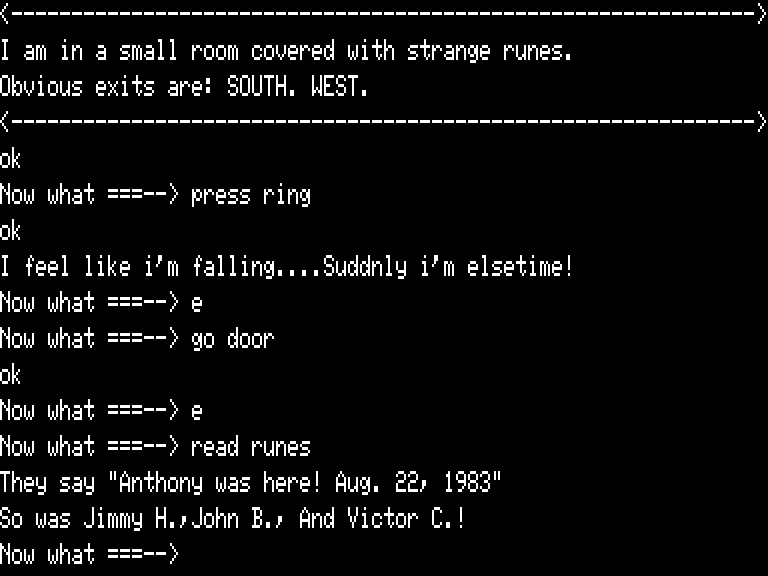
So what should we do with the scroll found on the beach?  Be warned that if we LOOK SCROLL in the wrong place, it is still taken by the parser as READ SCROLL, and thus activated, it fades to dust.  Its effect is intended to destroy the magical field, so if we trigger it prematurely we will need to restore an earlier save.  Reading the scroll in the diamond room, so that the field is dispelled, we can now GET DIAMOND, PRESS RING and... what?  We don't really seem to have traveled through time, per se, just space as we warp back to the starting location.  Maybe we lost or gained a few seconds, but there's no visible impact.  So I wandered around looking for paradoxes and other time-related changes, but discovered only that with the diamond in hand we can READ some previously unreadable RUNES in a small room underground to see a little inside joke:


Beyond finding this little homage to the author's friends circa 1983, I wasn't quite sure what to do next.  But the original TIME/TXT description file accompanying the game tells us that the ultimate object is simply to DROP DIAMOND at the starting location to win.  And so we can wrap this one up in very short order!


I expected Ruins at Time's Edge to be a little bit more difficult than Wood's other games, as there was no solution posted at the CASA Solution Archive (though mine has been added now), but it's pretty straightforward.  My walkthrough is also posted here, below the fold:

**** WALKTHROUGH ****