Sunday, November 20, 2011

Cover to Cover: Adventure International Spring 1981 Catalog (pp. 33-back cover)

At last we come to the end of Adventure International's Spring 1981 catalog of software and products for early home computers. I'm going to cram these last four pages from Scott Adams' company into a single post, so without further ado...

Page 33 captures Adventure International's official Limited Warranty and purchasing details, along with an ad for The Alternate Source, a TRS-80 magazine:


I actually had the opportunity to visit the Adventure International Computer Center back in the day during a family trip to Disney World -- it was my first experience of a computer store that was not Radio Shack, and at age 13 it was extremely cool to see all these products I'd only seen in the catalog actually hanging on the walls in all their poly-bagged glory.  And the company had its own BBS as well, the Adventure Forum-80, which I never had the chance to try out.

The Alternate Source was an early home computing magazine, and the promotional bonus Wizard's Castle was apparently a text adventure/RPG hybrid written in BASIC that appeared on a number of platforms after originating on the obscure Exidy Sorcerer.  The best information I can find online indicates that only 18 or 19 issues of the magazine were published between 1980 and 1984, and that it was bi-monthly rather than monthly, so a twelve-issue subscription starting in 1981 would probably have just about covered the rest of its life.

Page 34 is another third-party ad, from Software Shack, a company that would probably have run into the same problems as Computer Shack did later on:


What's most interesting about Software Shack is that, while its full-page ad provides few specifics on products or pricing, it was running a FORUM-80 BBS that provided an online catalog and ordering system over modem -- a genuine forerunner to today's largely Web-based software market, aside from the fact that any software ordered would still be delivered on physical media.

Page 35 gets back to one last round of Adventure International products, all utilities of the sort that were very handy in the early days but most of which would hardly qualify as stand-alone products today:


BOSS was an enhancement package for the TRS-80's built in Microsoft BASIC interpreter; IRV a keyboard macro processor; and D.I.M. II a diskette catalog/index utility.  PECA was a niche product (even by 1981 standards) aimed at engineers and hobbyists designing circuit boards or other electronic projects, allowing the user to model the design and calculating the power flow through up to 20 combined components, if I'm reading the ad copy right.  E-Z Sounds was a utility by James Talley (Kid-Venture) providing routines BASIC programmers could call upon to provide sounds in TRS-80 projects -- the system did not officially have sound output per Radio Shack's design, but enterprising programmers figured out how to modulate the system's cassette audio output to produce sound effects, even digitized speech.  And Lance Micklus' ST80-UC was a standby for many early modem users, emulating the classic ST-80 smart terminal for use with academic and commercial mainframe systems.

At last, we have reached the catalog's back cover -- does anyone still have a "WHIZ" T-Shirt?


I also note that the entertainment software industry seems too young to be suffering a "HOT FLASH" in 1981, but it's just a last-minute announcement that the pre-Broderbund edition of Galactic Empire we saw back on page 20 is now available for the Atari home computers.  It's a reminder that these publications were still cut-and-pasted together by doing actual, physical cutting and pasting of printed typeset material and pictures.  The Macintosh and Adobe Pagemaker were still several years away.

And with that, we are done with one of the thickest vintage catalogs in my collection.  Scott Adams pioneered adventure gaming on microcomputers, and he also saw the potential in the home computing industry.  His company was one of the many that perished during the mid-80s industry crash, due at that time to business factors rather than any incipient demise of text adventure games per se -- that would take several more years.  But in 1981 Adventure International was just getting started and had an ambitious lineup of products for sale.

I hope you've all enjoyed this little trip down nostalgia lane.  I have no idea what we're going to be looking at next, but I'd better get cracking!

Saturday, November 19, 2011

Cover to Cover: Adventure International Spring 1981 Catalog (insert)

We're just about done with our tour through the Spring 1981 Adventure International catalog... and I almost forgot about this two-page advertising insert!  Scott Adams founded his company to publish his own adventure games and other products, primarily for the Radio Shack TRS-80 in the early days.  And before mass-market computer magazines existed, it made sense for other companies -- even competitors -- to advertise in his widely-circulated (by 1981 standards) catalog.  These products and ads apparently arrived too late to make the regular print run, but were added as a stand-alone page inserted into the regular catalog.

Page "A" offers a number of specials on random computer paraphernalia:


Most of these are recognizable items -- disk drives, modems, books and diskettes -- but a few of these offerings were very TRS-80 specific and deserve some explication.  The GREEN WINDOWS were simply green overlays designed to fit the standard TRS-80 Model I, II and III 60 Hz black-and-white monitors, to provide a more professional green-on-black look better suited to long hours at the computer.  The LOWER CASE KIT  added true lowercase characters to the budget-minded Model I's built-in font ROM -- while the machine could represent the full ASCII character set in memory, the standard model reused the uppercase characters for lowercase display, making it impossible to distinguish between the two onscreen.  Radio Shack offered its own upgrade kit, but cheaper aftermarket kits were very popular too.  Finally, we have the RESET BUTTON EXTENDERS -- the Model I's reset button was hidden under a door on the rear of the keyboard/CPU unit, and most users ended up removing the door.  Even with the door off, reaching the button tended to require hooking a finger blindly into the casing from a normal seated position, so a simple plastic extension on the reset button was deemed handy.

Page "B" reminds us how lucky we are to live in the age of USB -- back in the day, being able to simply "Plug in your Printer and PRINT" was actually an unrealized dream.  Even the old-fashioned Centronics printer port was not standard on home computers, so in addition to buying a dot-matrix Epson printer for six hundred and forty-five 1981 dollars, users had to buy machine-specific adapters and cables for anywhere from 30 to 250 dollars.  Spectrum Computers was only too happy to provide package deals for users of Atari, Radio Shack, and Apple home computers:


Just a few more pages to go, tomorrow!

Friday, November 18, 2011

Of Import: Road Spirits (1991)

Road Spirits: Pleasant Game of Courteous Driving!

That's not the actual tagline for Road Spirits, a 1991 Japanese racing game published by Arc Co. Ltd. and Pack-In Video for the PC Engine CD-ROM format, but it's the most appropriate one I can come up with.  This globe-trotting auto racing game inspired by Sega's OutRun provides seventeen courses scattered around the globe, in no logical order whatsoever.  Road Spirits was never released in the US, but the game is entirely in English so it's no problem for import gaming purposes.  Unless, of course, you were hoping to do some actual gaming.


I really should have taken a hint from the post-title screen -- in fact, I tried not to be ready, I really did.


But claiming unprepared status only takes us to the options screen, where we can select one of the four available vehicles -- we will see these same four vehicles onscreen throughout the game as our competitors, and while they have varying dashboard displays they all seem to handle about the same.  We can also switch from a two-speed to a five-speed transmission, and select a music track before deciding that IT'S ALLRIGHT and we are ready to race.  Once we have made our car and transmission selection, they are locked in for the duration of the game; our most recent race status, and record times for each course, are retained in the PCE's game-save memory.


There are 10 CD-audio music tracks, most of which are laid-back, jazzy 80s pop tracks, except for the bizarre track #10, titled "Q Chan," which sounds like a classical chamber jug band.  There are 10 tracks and 17 levels, and it's nice to have the option of changing the music once in a while.  Some tracks are reminiscent of the OutRun tunes, and I'd say the music is the best part of this disc.


The game engine is simple and runs smoothly -- it's a traditional 8/16-bit "ribbon road" approach, with roadside objects and billboards appearing once in a while and scaling crudely.  What little freshness the game offers occurs mostly in the graphic sets for each course -- the gameplay never changes, nor does the difficulty ramp up in any discernible way, but the CD-ROM storage is used to provide some visual and musical variety.  At playing speed, the billboards are hard to read, so I had to capture some screenshots.  Here, generic Slims cigarettes are promoted:


While in another part of the world, it appears that Beverly  Hillbillies star Buddy Ebsen has gone into the computer peripherals business:


Road Spirits is not difficult, at all -- there are no competitive racers on the road, so all we have to do is maintain control, weave in and out of the sparse traffic without crashing into other cars or roadside objects more than a few times per track, remember to shift into high gear for maximum speed, and get to the end of each course before the four-minute timer is up.  I finished the entire 17-course game in under 90 minutes, and never once ran out of time.  I'm not particularly good at racing games, but I was able to maintain a comfortable cruising speed, drifting through the curves by letting up on the accelerator now and then (the brake button is rarely needed) and finishing each track on the first try in around three-and-a-half minutes.

Our reward for completing each course is an appearance by a comely Japanese lass urging us to Try! Next Road.  Too bad we don't really have to try.


The simple game engine means that all of the tracks are fairly flat -- there are some mild inclines and dips, with the horizon moving up and down, but even in the Swiss Alps we're driving on a pretty flat surface.  The course sequence is strange, emphasized by the between-level map that shows our zig-zag course Indiana Jones style, with animated transportation -- we travel by plane, train, helicopter, even the Space Shuttle to get from one location to another as the game progresses.


Once we have finished the final level, the generically named "Forest Road" which appears to be located somewhere in Canada, we are given a final victory message:


The full scrolling text reads, "CONGRATULATIONS!   YOU ARE REAL ROAD SPIRITS".  Then the display recaps our time for each track, which we have been seeing repeatedly between levels anyway.

Road Spirits is not a terrible game, but it's so mind-numbingly generic and easy that it's more of a travelogue than anything else.  Driving past Moai heads on Easter Island while listening to pleasant music isn't the worst way I've ever killed a few hours on the PC Engine, but I'm glad I didn't import this one back in the day when Japanese games cost upwards of $70.  Now THAT would have been a waste.


If you simply must race randomly around the world, and are NOT looking for any kind of a gaming challenge, you might be able to buy a copy of Road Spirits here.

Thursday, November 17, 2011

The LoadDown -- 11/17/2011

The snow is starting to fall here in Michigan, which means the holiday shopping season will be ramping up soon.  Lots of big console titles are showing up on store shelves, but lots of little titles are turning up too...

WiiWare -- One new title, Pinocchio's Puzzle, which retells Carlo Collodi's classic tale one jigsaw puzzle at a time.  Up to 4 local players can participate in assembling the puzzles, but there's not a lot of entertainment value on offer.


DSiWare -- Two new titles this week.  Escape Trick - Convenience Store is a mini-adventure game, in which the player must solve puzzles to escape his own workplace.  Rated E with "mild language," so Clerks this is not.  Play & Learn Chinese is a language-education game, with vocabulary drills and other exercises.


3DS eShop -- The DSiWare titles are also on the 3DS, as always, along with the oddly-titled 3D Classics: Kirby's Adventure, which as far as I can see is just the 8-bit NES Classic running on the 3DS.  No three-dimensional effects are in evidence in Nintendo's publicity materials.  It's a great and underappreciated game that came out in 1993, late in the NES' life cycle -- I've played through it on the Wii Virtual Console, and it's a fine choice for portable play.  I just don't see what qualifies it as a 3-D Classic.


XBox Live Arcade -- One new game this week, Xotic, a colorful first-person shooter with some RPG elements.  One of those games that, at first glance, would have been a retail title once upon a time, but now qualifies only as a digital release.


PS3 on PSN -- Three new titles this week.  Telltale Games'  Jurassic Park: The Game, an adventure game heavy on the Quicktime Events (i.e. Dragon's Lair-style button-pressing challenges) is the big one -- it tells a new story set around the events of the first movie.  I am anxiously awaiting some free time to play the PC version, hopefully this weekend.  If dinosaurs don't appeal, PS3 owners also have Hollywood Squares, based on the long-popular TV game show, and Burgertime World Tour, updating the classic Data East arcade game.


PSOne Classics -- A new game this week, Human Entertainment's 1998 strategy-RPG Vanguard Bandits; I believe this is the US version, localized by Working Designs in 2000.

Tuesday, November 15, 2011

Adventure of the Week: Sam & Max Episode 101: Culture Shock (2006)

When Telltale Games decided to revive the adventure genre on a commercial basis, fans of the Lucasarts point-and-click era were thrilled to hear that new Sam & Max adventures were on the way.  The first episodic series (of three to date) started coming out five years ago, and Telltale has always published its own official walkthroughs, so I'm comfortable starting to cover these still-commercially-available games with my usual spoiler-heavy approach.


The first season (now known collectively as Sam & Max Save The World), and especially this first game, seems a little bit formative, compared to the sophisticated cinematography and now-established voices of Sam and Max.  Sam is voiced by the same actor (David Nowlin) who handles him today, but the grittiness isn't quite there, the film noir rhythms still taking shape.  And Max was recast after this initial episode -- Andrew Chaikin's voice fits him fine, but is audibly different from his current sound.  (Some fans prefer the voice cast from Lucasarts' Sam & Max Hit the Road, but as the Telltale series has matured, I can't imagine anyone else playing these roles.)

The writing in episode 101 isn't as sharp as it would become later, either -- there are lots of objects to click on, with appropriate commentary, but many of the incidental jokes fall slightly flat.  Telltale's team would learn to focus and edit the experience more effectively later on, and by the third season would adopt an art style more in tune with Steve Purcell's cult-classic comics.  But the best lines sound like classic Purcell, and the bright cartoon style works given the state of the Telltale Tool at the time.  I played the first series originally on the Nintendo Wii, and was expecting to see a little bit of graphical improvement on the PC -- but while the framerate is visibly better on my aging laptop, some of the textures are still visibly low-res.

As always, I encourage interested readers to buy and tackle Culture Shock independently before proceeding here.  It's not a difficult game, it should only take a handful of hours to play, and it's a lot of fun -- I won't be giving away all of the jokes as I focus on the plot and puzzles here, but it's still more entertaining to discover these things for oneself.  But my goal here is to document the development of the adventure genre, so beyond this point, be advised that there will be significant...

***** SPOILERS AHEAD! *****

The player plays as Sam (the dog) most of the time, who provides a measure of stability in comparison to the unpredictable, id-driven rabbit Max, although Max does occasionally step into action in this game.  (Later games tend to keep Max independent for the sake of structure and freedom of writing.)


The first puzzle is introductory in nature, giving players a chance to familiarize themselves with the interface, as we discover that resident office rat Jimmy Two-Teeth is holding Sam and Max's phone for ransom, preventing any calls from the commissioner that might set the story in motion.  He demands swiss cheese -- fortunately, our Freelance Police have a closet full of some other sort of cheese, and plenty of ammo.  With the post-gunplay "swiss cheese" delivered, Jimmy ups his demands, and Max takes matters into his own slippery little hands.


With the phone back in working order, Sam learns from the commissioner that something is amiss down at Bosco's convenience store.  This is our first encounter with Bosco, the paranoid conspiracy theorist who runs the place and plays a significant role in the first two seasons.  He's concerned about a "terrorist" who's been stocking his store with unwanted, unauthorized Eye-Bo videos by a pop guru named Brady Culture.  The "terrorist" is a former child actor who played the character known as "Whizzer" on a 1970s TV show, known as such for his speed of movement as well as his bladder control difficulties.  There's some nice animation here as Whizzer zips in and out, with very cartoonish motion blur.

We can see Stinky's diner across the street, which will outlast Bosco's store as the series progresses, but we can't actually walk over there this time around.  Another of the Soda Poppers, "Specs", is outside spray-painting graffiti of Brady Culture and his hypnotic stare on a vacant building's window shutters.  He's rather obsessive about his work, and can be easily distracted and made to mess up, but we'll have to figure out what to do with him later as well.

West of Sam & Max's (well, to the left onscreen anyway) is the establishment of Sybil, who in keeping with her namesake changes jobs every episode these first few seasons.  She's currently operating as a licensed psychotherapist, after a recent stint as a tattoo artist.  But the third Soda Popper, "Peepers," has locked her in the closet and is claiming to be her, using her position of supposed authority to promote Brady Culture's Eye-Bo videos.  A trend seems to be emerging here.


After Sybil is rescued from the closet, which isn't really a puzzle, she suggests that maybe Peepers has been hypnotized.  And that knocking him unconscious might bring him out of it.  But we can't just drop a bowling ball on his head, as much as Sam and Max would like to; at least, we can't do this onsite.

Back at the office, Sam and Max almost watch the Eye-Bo video before getting distracted and leaving -- but they leave the tape running, and Jimmy Two-Teeth gets hypnotized, so now we know something about Brady Culture's nefarious plot.

Of course, this wouldn't be a Sam & Max game if we couldn't cruise around in the open-top DeSoto, firing our guns at random and pulling over random motorists.  We have to rear-end someone to slow them down enough so we can intercept them, then shoot out a taillight, pull 'em over and demand a $10,000 fine be paid.  The first person we do this to, fortunately, decides to just pay up, which will come in handy later on.

Back at the convenience store, Sam can engage Bosco in a funny, extended series of "Do you have any..." conversations, with in-joke references to other point-and-click adventure games, such as "Do you have any vegetables in the shape of famous naturalists?" alluding to Sam & Max Hit the Road.  With the $10,000 confiscated earlier, we can buy Bosco's Tear Gas Grenade Launcher, which (also establishing a trend for the series) turns out to be a salad shooter filled with onions.  But it'll work -- at least, it's sufficient to blind the wide-eyed Peepers long enough to hit him with the boxing glove from Sam & Max's office. He wakes up and remembers going to Brady Culture's Home for Former Child Stars, but he can't remember where it's located.


As a reward for her rescue, Sybil agrees to psychoanalyze Sam.  We can select various psychological tests for our canine hero to take, but there's no immediate reason to do so, so we will come back to this later.

We can knock Whizzer out by putting some of Bosco's cheese in his video crate, so that when he tries to leave the store to restock he gets knocked out by Bosco's B-TADS automated anti-shoplifting defense system.  We learn from the semi-coherent Whizzer that Culture's operation is at  number 227... on some as-yet-unknown street.

Now we have to work on Specs.  If we can deface the Brady Culture painting right below Sam and Max's office window, we can probably drop a bowling ball on his head while he's fixing it.  How can we do that?

Visiting Sybil again, we can do some free association and explore an odd dream Sam has, set in the office.  This is a funny sequence, with Sam's choices causing the dream world to take shape around him.  There's quite a bit of humor here, but is there a reason to do it?  (I'll note here a bit of economy-minded reuse on Telltale's part -- an undefined character in Sam's dream appears to be a black silhouette version of one of the midway brothers from Bone: The Great Cow Race!)

We can watch the TV in the office to see four segments of a show called "Oh, Is He Still Alive?" that provides background on the Soda Poppers and Brady Culture.  Most importantly, we learn that Culture's Clubhouse used to air in the same time slot taken over by the Soda Poppers, so Brady is working with his old rivals.

Exploring again, we encounter the only bit of obscure pixel-hunting in Sam & Max 101 -- we have to notice a can of spray paint sitting on the fender of a car parked behind the DeSoto.  I was trying to distract Specs so I could steal his spray paint, or shoot the Brady Culture graffiti conveniently placed below our office window to damage it, but this item is what we actually need.


With the painting defaced and the repair-focused Specs knocked out with the bowling ball, a brief chase sequence through the streets ensues, where Sam and Max shoot wildly at the Eye-Bo van until it's out of commission, conveniently ending up right at Brady Culture's Home for Former Child Stars, an abandoned movie theatre.  (Incidentally, a movie poster on the wall outside features Harry Moleman, who we haven't met yet but will become a significant character later in the series.)


To gain admittance to Culture's domain, we must suffer from "Artificial Personality Disorder," which according to the admittance forms outside includes: Obsession with Fame, Violent Reactions to Dentistry, and an unconscious desire to marry one's mother.  Now we have some goals to pursue with Sybil!  This is a really well-written conversation puzzle -- we can work our way through it and have fun when we DON'T know what the goal is, and suddenly the pattern reveals itself once we do.  We need to satisfy the three symptoms using ink blots (seeing images associated with fame), free association (shooting at Sybil when she mentions "drill"), and dream analysis (seeing Sybil, representing Mom, in the room with a wedding cake), as Sybil notes them on Sam's admittance form.  (These puzzles are slightly randomized from game to game, so your experience may vary from mine here.)

Now we can enter Brady Culture's domain.  He appears playing a theatre organ, ranting about his evil scheme, and hypnotizes Sam into becoming his new video delivery man.  In the role of Max now, we clearly need to snap him out of it, but his weapons are gone and he's on auto-pilot, delivering videotapes indefinitely.  Snagging a piece of cheese from Bosco's sale table triggers the B-TADS system, knocking Sam unconscious for a bit and sending us into a dream version of his office, where Brady Culture (the "intruder in your dreams") holds sway and has taken over Max's body.

Back in control of the dream Sam, we must turn off the light switch to turn off the Brady head haunting the ceiling fan, pull the coat hanger off the TV to interrupt the broadcast Brady, and pump up a rat to eat the Swiss Cheese Brady lurking in the closet.  The last bit is trickier -- Max's head is floating near the ceiling, while his body with Brady's head is on the floor.  Sam can turn the upward-pointing One Way sign on the wall to temporarily invert gravity, but it doesn't last.  Sam must stand directly below Max, and SHOOT the sign to spin it so that he can catch him.  In a rather disturbing vignette, Max's head eats Brady's head, and Sam wakes up as his old self in Bosco's Inconvenience Store... to find that Max has been kidnapped!

We need some kind of anti-hypnosis device, but Bosco doesn't have anything for us.  Sybil has a blueprint for such a device, featuring a colander fairly prominently, but Sam has no clue about how to assemble it.  Fortunately, Bosco does, and just needs something for an antenna.  The coat hanger comes in handy yet again, and Bosco delivers without charging a cent, as he's paranoid about Brady Culture too.

The climax takes place at the "Home" For Former Child Stars.  Sam's spiffy new helmet defeats Culture's hypnotic rays, but when the Soda Poppers arrive to challenge him, he hypnotizes them again and they attack Sam.  Fortunately, Sam can duck out of the cartoon fracas and interrupt them with the punching glove.  He can order them to attack or become various people and items... getting them to Become Brady Culture introduces the topic of worship to the available options.


Now we can direct the Soda Poppers to worship Sam, causing Brady to react with a "No! Worship me! Me me me!"  And then we can pull a classic Bugs Bunny/Daffy Duck maneuver, by directing the Soda Poppers to attack the videotapes, causing Brady Culture to say, "No! Attack me!" and ending the chapter.


As our heroes wrap up this adventure, a TV set gives us a glimpse of Culture's continuing evil, as a talk show audience seems to sit in rapt -- perhaps hypnotic -- attention.


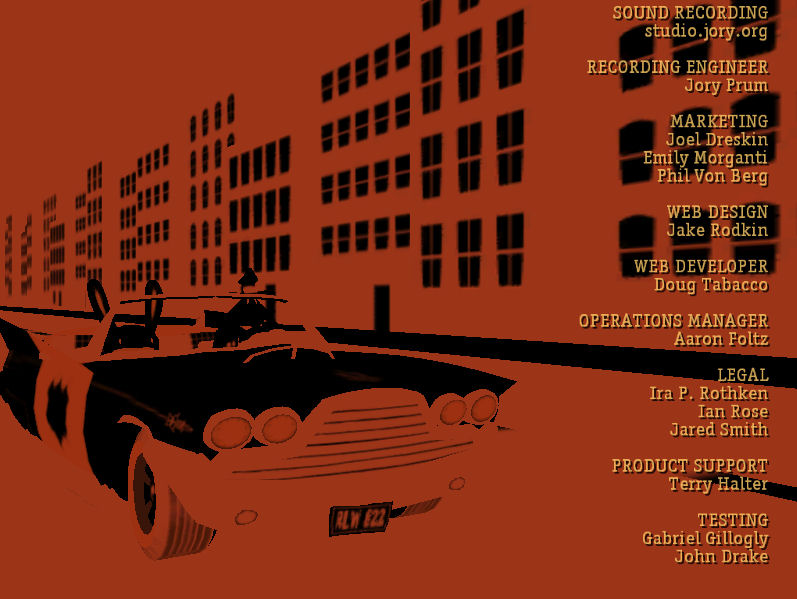
The end credits roll with the Soda Poppers' TV theme song playing, and the credits end with dedication in memory of Karyn Nelson, 1965-2006.

I have always loved Sam and Max, going back to my first encounter with Steve Purcell's work in comic book form in the late 1980s, and I am very happy these characters have been successful in the adventure game genre.  This first Telltale game is on the easy side, but it's still very, very entertaining, and I look forward to replaying the others as they age into retro-relevance here.

Sunday, November 13, 2011

Cover to Cover: Adventure International Spring 1981 Catalog (pp. 31-32)

Our page-by-page journey through the Spring 1981 Adventure International catalog is nearing its end, but it's not exactly a 32-page catalog, so we won't quite wrap it up today.

Page 31 is a promotion for what has to be the world's longest-running computer magazine -- Computer Shopper, which was founded in 1979 and at the time was essentially a classified-ad publication for individuals to sell and trade.  It has grown with the industry, though it's been impacted by (and has adapted to) the Internet like most other print publications.


Page 32 presents a couple of more adult-oriented entertainment products:


The Amazing Blackjack Machine was not just a game, but a statistical package to allow players to develop and test strategies for beating the house at the one casino game where skill can make a difference, with printable data for detailed post-game analysis.  Strip Dice & Concentration was in the grand tradition of 70's "naughty" party games, wherein players were encouraged to remove clothing and, um, get to know each other better.  The ad copy notes that EXPLICIT SEXUAL LANGUAGE MAY BE OFFENSIVE TO SOME USERS -- but I always say, if you find explicit sexual language offensive, don't use it!  And this TRS-80 game purportedly includes humorous sound effects and graphics -- given the system's 128x48 black-and-white display, I'm glad they didn't try to make the graphics anything but humorous.

Next weekend, I think we'll be able to wrap up this trip down memory lane.  So I'd better start digging through the archives for something else to share!

Saturday, November 12, 2011

Cover to Cover: Adventure International Spring 1981 Catalog (pp. 29-30)

We've been walking through the Spring 1981 Adventure International catalog, a few pages at a time, and the next few pages provide some insight into the structure of the home computing industry at the time.

Page 29 wraps up a two-page commercial interruption from another early software publisher, Acorn Software Products, who bought space to promote their own products to an appropriate audience, in the days when computer magazines had not yet gone mainstream:


There's no room for description of many of the products listed here -- we are briefly told what MUSIC, QUAD and ATERM are, but the language education programs and cryptically-named utilities are left to our imaginations (SBT? NUMB? EDAS?).  Everest Explorer was a simulation game that didn't directly compete with Adventure International's core product line, and Superscript was an enhancement patch for Radio Shack's popular SCRIPSIT word processing package, which I have previously written about in more detail here.

Page 30 is really unusual -- Scott Adams devoted a page of his own catalog to disavowal of an apparent endorsement in another company's magazine advertisement.  Apparently a disk drive vendor named Level IV Computing had changed hands since doing business with Adventure International once upon a time, and Mr. Adams was not pleased with the company's continued use of his name under its new management.  The industry was young, and everything was novel at the time; even advertising etiquette was sometimes a little off-the-cuff if not intentionally shady.


Tomorrow, we'll look at a few more pages -- I hope this series provides memories for some, and history for others.