
New downloadable games during the past week for a variety of platforms...
WiiWare -- One new title and two free demos this week. Spot the Differences! is a casual game in which one tries to... yes. There's also a demo version of last year's LIT, an interesting action/puzzle game centered around light and shadow, and a demo of the more recent territory-claiming game Urbanix.
Wii Virtual Console --An unusual and unexpected title this week, Natsume's S.C.A.T. for the NES, an action title similar to Capcom's Forgotten Worlds with two-player co-op featuring heroes named Arnold and Sigourney.
DSiWare -- Four titles up this week. G.G. Series Dark Spirits is a side-scrolling shoot-'em-up with a formation-based fleet mechanic. Boom Boom Squaries is a chain-reaction puzzler. 505 Tangram is a collection of five hundred and five Tangram shape-assembly puzzles. Shawn Johnson Gymnastics is an athletic simulation with career features and a variety of gymnastics events, featuring the licensed participation of the young Olympic gymnast Shawn Johnson.
XBox Live Arcade -- One new title this week, Capcom's Bionic Commando Rearmed 2. Unfortunately, critical reception has not been kind to this sequel.
Game Room -- Even the guy who stands out in the arcade's back alley selling weed is starting to notice the lack of activity around here.
PS3 on PSN -- Two titles this week: Capcom's Bionic Commando Rearmed 2 (see above), and Atari's The Undergarden, an atmospheric puzzle game released last November on XBLA.
PSOne Classics -- Capcom keeps the PSX Mega Man goodness coming, with the Japanese title Rockman 2: Dr. Wily no Nazo.
Monday, February 7, 2011


Sunday, February 6, 2011
Mindlink With Your Atari!
Sometimes good old print media still rules when it comes to research. This full-page image doesn't seem to be posted anywhere else on the web, so I'm sharing it here. It's from a brink-of-the-crash Atari sales catalog in videogame journalist Chris Bieniek's archives, a tiny image of which he shared in the final issue of Ultimate Gamer magazine back in 1996 (hence the poor scan quality, for which I apologize):

If you haven't heard of this futuristic gaming controller, the hype at the time implied that one could put on the Mindlink headband, sit back, and play Atari games hands-free using only the power of one's mind. This was not actually the case.
There are a few interesting details that can be gleaned from this sales sheet -- the controller was sold in one package for the Atari 2600 and 7800 (Atari's newest console, which went unreleased at the time, along with the Mindlink), and a separate one for the Atari home computers. It was notably NOT compatible with the Atari 5200, except via the 2600 VCS adapter, and was to be shipped to retailers in case packs of 4.
It's also interesting that it was not meant as a simple replacement for the standard Atari joystick -- the description mentions that it "relies upon special software," also never released, which would have severely limited its appeal if it had come to market.
The device has surfaced as a museum piece at retro game conventions over the years, revealing that the Mindlink was not actually capable of reading brain waves (remember, this was the 1980s). In fact, the cumbersome Mindlink headband picks up on electrical impulses generated by the muscles in the player's forehead. So it was not simply a matter of encouraging the player to "concentrate and relax" -- a bit of a contradiction anyway. Playing games with the Mindlink required considerable localized physical movement.
But if Atari had hyped it as the Browlink, it wouldn't have been nearly as interesting.

If you haven't heard of this futuristic gaming controller, the hype at the time implied that one could put on the Mindlink headband, sit back, and play Atari games hands-free using only the power of one's mind. This was not actually the case.
There are a few interesting details that can be gleaned from this sales sheet -- the controller was sold in one package for the Atari 2600 and 7800 (Atari's newest console, which went unreleased at the time, along with the Mindlink), and a separate one for the Atari home computers. It was notably NOT compatible with the Atari 5200, except via the 2600 VCS adapter, and was to be shipped to retailers in case packs of 4.
It's also interesting that it was not meant as a simple replacement for the standard Atari joystick -- the description mentions that it "relies upon special software," also never released, which would have severely limited its appeal if it had come to market.
The device has surfaced as a museum piece at retro game conventions over the years, revealing that the Mindlink was not actually capable of reading brain waves (remember, this was the 1980s). In fact, the cumbersome Mindlink headband picks up on electrical impulses generated by the muscles in the player's forehead. So it was not simply a matter of encouraging the player to "concentrate and relax" -- a bit of a contradiction anyway. Playing games with the Mindlink required considerable localized physical movement.
But if Atari had hyped it as the Browlink, it wouldn't have been nearly as interesting.
Saturday, February 5, 2011
Strategy Wargaming: The Good (?) Old Days
Sometimes I miss the old days of pencil-and-paper gaming, and remember Sunday afternoons clustered around the dining room table with dice and character sheets and spinners and graph paper, when we didn't have computers to keep track of all the details.
Then I run across something like this and remember why everything changed so quickly and definitively -- and why I played Dungeons & Dragons, but never really got into strategy wargaming before computer versions came along. Nothing dispels that warm, nostalgic glow like this page from venerable strategy game publisher Avalon Hill's replacement parts catalog, circa 1980:

Tiny cardboard chits and markers inevitably got lost or misplaced in the process of setting up and tearing down a game session, and the additional time (and other people) required made scheduling a challenge. It's so much easier to boot up a game, grab the mouse, and pick up where the game last left off, engaging handy CPU or online opponents.
Like TSR, Avalon Hill was eventually acquired by Wizards of the Coast eventually... and one of their big products these days is Axis & Allies... online.
Then I run across something like this and remember why everything changed so quickly and definitively -- and why I played Dungeons & Dragons, but never really got into strategy wargaming before computer versions came along. Nothing dispels that warm, nostalgic glow like this page from venerable strategy game publisher Avalon Hill's replacement parts catalog, circa 1980:

Tiny cardboard chits and markers inevitably got lost or misplaced in the process of setting up and tearing down a game session, and the additional time (and other people) required made scheduling a challenge. It's so much easier to boot up a game, grab the mouse, and pick up where the game last left off, engaging handy CPU or online opponents.
Like TSR, Avalon Hill was eventually acquired by Wizards of the Coast eventually... and one of their big products these days is Axis & Allies... online.
Friday, February 4, 2011
East vs. West: Andre Panza / The Kick Boxing
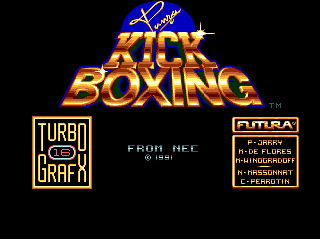
This is a very odd international release, format-wise. In 1991, French developer Loriciel/Futura produced Andre Panza Kick Boxing for the TurboGrafx-16, released in the US by NEC on the HuCard cartridge format. There were also versions from other publishers for the PC, Mega Drive/Genesis, NES and SNES, released in some cases as Best of the Best Championship Karate, without Mr. Panza's licensed image.
Andre Panza was not exactly a household name, even at the time, and his signature is featured somewhat less prominently on the title screen than his handlers might have hoped:
A version was also released by Micro World in Japan. But here's where this release deviates from the norm -- it wasn't a straight port of the Western HuCard, but was expanded a bit for the PC Engine Super CD-ROM format. As even fewer people in Japan had any idea who Andre Panza might be, he was replaced with a definite article -- the game was renamed The Kick Boxing, with a completely redone title screen:

This is one of those rare cases where I like the American box art better than the Japanese version -- the musculature is grotesquely exaggerated, but it's more colorful, and apparently features Andre Panza fighting himself in a battle of the hairstyles:

I suspect that the Japanese CD-ROM version was produced mostly because it was significantly cheaper to stamp out a disc than to produce a HuCard, given the game's presumably limited market. But the developer had to justify the expanded disc format somehow, so we are treated to a newly-added flick-frame "3-D" opening, and a dramatic flame-filled title screen with stirring Redbook audio music, before we get down to exactly the same gameplay.

The blonde, Schwarzenegger-esque boxer, with his eyes so heavily shadowed they appear to be gouged out, is even given a few lines of dialogue in accented English. He says, and I quote so as not to dilute the power of his stirring speech: "Hey, you! C'mon! Let's fight!"

Here's another oddity -- even though Andre Panza is no longer mentioned on The Kick Boxing's title screen or anywhere on the packaging, he still shows up among the other (fictional) boxers as the top-ranked opponent in-game, filling the Mike Tyson role as the ultimate champion to beat. Whether the license actually covered this Eastern appearance remains a mystery.

A tip-off here about this title's technical approach is that once the introductory pyrotechnics are past, the game apparently loads completely into memory and runs thereafter as a cartridge title. I draw this conclusion because a soft reset (SELECT + RUN on the PC Engine joypad) just returns us to the title screen, instead of going all the way back to the CD boot-up display. Once the game is running, the disc is used exclusively for high-quality background music, heard on the title screen and the victory screen. The game is otherwise silent except for the digitized punches, grunts, and referee calls, which sound quite a bit better here due to higher sample rates; there's also a new crowd noise effect, heard as each round begins.
The gameplay and nicely-animated rotoscoped graphics are identical in both versions. There's a training mode that can be used to beef up the player's boxer -- rapid button-pressing segments help build up Resist and Strength numbers, while hitting the bumpers quickly with high, straight and low kicks builds up Reflex stats:

The competitive kickboxing matches themselves are fun and challenging -- it takes stamina and a little bit of strategy to compete against the CPU opponent (two-player competition is also supported.) Positioning is forgiving, timing not so much, and it feels good to finally take an opponent down for the count:

If we win, we work our way up the rankings, with a bigger purse for the next fight:

And that's about it. Beyond the noteworthy technical and format differences between the US and Japanese versions of the game, Andre Panza Kick Boxing and The Kick Boxing are just a couple of halfway decent kick-boxing games. But there haven't been many "realistic" fighting games released over the years, and these polished little titles are worth looking at, if the genre appeals.
How is it I own both versions? Oh, right, this game is not in great demand, therefore it's relatively inexpensive. You might be able to buy a copy here or below:

Andre Panza was not exactly a household name, even at the time, and his signature is featured somewhat less prominently on the title screen than his handlers might have hoped:
A version was also released by Micro World in Japan. But here's where this release deviates from the norm -- it wasn't a straight port of the Western HuCard, but was expanded a bit for the PC Engine Super CD-ROM format. As even fewer people in Japan had any idea who Andre Panza might be, he was replaced with a definite article -- the game was renamed The Kick Boxing, with a completely redone title screen:
This is one of those rare cases where I like the American box art better than the Japanese version -- the musculature is grotesquely exaggerated, but it's more colorful, and apparently features Andre Panza fighting himself in a battle of the hairstyles:

I suspect that the Japanese CD-ROM version was produced mostly because it was significantly cheaper to stamp out a disc than to produce a HuCard, given the game's presumably limited market. But the developer had to justify the expanded disc format somehow, so we are treated to a newly-added flick-frame "3-D" opening, and a dramatic flame-filled title screen with stirring Redbook audio music, before we get down to exactly the same gameplay.
The blonde, Schwarzenegger-esque boxer, with his eyes so heavily shadowed they appear to be gouged out, is even given a few lines of dialogue in accented English. He says, and I quote so as not to dilute the power of his stirring speech: "Hey, you! C'mon! Let's fight!"
Here's another oddity -- even though Andre Panza is no longer mentioned on The Kick Boxing's title screen or anywhere on the packaging, he still shows up among the other (fictional) boxers as the top-ranked opponent in-game, filling the Mike Tyson role as the ultimate champion to beat. Whether the license actually covered this Eastern appearance remains a mystery.
A tip-off here about this title's technical approach is that once the introductory pyrotechnics are past, the game apparently loads completely into memory and runs thereafter as a cartridge title. I draw this conclusion because a soft reset (SELECT + RUN on the PC Engine joypad) just returns us to the title screen, instead of going all the way back to the CD boot-up display. Once the game is running, the disc is used exclusively for high-quality background music, heard on the title screen and the victory screen. The game is otherwise silent except for the digitized punches, grunts, and referee calls, which sound quite a bit better here due to higher sample rates; there's also a new crowd noise effect, heard as each round begins.
The gameplay and nicely-animated rotoscoped graphics are identical in both versions. There's a training mode that can be used to beef up the player's boxer -- rapid button-pressing segments help build up Resist and Strength numbers, while hitting the bumpers quickly with high, straight and low kicks builds up Reflex stats:
The competitive kickboxing matches themselves are fun and challenging -- it takes stamina and a little bit of strategy to compete against the CPU opponent (two-player competition is also supported.) Positioning is forgiving, timing not so much, and it feels good to finally take an opponent down for the count:
If we win, we work our way up the rankings, with a bigger purse for the next fight:
And that's about it. Beyond the noteworthy technical and format differences between the US and Japanese versions of the game, Andre Panza Kick Boxing and The Kick Boxing are just a couple of halfway decent kick-boxing games. But there haven't been many "realistic" fighting games released over the years, and these polished little titles are worth looking at, if the genre appeals.
How is it I own both versions? Oh, right, this game is not in great demand, therefore it's relatively inexpensive. You might be able to buy a copy here or below:
Thursday, February 3, 2011
At Random: Anticipation (NES, 1988)
Okay, this time I'm cheating slightly. My first random pick for this entry turned out to be World Cup, and since I just played an NES soccer game last time, I gave myself a do-over. On the retry, I came up with an early console title developed by Rare, from 1988 when the company was still known as Rare Coin-It. The game is Anticipation, published by Nintendo, and advertised on the box as Nintendo's first video board game.
I actually bought a copy of this game back when it was new, for a change of pace, and my college buddies and I had several evenings of fun with it before it became repetitive. I was a bit surprised to see that the whole game only takes up 64K of ROM space -- one megabit in 8-bit era terminology, fairly small in comparison to most NES games. But there's not really a lot of content here to eat up space; the game contains a few jazzy tunes, some simple graphics, and a whole bunch of dot-to-dot drawings.
The game plays like a computer-assisted version of Pictionary crossed with the tokens from Monopoly and the board from Trivial Pursuit. Up to four competitors (any combination of human and computer players) strive to maneuver around the board, collecting colored tokens by correctly guessing what the simple images drawn onscreen by an animated pencil are supposed to represent. There's a sliding difficulty scale, which affects the speed of the timer and how many clues are provided. As the difficulty increases, onscreen category names, blanks indicating the number of letters in the expected word or phrase, and some of the dots visibly outlining the image vanish.
At lower skill levels, the images are simple and not difficult to guess, although some trial and error still comes into play when entering the expected text:
Later levels mix it up with word play and visual puzzles, like this one, answered by one of the computer opponents long before I had any clue what the image was meant to represent -- I suspect it was cheating by looking at the code:
When a player has collected a complete set of four colored tokens, he or she gets promoted to the next level of the board, and the first player to clear all three levels is declared the winner. (This rainbow-colored beam-up special effect is nicely executed, and still-frame screenshots do not do it justice.)
The drawing data is clearly very space-efficient -- it's just an ordered set of vectors for outlining each image, so the 64K cartridge holds quite a few pictures -- but the results are often a little too schematic for easy recognition. A few of the puzzles completely stumped me -- I have no idea what this shape is supposed to be, and the computer players failed to chime in with the solution, but my failures did establish that it's not a GIRL or a WOMAN:
At any rate, despite the occasional misstep, I handily beat my computer opponents and entered the winner's circle, to minimal fanfare. The trophy appears to be built from the carbonite-encased corpses of all my opponents (and myself, actually, so we can conclude this is only a rather morbid trophy design):
So... yay!
That's about all there is to Anticipation. I don't think it was a huge hit at the time, and I don't recall that Nintendo ever released a second video board game for the NES, although the Mario Party series that came along a few hardware generations later successfully revived the idea. Anticipation was an interesting effort to do something different, more casual and family-oriented, with the NES hardware, and I think it succeeds.
And would you believe I tried to call this a RADIO? In 1988?
If you want a copy of Anticipation for your next retro game party, at least it shouldn't cost you much:
I actually bought a copy of this game back when it was new, for a change of pace, and my college buddies and I had several evenings of fun with it before it became repetitive. I was a bit surprised to see that the whole game only takes up 64K of ROM space -- one megabit in 8-bit era terminology, fairly small in comparison to most NES games. But there's not really a lot of content here to eat up space; the game contains a few jazzy tunes, some simple graphics, and a whole bunch of dot-to-dot drawings.
 |
| Mr. Bear really knows how to throw a party. |
 |
| Player 1 hopes the pink pumps don't make him look Easy. |
At lower skill levels, the images are simple and not difficult to guess, although some trial and error still comes into play when entering the expected text:
 |
| Let's see... should I start with H for Hot Dog, S for Sausage, or P for... Pepperoni? |
Later levels mix it up with word play and visual puzzles, like this one, answered by one of the computer opponents long before I had any clue what the image was meant to represent -- I suspect it was cheating by looking at the code:
 |
| GET... on the MOVE. See? Not MOM, thank goodness. |
When a player has collected a complete set of four colored tokens, he or she gets promoted to the next level of the board, and the first player to clear all three levels is declared the winner. (This rainbow-colored beam-up special effect is nicely executed, and still-frame screenshots do not do it justice.)
 |
| Beam me up, Gucci! |
The drawing data is clearly very space-efficient -- it's just an ordered set of vectors for outlining each image, so the 64K cartridge holds quite a few pictures -- but the results are often a little too schematic for easy recognition. A few of the puzzles completely stumped me -- I have no idea what this shape is supposed to be, and the computer players failed to chime in with the solution, but my failures did establish that it's not a GIRL or a WOMAN:
 |
| A wig? Marlo Thomas? The girl from the last human family in Robotron:2084? |
 |
| Pumps up the volume! Booyah! |
So... yay!
That's about all there is to Anticipation. I don't think it was a huge hit at the time, and I don't recall that Nintendo ever released a second video board game for the NES, although the Mario Party series that came along a few hardware generations later successfully revived the idea. Anticipation was an interesting effort to do something different, more casual and family-oriented, with the NES hardware, and I think it succeeds.
And would you believe I tried to call this a RADIO? In 1988?
 |
| We're rockin' the 80s with our awesome box of boom! |
If you want a copy of Anticipation for your next retro game party, at least it shouldn't cost you much:
Wednesday, February 2, 2011
Elsewhere: Saturday Supercade 1983 Opening Sequence
A lot of people remember Hanna-Barbera's Pac-Man animated series, which was popular enough to turn around and directly inspire Namco's Pac-Land arcade and home sequel. But there was another arcade-inspired Saturday morning cartoon series aired in the early 1980's -- produced by the Ruby-Spears studio, it was called Saturday Supercade. Here's the 1983 opening sequence, posted on YouTube by Yesterdays92:
Most of these games could provide only the barest outlines of a plot and a cast of characters, so the writers and animators had to take considerable liberties with the licenses to get a watchable series put together. Thus we find Q*Bert transposed to the 1950s with Coily cast as a motorcycle gang heavy, Frogger having adventures beyond getting across the road, Donkey Kong Jr. aping Scrappy-Doo with cries of "Monkey muscle!", and Mario playing the villainous comic foil to Donkey Kong by bringing a net to a monkey fight. At least the adventures of Pitfall Harry (as based on Pitfall II: Lost Caverns) feature niece Rhonda and Quickclaw the cat as seen in the game, though Harry's adventures are far more wide-ranging than seen on the Atari 2600.
Games today often have deep and engaging stories, but aside from the recent Dead Space and Halo animation projects these types of productions seem to have died out. I kind of miss them -- as corny and cheaply produced as they were, I'd love to see, say, Nintendo's Kirby, GTA IV's Niko Bellic and Silent Hill's Pyramid Head having random, formulaic adventures every Saturday morning.
Most of these games could provide only the barest outlines of a plot and a cast of characters, so the writers and animators had to take considerable liberties with the licenses to get a watchable series put together. Thus we find Q*Bert transposed to the 1950s with Coily cast as a motorcycle gang heavy, Frogger having adventures beyond getting across the road, Donkey Kong Jr. aping Scrappy-Doo with cries of "Monkey muscle!", and Mario playing the villainous comic foil to Donkey Kong by bringing a net to a monkey fight. At least the adventures of Pitfall Harry (as based on Pitfall II: Lost Caverns) feature niece Rhonda and Quickclaw the cat as seen in the game, though Harry's adventures are far more wide-ranging than seen on the Atari 2600.
Games today often have deep and engaging stories, but aside from the recent Dead Space and Halo animation projects these types of productions seem to have died out. I kind of miss them -- as corny and cheaply produced as they were, I'd love to see, say, Nintendo's Kirby, GTA IV's Niko Bellic and Silent Hill's Pyramid Head having random, formulaic adventures every Saturday morning.
Tuesday, February 1, 2011
Adventure of the Week: Perseus and Andromeda (1983)
It's been a while since I've tackled one of Brian Howarth's Mysterious Adventures, written in the UK to run on the classic Scott Adams engine. Next up from the series is Mysterious Adventure #9: Perseus and Andromeda. Like many classic text adventures, this one makes use of Greek mythology, though the plot is a basic rescue-the-princess affair. It's dedicated to A.J. Harding and the staff at Molimerx, Ltd., publishers of many of Howarth's games.
The game begins in classic fashion, very similar to Howarth's previous game, The Wizard of Akyrz -- we find ourselves in a marble hall near a throne room. LOOK KING (oddly, not TALK KING) informs us that we are to Slay MEDUSA and rescue ANDROMEDA! So we are clearly playing the title role of Perseus.

I started exploring this one using the Inform port of Howarth's original game, then switched to ScottFree to solve it, and played through one final time on the Commodore 64 to capture some illustrations. This game isn't one of the more difficult Howarth adventures -- the puzzles are straightforward, at least if one is familiar with Greek mythology and recalls Howarth's tendency to use WAITing as a trigger for important events. If it weren't for a bit of parser-induced frustration at one point, I would not have needed to consult the classic CASA walkthrough, written by the solution archive's founder, jgunness.
As always, I urge interested readers to tackle Perseus and Andromeda before continuing here, as for historical documentation's sake there will be...
***** SPOILERS ON A MYTHOLOGICAL SCALE! *****
In the Royal Palace's immediate neighborhood, we find the Temples of Hermes and Athene, a thirsty beggar and a leather sack. We can fill the sack with water and GIVE WATER to the beggar, who gives us a discus in exchange.
The discus can be thrown to knock a Golden Helmet down from a tall statue in a cave, but we must THROW HELMET - At what? - AT STATUE, not AT HELMET. Wearing the helmet makes us invisible, though we still can't KILL KING with impunity; in fact, LOOK KING still elicits the standard your-mission-should-you-choose-to-accept-it response, even though he presumably cannot see our inquiring glance.
PRAYing at the altar on the stone dais in the Temple of Athene yields a highly-reflective shield, which should be handy when we confront Medusa -- the game informs us that I hear the voice of the Goddess ATHENE: TAKE THE SHIELD, IT WILL PROTECT YOU IN MORE WAYS THAN ONE!
I got stuck after this point for a while -- there's a Withered Tree Stump in the neighborhood, but I could not climb, move, or otherwise make use of it; it appears that it is just scenery. Finally I tried to PRAY near the ivory pedestal in the Temple of Hermes a second time -- having collected the shield and helmet and discus by this point, I now saw a pair of Winged Sandals flutter down, without any explicatory commentary from the gods. Perhaps Hermes is simply not as talkative as Athene.
Now if we wear the helmet and the sandals, looking a bit like Hermes himself, we can GO PEDESTAL and WAIT. The sandals begin to flap vigorously, and we find ourselves hovering in the Air! We can now FLY NORTH once or twice, and FLY DOWN to land on additional ivory pedestals -- one on a small, grassy Island, the other in a grassy Plain.
The island presents us with a prickly thornbush -- we can LOOK BUSH to find some dark berries. We can then GIVE BERRIES to a Blind Peasant, who looks hungry! -- but before he can eat them, the Wild Hyena nearby pounces, eats the berries, and dies. This, as it turns out, is exactly what we want to happen, averting well-meaning manslaughter on our part. Some fruit from the nearby grove of tall trees would seem like a better dietary choice, but it's not initially clear how we can obtain it. Throwing the discus at the fruit, or at the trees, doesn't do the same thing it did with the helmet. We can't climb the trees, or intentionally FLY, but if we again WAIT, the sandals start to flap and bring us within reach of the luscious fruit. If we now GIVE FRUIT to the Peasant, we are rewarded with a Gleaming Sword, which also ought to come in handy. It's a good thing these starving, poverty-stricken individuals always have such useful items tucked into their humble rags.
In the grassy plain area, we can obtain a wooden torch and explore a ruined temple with an open roof, containing a silver halter protected by swooping harpies. The classical GRAIAE, the three Stygian witches who share a single eye, also put in an appearance nearby. We can GET EYE to induce the expected wailing and begging from the Graiae -- if we take pity and GIVE EYE back, we are shown a narrow crack in the rock wall; after that, we can LOOK GRAIAE to find the eye again, and repeat, to no new effect. We can't enter the narrow crack while wearing the Winged Sandals, apparently because they flap too much. Once inside, we can make our way to a huge underground cavern, though it isn't initially clear why we would want to.
More immediately useful is a large net found in a small, dark cave -- we need to light a torch in the cooking fire of the Graiae -- and it seems likely we can use this net to cover the hole in the roof of the ruined temple, especially because we can CLIMB TEMPLE to approach the roof. It took me a while to find the right verb here -- we can't DROP or PUT or PLACE or ATTACH or STRETCH it, but we can SPREAD NET to cover the hole, and it foils the harpies' attack.
As with most adventure game light sources, the torch eventually burns out; we can UNLIGHT TORCH to preserve it, but if we play efficiently it will last long enough.
If we WAIT in the cold chamber beyond the crack, the fabled Gorgon MEDUSA appears and we die, turned to stone. To prevent this, we must LOOK SHIELD before we WAIT; now we can see a Reflection of MEDUSA in the shield. If we now try to KILL MEDUSA, the game asks us to Be more specific, and if we're not quick to dispatch her, she strangles us. The gleaming sword obtained on the grassy island is called for here, but we still can't just kill Medusa or STAB her, or USE SWORD, SWING SWORD, or THROW SWORD to do her in. We would do well to remember the story of Perseus, or at least the movie Clash of the Titans, but even with that precedent in mind we can't DECAPITATE MEDUSA or CUT HEAD. But if we BEHEAD MEDUSA or CUT MEDUSA, she is defeated, and her head rolls away to another location.
One annoyance with the illustrated version is that, after we WAIT for Medusa to appear, it's not actually clear that she has done so while the graphics screen is displayed; she is only mentioned in the text description of the room's contents, so her appearance can be missed with the graphics turned on:

In the huge underground cavern nearby, the winged horse PEGASUS materializes, growing from the blood trickling from the Gorgon's severed head down here where it has come to rest (traditional brother Chrysaor is nowhere in sight, and it's still not safe to LOOK HEAD.) If we try to MOUNT PEGASUS, however, we are immediately thrown off, so this seems like a good time to use the silver halter obtained by outwitting the harpies. Again, the parser requires us to work a little bit even though we know what we want to do. We can't APPLY or USE or GIVE or TIE or PUT HALTER successfully, or attempt to use it to TACK or LEAD PEGASUS. I got stuck here for a while, and finally gave in, consulting the walkthrough to discover that we can successfully FIT HALTER, which, arguably, is one (see, it halts... the parser giving us... erm... fits... Sorry.)
We can now RIDE PEGASUS, twice, to find ourselves deposited on a small Island of Rock (despite the name, no bass guitarists appear.) We can travel to the considerably less headbang-inspiring Huge Outcrop of Rock, where we find a Maiden chained to Rock, and encounter the mighty KRAKEN. It would be too simple to let us simply KILL KRAKEN, of course, and if we try to do so he readily tears us to pieces. Neither can we THROW DISCUS at the creature; we can CUT CHAIN before killing the monster, but there's still no chance of escape. What we need to do is bring Medusa's severed head along, then SHOW HEAD to the Kraken, turning the sea beast to stone.
Now, we simply CUT CHAIN -- victory is ours, and so is the princess Andromeda, with Athene's blessing, and none of that nasty classical business about turning her uncle Phineus to stone with the gorgon's head when he complains at the wedding!

I enjoyed playing Perseus and Andromeda -- it's a good old-fashioned text adventure, not unreasonably difficult aside from the critical waiting moments, and it makes appropriate use of its mythological inspiration. I look forward to tackling Howarth's next adventure sometime soon.
The game begins in classic fashion, very similar to Howarth's previous game, The Wizard of Akyrz -- we find ourselves in a marble hall near a throne room. LOOK KING (oddly, not TALK KING) informs us that we are to Slay MEDUSA and rescue ANDROMEDA! So we are clearly playing the title role of Perseus.

I started exploring this one using the Inform port of Howarth's original game, then switched to ScottFree to solve it, and played through one final time on the Commodore 64 to capture some illustrations. This game isn't one of the more difficult Howarth adventures -- the puzzles are straightforward, at least if one is familiar with Greek mythology and recalls Howarth's tendency to use WAITing as a trigger for important events. If it weren't for a bit of parser-induced frustration at one point, I would not have needed to consult the classic CASA walkthrough, written by the solution archive's founder, jgunness.
As always, I urge interested readers to tackle Perseus and Andromeda before continuing here, as for historical documentation's sake there will be...
***** SPOILERS ON A MYTHOLOGICAL SCALE! *****
In the Royal Palace's immediate neighborhood, we find the Temples of Hermes and Athene, a thirsty beggar and a leather sack. We can fill the sack with water and GIVE WATER to the beggar, who gives us a discus in exchange.
The discus can be thrown to knock a Golden Helmet down from a tall statue in a cave, but we must THROW HELMET - At what? - AT STATUE, not AT HELMET. Wearing the helmet makes us invisible, though we still can't KILL KING with impunity; in fact, LOOK KING still elicits the standard your-mission-should-you-choose-to-accept-it response, even though he presumably cannot see our inquiring glance.
PRAYing at the altar on the stone dais in the Temple of Athene yields a highly-reflective shield, which should be handy when we confront Medusa -- the game informs us that I hear the voice of the Goddess ATHENE: TAKE THE SHIELD, IT WILL PROTECT YOU IN MORE WAYS THAN ONE!
I got stuck after this point for a while -- there's a Withered Tree Stump in the neighborhood, but I could not climb, move, or otherwise make use of it; it appears that it is just scenery. Finally I tried to PRAY near the ivory pedestal in the Temple of Hermes a second time -- having collected the shield and helmet and discus by this point, I now saw a pair of Winged Sandals flutter down, without any explicatory commentary from the gods. Perhaps Hermes is simply not as talkative as Athene.
Now if we wear the helmet and the sandals, looking a bit like Hermes himself, we can GO PEDESTAL and WAIT. The sandals begin to flap vigorously, and we find ourselves hovering in the Air! We can now FLY NORTH once or twice, and FLY DOWN to land on additional ivory pedestals -- one on a small, grassy Island, the other in a grassy Plain.
The island presents us with a prickly thornbush -- we can LOOK BUSH to find some dark berries. We can then GIVE BERRIES to a Blind Peasant, who looks hungry! -- but before he can eat them, the Wild Hyena nearby pounces, eats the berries, and dies. This, as it turns out, is exactly what we want to happen, averting well-meaning manslaughter on our part. Some fruit from the nearby grove of tall trees would seem like a better dietary choice, but it's not initially clear how we can obtain it. Throwing the discus at the fruit, or at the trees, doesn't do the same thing it did with the helmet. We can't climb the trees, or intentionally FLY, but if we again WAIT, the sandals start to flap and bring us within reach of the luscious fruit. If we now GIVE FRUIT to the Peasant, we are rewarded with a Gleaming Sword, which also ought to come in handy. It's a good thing these starving, poverty-stricken individuals always have such useful items tucked into their humble rags.
In the grassy plain area, we can obtain a wooden torch and explore a ruined temple with an open roof, containing a silver halter protected by swooping harpies. The classical GRAIAE, the three Stygian witches who share a single eye, also put in an appearance nearby. We can GET EYE to induce the expected wailing and begging from the Graiae -- if we take pity and GIVE EYE back, we are shown a narrow crack in the rock wall; after that, we can LOOK GRAIAE to find the eye again, and repeat, to no new effect. We can't enter the narrow crack while wearing the Winged Sandals, apparently because they flap too much. Once inside, we can make our way to a huge underground cavern, though it isn't initially clear why we would want to.
More immediately useful is a large net found in a small, dark cave -- we need to light a torch in the cooking fire of the Graiae -- and it seems likely we can use this net to cover the hole in the roof of the ruined temple, especially because we can CLIMB TEMPLE to approach the roof. It took me a while to find the right verb here -- we can't DROP or PUT or PLACE or ATTACH or STRETCH it, but we can SPREAD NET to cover the hole, and it foils the harpies' attack.
As with most adventure game light sources, the torch eventually burns out; we can UNLIGHT TORCH to preserve it, but if we play efficiently it will last long enough.
If we WAIT in the cold chamber beyond the crack, the fabled Gorgon MEDUSA appears and we die, turned to stone. To prevent this, we must LOOK SHIELD before we WAIT; now we can see a Reflection of MEDUSA in the shield. If we now try to KILL MEDUSA, the game asks us to Be more specific, and if we're not quick to dispatch her, she strangles us. The gleaming sword obtained on the grassy island is called for here, but we still can't just kill Medusa or STAB her, or USE SWORD, SWING SWORD, or THROW SWORD to do her in. We would do well to remember the story of Perseus, or at least the movie Clash of the Titans, but even with that precedent in mind we can't DECAPITATE MEDUSA or CUT HEAD. But if we BEHEAD MEDUSA or CUT MEDUSA, she is defeated, and her head rolls away to another location.
One annoyance with the illustrated version is that, after we WAIT for Medusa to appear, it's not actually clear that she has done so while the graphics screen is displayed; she is only mentioned in the text description of the room's contents, so her appearance can be missed with the graphics turned on:

In the huge underground cavern nearby, the winged horse PEGASUS materializes, growing from the blood trickling from the Gorgon's severed head down here where it has come to rest (traditional brother Chrysaor is nowhere in sight, and it's still not safe to LOOK HEAD.) If we try to MOUNT PEGASUS, however, we are immediately thrown off, so this seems like a good time to use the silver halter obtained by outwitting the harpies. Again, the parser requires us to work a little bit even though we know what we want to do. We can't APPLY or USE or GIVE or TIE or PUT HALTER successfully, or attempt to use it to TACK or LEAD PEGASUS. I got stuck here for a while, and finally gave in, consulting the walkthrough to discover that we can successfully FIT HALTER, which, arguably, is one (see, it halts... the parser giving us... erm... fits... Sorry.)
We can now RIDE PEGASUS, twice, to find ourselves deposited on a small Island of Rock (despite the name, no bass guitarists appear.) We can travel to the considerably less headbang-inspiring Huge Outcrop of Rock, where we find a Maiden chained to Rock, and encounter the mighty KRAKEN. It would be too simple to let us simply KILL KRAKEN, of course, and if we try to do so he readily tears us to pieces. Neither can we THROW DISCUS at the creature; we can CUT CHAIN before killing the monster, but there's still no chance of escape. What we need to do is bring Medusa's severed head along, then SHOW HEAD to the Kraken, turning the sea beast to stone.
Now, we simply CUT CHAIN -- victory is ours, and so is the princess Andromeda, with Athene's blessing, and none of that nasty classical business about turning her uncle Phineus to stone with the gorgon's head when he complains at the wedding!

I enjoyed playing Perseus and Andromeda -- it's a good old-fashioned text adventure, not unreasonably difficult aside from the critical waiting moments, and it makes appropriate use of its mythological inspiration. I look forward to tackling Howarth's next adventure sometime soon.
Subscribe to:
Posts (Atom)


 Posts
Posts

