
It's Monday, and time to take a look at recent downloadable games for the various console platforms. The big news this week is the arrival of a new distribution channel for retro games, in the form of Microsoft's Game Room.
WiiWare -- Two new titles this week. WarioWare D.I.Y. Showcase allows Wii owners to download and play frantic microgames created on the DS WarioWare D.I.Y. platform. Diner Dash brings the popular PC title to the Wii.
Wii Virtual Console -- A rarity this week -- Ogre Battle 64: Person of Lordly Calibre brings the classic Nintendo 64 strategy game to the VC. I really enjoyed the SNES Ogre Battle, so this one is tempting.
DSiWare -- Five new titles this week, three of which are traditional games. Disney Fireworks is a virtual toy with game elements, allowing the player to generate colorful fireworks displays with the stylus and hit targets for points. Save the Turtles is an action-puzzler challenging players to help baby turtles hatch and make their way to the sea. Two musician tools, Nintendo DSi Metronome and Nintendo DSi Instrument Tuner make the DSi a useful companion for practice and performance. Super Yum Yum Puzzle Adventures stars Leon the chameleon.
XBox Live Arcade -- No new games for the general XBLA platform last week, because the new Game Room channel became available (on XBLA and also for Windows PC). As weekly retro game releases are expected, I will be covering this as a unique distribution channel, with a review coming up on this week's video podcast.
XBLA Game Room -- Debuted on February 24th, 2010, with a solid mix of thirty-one games for a number of platforms. Specifically, for the Atari 2600: Adventure, Combat, Millipede, Outlaw, Realsports Tennis, Star Raiders and Yar’s Revenge. For the Intellivision: Armor Battle, Astrosmash, Football, Sea Battle, Mountain Madness - Super Pro Skiing, Space Armada, Space Hawk, and Sub Hunt. Atari coin-op arcade games: Asteroids Deluxe, Centipede, Crystal Castles, Gravitar, Lunar Lander, Red Baron, and Tempest. Konami arcade games: Battlantis, Finalizer, Jungler, Road Fighter, Scramble, Shao-lin's Road, Super Cobra and Tutankham. So far I've purchased Tutankham for unlimited play. So far.
PS3 on PSN -- Three new titles arrived last week after a quiet period. Blue Toad Murder Files is an episodic series of mystery/puzzle games. Hamsterball is an action game patterned after the classic Marble Madness. Wakeboarding HD is a retro-style water-based stunts-and-hazards game.
Monday, March 29, 2010


Sunday, March 28, 2010
Return of the Video Game Glove
I always thought that the spandex video game glove was an early-80's affectation, surviving only during those heady, pioneering days when the term "video athletics" could be uttered with a straight face.
But then I ran across this ad from the early 90's promoting exactly the same thing -- this time with licensed Sega Genesis and NEC TurboGrafx-16 logos (Nintendo apparently steered clear of this one, leaving a third design with a generic "HOT Gloves" logo):

These manufacturers never really got it. Few serious gamers would consider the hot look (in neon pink, orange, green or yellow) a realistic prerequisite for being one of the best players around. Especially as the arcade scene was already ceding dominance to home consoles, and the only person likely to see you in your hot gloves was your snarky little sister.
Still, the ad does its best to make the prospect seem attractive, citing the gloves' appearance on the mysterious Video Power TV show and shouting It's HOT! It's NEW! in colorful starbursts.
I have no doubt the gloves were hot -- they are described as Padded for Super Video Game Play, which likely made them feel like sweaty neon oven mitts after fifteen minutes or so.
But calling them NEW is radically overstating the case.
But then I ran across this ad from the early 90's promoting exactly the same thing -- this time with licensed Sega Genesis and NEC TurboGrafx-16 logos (Nintendo apparently steered clear of this one, leaving a third design with a generic "HOT Gloves" logo):

These manufacturers never really got it. Few serious gamers would consider the hot look (in neon pink, orange, green or yellow) a realistic prerequisite for being one of the best players around. Especially as the arcade scene was already ceding dominance to home consoles, and the only person likely to see you in your hot gloves was your snarky little sister.
Still, the ad does its best to make the prospect seem attractive, citing the gloves' appearance on the mysterious Video Power TV show and shouting It's HOT! It's NEW! in colorful starbursts.
I have no doubt the gloves were hot -- they are described as Padded for Super Video Game Play, which likely made them feel like sweaty neon oven mitts after fifteen minutes or so.
But calling them NEW is radically overstating the case.
Saturday, March 27, 2010
Spectravideo Does The Job Half-Right
The Colecovision videogame console was a pretty capable piece of hardware in its day, but its standard controller was... shall we say... unwieldy. It featured a stubby joystick that made it hard to register the intended direction, side-mounted fire buttons that wore out one's squeezing muscles fairly quickly, and a keypad that took up most of the unit's surface area. So it was only a matter of time before aftermarket controllers arrived to address the situation.
Unfortunately, Spectravideo's Quickshot III leaves the job half-finished. It starts out well enough at the top, with a proper joystick and two easily accessible fire buttons. But then it all goes wrong toward the bottom:

Note the suction cups -- the ad claims the Quickshot III can be used two-handed, but clearly this is meant to be a surface-mounted controller, throwing in the towel as far as handheld comfort goes.
Note also that the design requires the player to reach around the joystick to hit any of the keypad buttons -- which are, of course, obscured by the player's joystick-gripping hand during play. At least the ad only mentions use of the keypad to select difficulty level and number of players, implicitly acknowledging its complete unsuitability for any game that requires keypad access during play.
It's also worth noting that the ad mentions that this controller will work with Spectravideo's Coleco Game Adapter, intended to allow Colecovision cartridges to run on the company's MSX-based home computer. The Spectravideo computer was released but failed to make a noticeable dent in the US market, and as far as I can determine its Colecovision adapter never actually came out.
Quick shot, perhaps. A miss, for sure.
Unfortunately, Spectravideo's Quickshot III leaves the job half-finished. It starts out well enough at the top, with a proper joystick and two easily accessible fire buttons. But then it all goes wrong toward the bottom:

Note the suction cups -- the ad claims the Quickshot III can be used two-handed, but clearly this is meant to be a surface-mounted controller, throwing in the towel as far as handheld comfort goes.
Note also that the design requires the player to reach around the joystick to hit any of the keypad buttons -- which are, of course, obscured by the player's joystick-gripping hand during play. At least the ad only mentions use of the keypad to select difficulty level and number of players, implicitly acknowledging its complete unsuitability for any game that requires keypad access during play.
It's also worth noting that the ad mentions that this controller will work with Spectravideo's Coleco Game Adapter, intended to allow Colecovision cartridges to run on the company's MSX-based home computer. The Spectravideo computer was released but failed to make a noticeable dent in the US market, and as far as I can determine its Colecovision adapter never actually came out.
Quick shot, perhaps. A miss, for sure.
Friday, March 26, 2010
East vs. West: TV Sports Football
In the late 1980's, a company called Cinemaware was pioneering new technology on the Commodore Amiga, producing a series of games that were generally long on audiovisuals and short on gameplay. As NEC was preparing the TurboGrafx-16 for its North American debut, Cinemaware was convinced to bring several of its properties to the platform (and to its enticing CD-ROM peripheral, which hosted a unique version of Cinemaware's biggest hit, It Came from the Desert.)
What I hadn't known until a few years ago was that TV Sports Football also made its way across the ocean to Japan for the PC Engine, courtesy of Victor Musical Industries. Normally this would be perfect material for an interesting East vs. West comparison, but in this case the Japanese localization had very, very little impact on the game as a whole.
The packaging, at least, is different -- the Japanese edition uses the original artwork from the American computer release, with the English word FOOTBALL replaced with Japanese text, while the American version sports new, more awkwardly "dynamic" cover art that gives the impression it is not bringing the game into your home, so much as the actual players, and unintentionally at that:

(Yes, the above image is a scan of games from my personal collection. I'm not a major collector, but I can't pass up an inexpensive game complete in the box. Or, uh... two.)
Once the shrinkwrap is off, the title screen is almost exactly the same, with the NEC logo removed but no Victor logo added to the Japanese version:

The player start/join screen is in English, also exactly the same (note the support for up to 5 players, a nice improvement over the computer original):

It's only when we get to the generic team names that a difference arises, and it's not huge -- the Sharks and the Tidal Waves are still the Sharks and the Tidal Waves, as the American game did not sport an NFL license either (though the Amiga and PC original did):

And the game plays exactly the same way, with all the sampled calls and grunts remaining in the original English. I don't know what I was expecting, really -- certainly not sake and squid at the concession stands, nor big-eyed cheerleaders armed with magical firepower -- but it's kind of disappointing to find out that it's still just good old American football:

It is interesting to note some differences between the PC Engine/TG-16 version and the Amiga/PC edition; the 3 MB cartridge is eaten up mostly by the audio samples, so the frequent "TV presentation" images of the crowd and the cheerleaders are missing in the console version. All we have left to break up the gameplay is a "Hi, mom!" shot of a grinning post-touchdown player:

There's also an announcer, redrawn for the console version -- he doesn't call any play-by-play, but occasionally sums up recent events in localized text:

And that's about all there is to it. I can't imagine this game was a big seller in the US, let alone in Japan; the presentation is nicely done, but it's an entirely generic title and could not have provided much competition for EA's early Madden Football games on the Sega Genesis. Watching the Buzzards take on the Hounds was never the same as watching the Steelers vs. the Packers, or even the Lions.
If you simply must have every release of TV Sports Football ever produced, you may be able to find it at this affiliate link. It's not an expensive game in any territory - nothing, it seems, is less collectible than an aging sports game.
What I hadn't known until a few years ago was that TV Sports Football also made its way across the ocean to Japan for the PC Engine, courtesy of Victor Musical Industries. Normally this would be perfect material for an interesting East vs. West comparison, but in this case the Japanese localization had very, very little impact on the game as a whole.
The packaging, at least, is different -- the Japanese edition uses the original artwork from the American computer release, with the English word FOOTBALL replaced with Japanese text, while the American version sports new, more awkwardly "dynamic" cover art that gives the impression it is not bringing the game into your home, so much as the actual players, and unintentionally at that:

(Yes, the above image is a scan of games from my personal collection. I'm not a major collector, but I can't pass up an inexpensive game complete in the box. Or, uh... two.)
Once the shrinkwrap is off, the title screen is almost exactly the same, with the NEC logo removed but no Victor logo added to the Japanese version:

The player start/join screen is in English, also exactly the same (note the support for up to 5 players, a nice improvement over the computer original):

It's only when we get to the generic team names that a difference arises, and it's not huge -- the Sharks and the Tidal Waves are still the Sharks and the Tidal Waves, as the American game did not sport an NFL license either (though the Amiga and PC original did):

And the game plays exactly the same way, with all the sampled calls and grunts remaining in the original English. I don't know what I was expecting, really -- certainly not sake and squid at the concession stands, nor big-eyed cheerleaders armed with magical firepower -- but it's kind of disappointing to find out that it's still just good old American football:

It is interesting to note some differences between the PC Engine/TG-16 version and the Amiga/PC edition; the 3 MB cartridge is eaten up mostly by the audio samples, so the frequent "TV presentation" images of the crowd and the cheerleaders are missing in the console version. All we have left to break up the gameplay is a "Hi, mom!" shot of a grinning post-touchdown player:

There's also an announcer, redrawn for the console version -- he doesn't call any play-by-play, but occasionally sums up recent events in localized text:

And that's about all there is to it. I can't imagine this game was a big seller in the US, let alone in Japan; the presentation is nicely done, but it's an entirely generic title and could not have provided much competition for EA's early Madden Football games on the Sega Genesis. Watching the Buzzards take on the Hounds was never the same as watching the Steelers vs. the Packers, or even the Lions.
If you simply must have every release of TV Sports Football ever produced, you may be able to find it at this affiliate link. It's not an expensive game in any territory - nothing, it seems, is less collectible than an aging sports game.
Thursday, March 25, 2010
Oddities: Cabbage Patch Kids - Adventures In The Park
Having had some success with Smurf: Rescue in Gargamel's Castle, Coleco decided to base another children's videogame on a property it already had under license - the Cabbage Patch Kids. The game was developed by Konami, and also came out for the Japanese MSX computers; an Atari 2600 version exists in prototype form but was never released. There were at least two different Colecovision editions, with slightly different titles; this screenshot doesn't quite match the official box title, Cabbage Patch Kids: Adventures in the Park:

Younger readers may not be aware of just how big the Cabbage Patch Kids were in the early 1980's -- new manufacturing techniques allowed each chubby little doll's coloration, outfit and features to be randomized and fairly unique, but shipped quantities were insufficient to meet early demand, and stories about physical altercations between shoppers in search of the elusive dolls were common at the time. Coleco survived the death of the Colecovision during the mid-80's industry crash largely on the back of the Cabbage Patch Kids, but that craze also came to an end -- a more definitive one, in retrospect -- and Coleco went under shortly thereafter.
Like Smurf: Rescue, Cabbage Patch Kids: Adventures in the Park is clearly ancestral to the Mario-era platformer. The screens do not scroll - instead, the action flips from one screen to the next - but the hazards are many and varied, and the game is more difficult than one might expect. The player's goal is to guide little Anna Lee from one Babyland General hospital location to the next, heading from left to right -- the gameplay borrows heavily from Activision's classic Pitfall!, though the graphics are significantly more detailed:

Some screens contain no hazards at all, at least on the lower difficulty levels, but some of the challenges are trickier than they appear, especially because the rules of platforming were still in their formative stages. One annoying convention is that Anna Lee can't survive a "fall" taken when she jumps over an obstacle she is meant to jump onto, even though she isn't landing any lower than she started:

Other screens are challenging for other reasons, not always good ones. This sequence isn't really difficult to survive, but jumping from one Donkey Kong-esque spring to the next takes careful timing -- it's easy to get stuck in place, bouncing up and down repeatedly while the clock ticks away:

At every 10th screen, Anna Lee reaches Babyland General and celebrates the end of the stage:

But apparently her princess is in another hospital -- there are at least 70 stages, according to online reports, and I'm not sure anyone's documented a complete runthrough of the game. So without so much as an intermission, Anna Lee is off to the next stage. A major improvement over Smurf: Rescue is that most of the early screens actually introduce new hazards, though the background graphics are heavily recycled:

This was a fairly late entry in the Colecovision library, and it's a smooth, colorful game with simple but pleasant background music. A notable visual improvement is the adoption of arcade-style screen fonts, which Coleco often featured in its early artists' renderings of upcoming games, only to rely on the console's standard thin-line font (as seen on the title screen) in the actual releases.
Cabbage Patch Kids: Adventures in the Park is an entertaining little platformer, and the Colecovision technology was within a stone's throw of the NES in many ways; playing this game, it's easy to see Super Mario Brothers as a logical next step, just a few years later.

Younger readers may not be aware of just how big the Cabbage Patch Kids were in the early 1980's -- new manufacturing techniques allowed each chubby little doll's coloration, outfit and features to be randomized and fairly unique, but shipped quantities were insufficient to meet early demand, and stories about physical altercations between shoppers in search of the elusive dolls were common at the time. Coleco survived the death of the Colecovision during the mid-80's industry crash largely on the back of the Cabbage Patch Kids, but that craze also came to an end -- a more definitive one, in retrospect -- and Coleco went under shortly thereafter.
Like Smurf: Rescue, Cabbage Patch Kids: Adventures in the Park is clearly ancestral to the Mario-era platformer. The screens do not scroll - instead, the action flips from one screen to the next - but the hazards are many and varied, and the game is more difficult than one might expect. The player's goal is to guide little Anna Lee from one Babyland General hospital location to the next, heading from left to right -- the gameplay borrows heavily from Activision's classic Pitfall!, though the graphics are significantly more detailed:

Some screens contain no hazards at all, at least on the lower difficulty levels, but some of the challenges are trickier than they appear, especially because the rules of platforming were still in their formative stages. One annoying convention is that Anna Lee can't survive a "fall" taken when she jumps over an obstacle she is meant to jump onto, even though she isn't landing any lower than she started:

Other screens are challenging for other reasons, not always good ones. This sequence isn't really difficult to survive, but jumping from one Donkey Kong-esque spring to the next takes careful timing -- it's easy to get stuck in place, bouncing up and down repeatedly while the clock ticks away:

At every 10th screen, Anna Lee reaches Babyland General and celebrates the end of the stage:

But apparently her princess is in another hospital -- there are at least 70 stages, according to online reports, and I'm not sure anyone's documented a complete runthrough of the game. So without so much as an intermission, Anna Lee is off to the next stage. A major improvement over Smurf: Rescue is that most of the early screens actually introduce new hazards, though the background graphics are heavily recycled:

This was a fairly late entry in the Colecovision library, and it's a smooth, colorful game with simple but pleasant background music. A notable visual improvement is the adoption of arcade-style screen fonts, which Coleco often featured in its early artists' renderings of upcoming games, only to rely on the console's standard thin-line font (as seen on the title screen) in the actual releases.
Cabbage Patch Kids: Adventures in the Park is an entertaining little platformer, and the Colecovision technology was within a stone's throw of the NES in many ways; playing this game, it's easy to see Super Mario Brothers as a logical next step, just a few years later.
Wednesday, March 24, 2010
Video Podcast - Captain N The **** Master
This week, we take a look back at the Nintendo-est Saturday morning show ever -- Captain N, The Game Master!
Tuesday, March 23, 2010
Adventure of the Week: Xenos (1982)
One of the best things about writing this blog series has been the discovery of lost gems -- adventures I would have loved back in the day but somehow missed out on completely. A reader recently made me aware of Robert Arnstein's Xenos, published by Radio Shack for the TRS-80 Model I disk system. I played and enjoyed Arnstein's Pyramid 2000, Raaka-Tu, and Bedlam when they were released, but I never owned a disk drive for the Model I and had moved on to the Color Computer by the time this game arrived.
The plot of Xenos centers around a reported UFO landing, with the player cast as an investigator sent to the desert town of Purgatory to find out what's happened. We arrive on foot, apparently, standing on a lonely highway west of town:

Arnstein's earlier games were written to load and run completely in-memory, and it's interesting to see how the availability of disk storage for this title affected his design approach. The map is huge and tricky to navigate outside of town; descriptions are much more detailed, and there are numerous red herrings and interesting areas to explore that enrich the story and atmosphere but aren't essential to completing the game. There are also dead ends and surprise fatalities, in the old-school adventure tradition.
For specifics, read on... and I always say this, but it bears repeating: those who wish to experience Xenos for themselves are advised to do so before continuing here. I'm pleased to document the interesting details of these games for the record, but my comments aren't meant as a substitute for the actual experience.
****** SPOILERS AHEAD! *******
From a technical perspective, Arnstein did not adopt the Infocom approach of cacheing text into memory as needed -- instead, Xenos keeps all the critical variables in memory, but uses overlays to replace whole sections of the game map and text at once. The effect is generally seamless, aside from the obvious loading times. The only drawback is that the game is smart enough to use brief descriptions for rooms we have already visited -- but once we cross the overlay boundary, the verbose text returns as though we are entering for the first time.
The game is nicely designed from a progression perspective -- one initially gets the impression that the highways and deserts outside of town are infinite, but they actually are mappable, and they don't loop back on themselves for quite a distance. But it's best to ignore the outside world and focus on the town at the beginning, in order to collect items that will be needed later.
Mr. Arnstein clearly enjoyed the freedom to write lengthy descriptions, but he goes to naturalistic extremes in town -- in every location, we can see what's nearby, as well as what's down the street a few "rooms" away. It's useful detail during initial orientation, but as we discover that every room describes our perspective in extensive detail, it starts to seem unnecessary. And it becomes annoying later on that such detailed information is NOT provided in the desert areas that are so tricky to map -- a few landmarks visible in the distance would make it easier to keep our bearings, without damaging the game's naturalistic style.
There are some intriguing artifacts and locations that don't ultimately lead anywhere, and seem like design leftovers from story elements ultimately cut for space. At the beginning, the Last Chance gas station presents us with a jack, a skeleton key, a padlocked gas pump, and a crowbar. The jack can be used to replace the flat tire on a jeep parked in back of the gas station -- we can even GET IN JEEP and attempt to START JEEP, learning that the battery is dead -- and the skeleton key can be used to access the gas station's restroom. But there's no ultimate reason to do any of these things. There's also a mysterious alcove in town, which the game pointedly tells us is NOT VISIBLE FROM THE STREET OR THE DESERT; but we can neither enter nor examine it. A radiation detector occasionally flashes in its vicinity, but nothing ever comes of it.
I like the way the story is developed in general -- there are some subtle details that work well. The radio in Harvey's Bar & Grill briefly mentions a strange UFO landing, then goes back to playing music. We run across a key for Slim's grocery store, but it's already been broken into and ransacked when we arrive. The puzzles in town aren't particularly difficult -- it's mostly a matter of doing things in the right order -- but the sense of hasty abandonment is evident everywhere we go.
Dealing with the dangerous snake lurking in the north end of Bob's Hardware store feels a lot like the RPG-esque monster battles in Arnstein's Raaka-Tu at first blush. I made several attempts to bludgeon the snake to death with a nearby shovel, and was able to do so -- but never without being fatally bitten in the process. Failing to find any sort of armor, and not wanting to waste the dynamite, I finally liberated the shotgun from the sheriff's office and found it to be a safer, more efficient solution.
The SAVE GAME feature requires a formatted disk in another drive, and only allows one save per disk, making it difficult to keep and go back to a "good save." For efficiency's sake, I tried mounting two save disks in (virtual) disk drives 2 and 3, but even when I specified disk 3 as the target, the game always wrote to the first disk it found, in drive 2.
I thought the number 33 might be a clue of some kind -- gas is priced at $0.33 a gallon, the bank has $33,000 in assets -- but I never found a connection.
The puzzles in town are generally realistic, with some useful clues about what we should do next -- there's no magic or alien technology involved in the early going. A sign in the hotel informs us there's a storm shelter on the west side of the saloon; we can dig our way into it to find the stick of dynamite. But the game's not intrusively guided -- on my first attempt, I used the dynamite to liberate the bank's assets from the vault, which worked just fine, but made it impossible to finish the game when I later encountered an immovable boulder. There's nothing truly useful in the bank's vault, just money which has no purpose within the scope of the game.
A bottle in the bar purportedly contains whiskey, but is poisonous if we drink it. I'm not sure if that's meant to be a clue, a commentary on alcoholism, or just a nasty trick. I though it might be useful for sterilizing the wound from the snake's bite, but I found no way to apply it.
The game doesn't have much of a sense of humor -- it's generally played straight and bleak, though there are glimmers of the author's voice here and there. If we don't have the shovel, we can try to clear the entrance to the bomb shelter manually, but DIG SAND WITH HANDS only yields I DIG IT TOO, MAN!
We only encounter one other human being in the game, a prospector in the desert whom one imagines has graduated from the Gabby Hayes School of Cantankerous Acting:

One interesting RPG-style feature in Xenos is that there are some size/weight factors considered in the inventory handling -- we can carry many keys around, but only a few of the larger items. Most games of this era just put a limit on the number of items; the limit here is not overly restrictive, but it does require a bit of planning and risk-taking.
Even though it was not a good idea and I had to backtrack, I was glad I experimented with the dynamite in the bank before needing it later on under duress. There are instructions printed on the stick of dynamite telling us to STRIKE FUSE and evacuate the area. I found that I could not THROW DYNAMITE AT BANK or THROW DYNAMITE INTO BANK. And I also learned that if I dropped the dynamite first, STRIKE FUSE would cause me to pick it up again. It takes a few turns for the dynamite to explode, so the correct usage is to STRIKE FUSE, DROP DYNAMITE, and skedaddle.
The game's scoring mechanism is simple, reporting the mission's overall percentage complete; there are ten milestones, each worth ten percent, and not all of them have to be achieved.
The shotgun has two shells in it, and we can use it to kill the dangerous shaggy alien encountered in the desert. But another one always shows up shortly, so it's best to just keep moving if we can avoid being successfully attacked by these creatures. If we are hit, we find that we now have A POISON in our inventory -- but we can't DROP it or even EXAMINE it; we're just marked for death within a handful of turns.
Mapping presents the most difficult challenge of Xenos. There are many, many rooms -- the desert does not simply loop or wrap around on itself, at least not consistently, and the alien ship has color-coded portals that seem to be part of a giant state machine -- doing the same thing in the same room does not necessarily take us to the same place it did before. I succeeded in finding some interesting elements in both environments, but only a few turned out to be important. The desert is particularly frustrating because we can only survive the exposure and the constant alien attacks for so long -- there are some trails and paths to follow, but they are not the shortest possible routes to the key areas.
The story's second act starts to kick into gear when we discover a dying alien being in the desert, who says "GLEEPOOP!" in the time-honored Squa Tront! Spa Fon! tradition of making alien languages sound like gibberish, and points west before expiring. We acquire the green cube and the rod with the green sphere for later use when we find the alien ship.
As it turns out, the green sphere mounted on the rod is a hazard detector. We are occasionally told that the GREEN SPHERE IS SLOWLY FLASHING AND BEEPING, but its only significant behavior occurs when we near the alien ship's engine room, at which point it begins beeping louder and finally flashing wildly. Of course, it's too late once we're inside the MOTOVATOM ENGINES room -- we shortly become nausesous and die of what I presume is radiation poisoning.
Exploring the alien ship requires navigating a series of small rooms, pushing colored buttons to open portals to other locations. I had to break myself of an old habit borne of the Scott Adams adventures -- it's actually necessary to PUSH BLUE BUTTON, and I kept trying to abbreviate the command to PUSH BLUE.
There's a whole alien world to explore if we SQUEEZE HANDGRIP in the ship's recreation room; we're beamed to a fairly large area that distinctly resembles our own culture, as is so often the case in science fiction. There are thousands of aliens going about their business, and fun areas like a museum and a disco (remember, this game was published in 1982.) There are even references to American landmarks like GRAND CENTRAL STATION, PITTSBURG [sic] and DETROIT. We can even pick up some alien language here, though the decoding is straightforward -- NURGLE, ENURGLE, SORWIT and WITSOR represent the cardinal directions; ESNEL = DOOR, and UKORK variously means LOCKED and/or KEY. The parser does give the translation away a bit - at one point I typed EXAMINE FLASM and was told THERE'S NOTHING SPECIAL ABOUT THE WALL. I wasn't able to find my way back out of this area, and discovered no real reason to be there -- but it's a fairly large section of the map, and it's entertaining to explore before getting back to the mission at hand. I did find a coded message in this area that I wasn't quite able to make sense of -- it had no apparent bearing on finishing the game:

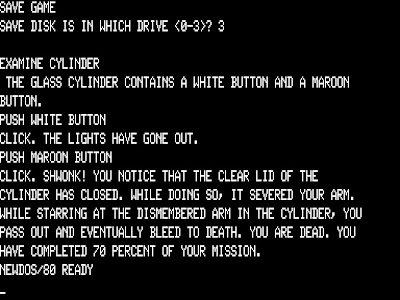
There are a number of other areas to explore on the ship -- the sick bay contains a vial referenced as TSOM SOLUTION, useful for refreshing hydration later on, since we have used up our initial supply of water just getting to the alien ship. And I learned it's a bad idea to push the maroon button on an intriguing glass cylinder in another room - it closes, fatally:
At last we reach the ARMSMITAN WEAPONRY room, which has a viewing screen, a white button, and a green button. All we have to do here is turn on the weapons system by pushing the white button, then POINT AT MOTHER SHIP to see the alien base destroyed in an instant by an energy beam.
After that, we still have to get back out of the ship and find our way back to town, which is primarily a mapping challenge. Once we hit the city limits, the ending is surprisingly abrupt:

I enjoyed Xenos quite a lot in the early going, but the mapping started to become a pain after my umpteenth death in the desert. The puzzles are logical and not particularly difficult, but I was glad to have a walkthrough handy later on -- by the time I emerged from the alien craft, I had covered several sheets of paper with boxes, loops, and arrows crammed in as best I could, and was no closer to finding my way around efficiently. I was anxious to get back to town and see if I could fire up the jeep -- which proved unnecessary in the end. Xenos features some really good interactive storytelling, and is well worth playing -- but I prefer my mapping challenges in much smaller doses.
The plot of Xenos centers around a reported UFO landing, with the player cast as an investigator sent to the desert town of Purgatory to find out what's happened. We arrive on foot, apparently, standing on a lonely highway west of town:

Arnstein's earlier games were written to load and run completely in-memory, and it's interesting to see how the availability of disk storage for this title affected his design approach. The map is huge and tricky to navigate outside of town; descriptions are much more detailed, and there are numerous red herrings and interesting areas to explore that enrich the story and atmosphere but aren't essential to completing the game. There are also dead ends and surprise fatalities, in the old-school adventure tradition.
For specifics, read on... and I always say this, but it bears repeating: those who wish to experience Xenos for themselves are advised to do so before continuing here. I'm pleased to document the interesting details of these games for the record, but my comments aren't meant as a substitute for the actual experience.
****** SPOILERS AHEAD! *******
From a technical perspective, Arnstein did not adopt the Infocom approach of cacheing text into memory as needed -- instead, Xenos keeps all the critical variables in memory, but uses overlays to replace whole sections of the game map and text at once. The effect is generally seamless, aside from the obvious loading times. The only drawback is that the game is smart enough to use brief descriptions for rooms we have already visited -- but once we cross the overlay boundary, the verbose text returns as though we are entering for the first time.
The game is nicely designed from a progression perspective -- one initially gets the impression that the highways and deserts outside of town are infinite, but they actually are mappable, and they don't loop back on themselves for quite a distance. But it's best to ignore the outside world and focus on the town at the beginning, in order to collect items that will be needed later.
Mr. Arnstein clearly enjoyed the freedom to write lengthy descriptions, but he goes to naturalistic extremes in town -- in every location, we can see what's nearby, as well as what's down the street a few "rooms" away. It's useful detail during initial orientation, but as we discover that every room describes our perspective in extensive detail, it starts to seem unnecessary. And it becomes annoying later on that such detailed information is NOT provided in the desert areas that are so tricky to map -- a few landmarks visible in the distance would make it easier to keep our bearings, without damaging the game's naturalistic style.
There are some intriguing artifacts and locations that don't ultimately lead anywhere, and seem like design leftovers from story elements ultimately cut for space. At the beginning, the Last Chance gas station presents us with a jack, a skeleton key, a padlocked gas pump, and a crowbar. The jack can be used to replace the flat tire on a jeep parked in back of the gas station -- we can even GET IN JEEP and attempt to START JEEP, learning that the battery is dead -- and the skeleton key can be used to access the gas station's restroom. But there's no ultimate reason to do any of these things. There's also a mysterious alcove in town, which the game pointedly tells us is NOT VISIBLE FROM THE STREET OR THE DESERT; but we can neither enter nor examine it. A radiation detector occasionally flashes in its vicinity, but nothing ever comes of it.
I like the way the story is developed in general -- there are some subtle details that work well. The radio in Harvey's Bar & Grill briefly mentions a strange UFO landing, then goes back to playing music. We run across a key for Slim's grocery store, but it's already been broken into and ransacked when we arrive. The puzzles in town aren't particularly difficult -- it's mostly a matter of doing things in the right order -- but the sense of hasty abandonment is evident everywhere we go.
Dealing with the dangerous snake lurking in the north end of Bob's Hardware store feels a lot like the RPG-esque monster battles in Arnstein's Raaka-Tu at first blush. I made several attempts to bludgeon the snake to death with a nearby shovel, and was able to do so -- but never without being fatally bitten in the process. Failing to find any sort of armor, and not wanting to waste the dynamite, I finally liberated the shotgun from the sheriff's office and found it to be a safer, more efficient solution.
The SAVE GAME feature requires a formatted disk in another drive, and only allows one save per disk, making it difficult to keep and go back to a "good save." For efficiency's sake, I tried mounting two save disks in (virtual) disk drives 2 and 3, but even when I specified disk 3 as the target, the game always wrote to the first disk it found, in drive 2.
I thought the number 33 might be a clue of some kind -- gas is priced at $0.33 a gallon, the bank has $33,000 in assets -- but I never found a connection.
The puzzles in town are generally realistic, with some useful clues about what we should do next -- there's no magic or alien technology involved in the early going. A sign in the hotel informs us there's a storm shelter on the west side of the saloon; we can dig our way into it to find the stick of dynamite. But the game's not intrusively guided -- on my first attempt, I used the dynamite to liberate the bank's assets from the vault, which worked just fine, but made it impossible to finish the game when I later encountered an immovable boulder. There's nothing truly useful in the bank's vault, just money which has no purpose within the scope of the game.
A bottle in the bar purportedly contains whiskey, but is poisonous if we drink it. I'm not sure if that's meant to be a clue, a commentary on alcoholism, or just a nasty trick. I though it might be useful for sterilizing the wound from the snake's bite, but I found no way to apply it.
The game doesn't have much of a sense of humor -- it's generally played straight and bleak, though there are glimmers of the author's voice here and there. If we don't have the shovel, we can try to clear the entrance to the bomb shelter manually, but DIG SAND WITH HANDS only yields I DIG IT TOO, MAN!
We only encounter one other human being in the game, a prospector in the desert whom one imagines has graduated from the Gabby Hayes School of Cantankerous Acting:

One interesting RPG-style feature in Xenos is that there are some size/weight factors considered in the inventory handling -- we can carry many keys around, but only a few of the larger items. Most games of this era just put a limit on the number of items; the limit here is not overly restrictive, but it does require a bit of planning and risk-taking.
Even though it was not a good idea and I had to backtrack, I was glad I experimented with the dynamite in the bank before needing it later on under duress. There are instructions printed on the stick of dynamite telling us to STRIKE FUSE and evacuate the area. I found that I could not THROW DYNAMITE AT BANK or THROW DYNAMITE INTO BANK. And I also learned that if I dropped the dynamite first, STRIKE FUSE would cause me to pick it up again. It takes a few turns for the dynamite to explode, so the correct usage is to STRIKE FUSE, DROP DYNAMITE, and skedaddle.
The game's scoring mechanism is simple, reporting the mission's overall percentage complete; there are ten milestones, each worth ten percent, and not all of them have to be achieved.
The shotgun has two shells in it, and we can use it to kill the dangerous shaggy alien encountered in the desert. But another one always shows up shortly, so it's best to just keep moving if we can avoid being successfully attacked by these creatures. If we are hit, we find that we now have A POISON in our inventory -- but we can't DROP it or even EXAMINE it; we're just marked for death within a handful of turns.
Mapping presents the most difficult challenge of Xenos. There are many, many rooms -- the desert does not simply loop or wrap around on itself, at least not consistently, and the alien ship has color-coded portals that seem to be part of a giant state machine -- doing the same thing in the same room does not necessarily take us to the same place it did before. I succeeded in finding some interesting elements in both environments, but only a few turned out to be important. The desert is particularly frustrating because we can only survive the exposure and the constant alien attacks for so long -- there are some trails and paths to follow, but they are not the shortest possible routes to the key areas.
The story's second act starts to kick into gear when we discover a dying alien being in the desert, who says "GLEEPOOP!" in the time-honored Squa Tront! Spa Fon! tradition of making alien languages sound like gibberish, and points west before expiring. We acquire the green cube and the rod with the green sphere for later use when we find the alien ship.
As it turns out, the green sphere mounted on the rod is a hazard detector. We are occasionally told that the GREEN SPHERE IS SLOWLY FLASHING AND BEEPING, but its only significant behavior occurs when we near the alien ship's engine room, at which point it begins beeping louder and finally flashing wildly. Of course, it's too late once we're inside the MOTOVATOM ENGINES room -- we shortly become nausesous and die of what I presume is radiation poisoning.
Exploring the alien ship requires navigating a series of small rooms, pushing colored buttons to open portals to other locations. I had to break myself of an old habit borne of the Scott Adams adventures -- it's actually necessary to PUSH BLUE BUTTON, and I kept trying to abbreviate the command to PUSH BLUE.
There's a whole alien world to explore if we SQUEEZE HANDGRIP in the ship's recreation room; we're beamed to a fairly large area that distinctly resembles our own culture, as is so often the case in science fiction. There are thousands of aliens going about their business, and fun areas like a museum and a disco (remember, this game was published in 1982.) There are even references to American landmarks like GRAND CENTRAL STATION, PITTSBURG [sic] and DETROIT. We can even pick up some alien language here, though the decoding is straightforward -- NURGLE, ENURGLE, SORWIT and WITSOR represent the cardinal directions; ESNEL = DOOR, and UKORK variously means LOCKED and/or KEY. The parser does give the translation away a bit - at one point I typed EXAMINE FLASM and was told THERE'S NOTHING SPECIAL ABOUT THE WALL. I wasn't able to find my way back out of this area, and discovered no real reason to be there -- but it's a fairly large section of the map, and it's entertaining to explore before getting back to the mission at hand. I did find a coded message in this area that I wasn't quite able to make sense of -- it had no apparent bearing on finishing the game:

There are a number of other areas to explore on the ship -- the sick bay contains a vial referenced as TSOM SOLUTION, useful for refreshing hydration later on, since we have used up our initial supply of water just getting to the alien ship. And I learned it's a bad idea to push the maroon button on an intriguing glass cylinder in another room - it closes, fatally:

At last we reach the ARMSMITAN WEAPONRY room, which has a viewing screen, a white button, and a green button. All we have to do here is turn on the weapons system by pushing the white button, then POINT AT MOTHER SHIP to see the alien base destroyed in an instant by an energy beam.
After that, we still have to get back out of the ship and find our way back to town, which is primarily a mapping challenge. Once we hit the city limits, the ending is surprisingly abrupt:

I enjoyed Xenos quite a lot in the early going, but the mapping started to become a pain after my umpteenth death in the desert. The puzzles are logical and not particularly difficult, but I was glad to have a walkthrough handy later on -- by the time I emerged from the alien craft, I had covered several sheets of paper with boxes, loops, and arrows crammed in as best I could, and was no closer to finding my way around efficiently. I was anxious to get back to town and see if I could fire up the jeep -- which proved unnecessary in the end. Xenos features some really good interactive storytelling, and is well worth playing -- but I prefer my mapping challenges in much smaller doses.
Subscribe to:
Posts (Atom)


 Posts
Posts

