
If you pay any attention to the little XBox Live doohickey posted alongside this blog, you'll likely have noticed that I'm almost never engaged in playing the latest and greatest XBox 360 games. As I write this, I'm still working my way through Bioware's excellent sci-fi RPG Mass Effect, while all of the cool kids are gearing up for Mass Effect 2.
Part of this is because the blog consumes much of my available gaming time. Playing, writing, research and editing all take time away from trying out the new stuff. I still consider it gaming time, because it's directly related to my hobby, and I certainly don't begrudge the effort it takes to do this. But it's an inhibiting factor when I'm staring a brand new, 40-hour game in the face that may take me several months to tackle.
But as my free time has become more limited over the years, I've also realized that a little patience makes it easier to be picky and focus on the high-quality experiences, and also makes my gaming a lot cheaper.
See, I could have paid $60 for Mass Effect when it came out, then bought the additional downloadable chapters for $10 apiece. I have no doubt I would have gotten $90 worth of entertainment out of the experience. But as it turned out, I paid $20 for a new copy of the Platinum Edition, with the DLC content included, thereby saving myself no little cash. I didn't necessarily pocket that extra money --during the holidays, when I had some extra time for games, I picked up Banjo-Kazooie: Nuts & Bolts for $10, Raiden Fighters for $15, and Shadow Complex for $10 (normally $15 on XBLA.)
Were any of these games hurt by the delay? Well, it's very difficult to get an 8-player Banjo-Kazooie race going on XBLA, because nobody seems to be playing it online anymore, if they ever did. So the multiplayer-related achievements for that title will likely remain out of reach. But I am still enjoying all of these games -- the technology is still current, the games are still worthwhile, and playing them "late" doesn't damage my own experience in any measurable way.
The economics also apply to retro gaming -- while a few rare titles are pricey and hard to come by, most vintage games can be had now for considerably less than their original retail price. Some quality computer titles have been released into the public domain by their authors for no-cost enjoyment, and downloadable channels provide many classic games at reasonable prices.
And there's still satisfaction in finally getting around to acquiring that great game or system I never tracked down during its heyday. Lots of great stuff is still out there, waiting.
Personally, I know that someday I will buy that arcade-quality Neo-Geo console -- the one that taunted me with its $600 price tag and $200 games back in 1989.
Mostly because I already have several cartridges for it, still new in the box. $30 each on closeout.
Thursday, January 14, 2010


Wednesday, January 13, 2010
Video Podcast - GameScience: Fugue in 60 Hz?
In which we consider the technical roots of videogame music.
Tuesday, January 12, 2010
Adventure of the Week: Arrow of Death (Pt. 1) (1981)
Returning to the oeuvre of Brian Howarth, this week we tackle the first of a two-game saga, Arrow of Death (Pt. 1) (Mysterious Adventure #3). Howarth's games run on the Scott Adams engine and can be played on modern machines using the ScottFree interpreter. I solved this one using ScottFree for the sake of better save/restore support, then played through the illustrated version on the Commodore 64 for screen capture purposes.
Set in the same universe as Mysterious Adventure #1, The Golden Baton, this fantasy story sends us off to destroy a bad guy named XERDON with a magical arrow. As it turns out, Part 1 is concerned strictly with acquiring the components of said magical arrow, so we'll have to wait for Part 2 to wrap up the storyline.
The game opens in a courtyard, with a dead messenger at our feet; it's a sign of dark things to come:

This game wasn't too difficult, but I did resort to a walkthrough after running out of experiments to try, and I needed a hint to solve a parser challenge where I was otherwise on the right track. Suffice it to say that searching every room and object is key to solving Arrow of Death (Pt. 1) -- there are lots of hidden items and clues, and while the map is straightforward within each area, it's vital to acquire necessary objects before making any navigational leaps.
***** SPOILERS AHEAD! *****
Many of the in-game clues are informational in nature -- which means the puzzles and actions revealing them can be skipped altogether on a replay. The amulet is decorated with a picture of a barge, for instance, but the player does not need to discover this in order for it to work as intended; also, it's not strictly necessary to visit the burned-out village or roll away the boulder in front of the cave.
We find ZARDRA the magician early in the game, and he dies shortly thereafter, though not until we LOOK ZARDRA and get to hear his dying words, which set the plot in motion. It's very considerate of him to delay his demise on our account.
We also find the Golden Baton we reclaimed playing the first of Howarth's adventures, but times have changed -- even looking at it proves fatal in this one.
Bribing the beggar isn't initially essential -- he doesn't block our way in the traditional guardian-puzzle mode, but he reveals a critical clue that tends to dead-end the game if the player doesn't know about it: we have to WAIT in several locations for magical transport to take us elsewhere. He also gives us the Glass Orb, which is critical to finishing the game.
The game's map is straightforward -- there are a few mini-mazes where similar rooms are adjacent, but nothing that randomly wandering can't handle. Deciding when to move forward is a bigger challenge, as after certain moves the player can no longer return to previously visited areas. This geographical constraint may have been a design decision, if the author wasn't sure where Part 1 would end and Part 2 would begin.
There's a slave chained up in one area, and fortunately the parser helps us out a bit. FREE SLAVE yields Cut his chains!, so CUT CHAINS has the desired effect and the slave begins following us around. We have to avail ourselves of the slave's assistance before wandering into the Toadstool location, however, because the Beggar shows up here and drugs him. This bit of uncalled-for nastiness is apparently meant to demonstrate the toadstools' effectiveness as a sleeping drug, though I happened to discover it myself by eating the mushrooms (and dying when the giants found me asleep) before freeing the slave.
Magic-based puzzles can be irritating, because there isn't always a clear reason why the player would want to act the way the designer expects. The most difficult puzzle I ran into involved the suit of armour (UK spelling) found early in the game. It has only one purpose -- if we don't wear it when facing the serpent, the serpent eats us, and it provides no defense against the giants. Finding the armour's use is a "path of most resistance" puzzle -- we can't carry it up to the cliff ledge, and there are no clues as to what we should be doing there anyway. I had to resort to a walkthrough to learn that RUB ORB on the ledge opens the cave where the serpent resides; I had discovered the Orb's alternate use as a light source, but it hadn't occurred to me that it might have another purpose. It then became clear that getting the armour up to the serpent's cave was going to be necessary, and I might never have found the necessary rope, if not for seeing the first few steps of the same walkthrough while looking for a hint.
The vintage two-word parser has a few annoying limitations. TIE HOOK does not work, but TIE ROPE assumes (to hook) and does. TALK is interpreted as SAY, and there's no way to talk to another character; any verbal clues are triggered by more direct actions. And I could not for the life of me figure out how to drug the giants' broth -- BREW TOADSTOOLS, BOIL TOADSTOOLS, ADD TOADSTOOLS, MIX BROTH, DROP TOADSTOOLS... none of these worked. The lack of prepositions always makes these kinds of puzzles difficult to solve -- fortunately, the walkthrough led me to DRUG CAULDRON, which sufficed (DRUG BROTH also works.)
The game allows us to KILL EAGLE, but it's not a good idea. PLUCK FEATHER gets us what we need and also transports us to a new location.
Death is everywhere in this dark tale -- a dead dwarf lies in what would otherwise seem an idyllic hut near the babbling brook:

If we borrow the dwarf's spectacles, steal his silver medallion, and find the trapdoor in the burned-out village nearby, we can read an ancient book to learn that we should:

We are now, presumably, prepared to proceed with Part 2 of the adventure with the titular Arrow of Death in hand. There's no password given at the end of this chapter, or required by the next one, so it's not technically necessary to finish this game before tackling the next one. But the story makes more sense in the proper order -- and of course, we will take on Arrow of Death (Pt. 2) in a future installment.
Set in the same universe as Mysterious Adventure #1, The Golden Baton, this fantasy story sends us off to destroy a bad guy named XERDON with a magical arrow. As it turns out, Part 1 is concerned strictly with acquiring the components of said magical arrow, so we'll have to wait for Part 2 to wrap up the storyline.
The game opens in a courtyard, with a dead messenger at our feet; it's a sign of dark things to come:

This game wasn't too difficult, but I did resort to a walkthrough after running out of experiments to try, and I needed a hint to solve a parser challenge where I was otherwise on the right track. Suffice it to say that searching every room and object is key to solving Arrow of Death (Pt. 1) -- there are lots of hidden items and clues, and while the map is straightforward within each area, it's vital to acquire necessary objects before making any navigational leaps.
***** SPOILERS AHEAD! *****
Many of the in-game clues are informational in nature -- which means the puzzles and actions revealing them can be skipped altogether on a replay. The amulet is decorated with a picture of a barge, for instance, but the player does not need to discover this in order for it to work as intended; also, it's not strictly necessary to visit the burned-out village or roll away the boulder in front of the cave.
We find ZARDRA the magician early in the game, and he dies shortly thereafter, though not until we LOOK ZARDRA and get to hear his dying words, which set the plot in motion. It's very considerate of him to delay his demise on our account.
We also find the Golden Baton we reclaimed playing the first of Howarth's adventures, but times have changed -- even looking at it proves fatal in this one.
Bribing the beggar isn't initially essential -- he doesn't block our way in the traditional guardian-puzzle mode, but he reveals a critical clue that tends to dead-end the game if the player doesn't know about it: we have to WAIT in several locations for magical transport to take us elsewhere. He also gives us the Glass Orb, which is critical to finishing the game.
The game's map is straightforward -- there are a few mini-mazes where similar rooms are adjacent, but nothing that randomly wandering can't handle. Deciding when to move forward is a bigger challenge, as after certain moves the player can no longer return to previously visited areas. This geographical constraint may have been a design decision, if the author wasn't sure where Part 1 would end and Part 2 would begin.
There's a slave chained up in one area, and fortunately the parser helps us out a bit. FREE SLAVE yields Cut his chains!, so CUT CHAINS has the desired effect and the slave begins following us around. We have to avail ourselves of the slave's assistance before wandering into the Toadstool location, however, because the Beggar shows up here and drugs him. This bit of uncalled-for nastiness is apparently meant to demonstrate the toadstools' effectiveness as a sleeping drug, though I happened to discover it myself by eating the mushrooms (and dying when the giants found me asleep) before freeing the slave.
Magic-based puzzles can be irritating, because there isn't always a clear reason why the player would want to act the way the designer expects. The most difficult puzzle I ran into involved the suit of armour (UK spelling) found early in the game. It has only one purpose -- if we don't wear it when facing the serpent, the serpent eats us, and it provides no defense against the giants. Finding the armour's use is a "path of most resistance" puzzle -- we can't carry it up to the cliff ledge, and there are no clues as to what we should be doing there anyway. I had to resort to a walkthrough to learn that RUB ORB on the ledge opens the cave where the serpent resides; I had discovered the Orb's alternate use as a light source, but it hadn't occurred to me that it might have another purpose. It then became clear that getting the armour up to the serpent's cave was going to be necessary, and I might never have found the necessary rope, if not for seeing the first few steps of the same walkthrough while looking for a hint.
The vintage two-word parser has a few annoying limitations. TIE HOOK does not work, but TIE ROPE assumes (to hook) and does. TALK is interpreted as SAY, and there's no way to talk to another character; any verbal clues are triggered by more direct actions. And I could not for the life of me figure out how to drug the giants' broth -- BREW TOADSTOOLS, BOIL TOADSTOOLS, ADD TOADSTOOLS, MIX BROTH, DROP TOADSTOOLS... none of these worked. The lack of prepositions always makes these kinds of puzzles difficult to solve -- fortunately, the walkthrough led me to DRUG CAULDRON, which sufficed (DRUG BROTH also works.)
The game allows us to KILL EAGLE, but it's not a good idea. PLUCK FEATHER gets us what we need and also transports us to a new location.
Death is everywhere in this dark tale -- a dead dwarf lies in what would otherwise seem an idyllic hut near the babbling brook:

If we borrow the dwarf's spectacles, steal his silver medallion, and find the trapdoor in the burned-out village nearby, we can read an ancient book to learn that we should:
Destroy XERDON the EvilThese instructions seem pretty clear. However, GIVE MEDALLION in the Willow Grove does not work or provoke any informative reaction from the guardians. THROW MEDALLION causes them to chase it, however, giving us a chance to CUT WILLOW, leading immediately to this chapter's rather abrupt ending:
with an Arrow from the Sacred Willow
The Guardians of the Willow
Lust for Silver!

We are now, presumably, prepared to proceed with Part 2 of the adventure with the titular Arrow of Death in hand. There's no password given at the end of this chapter, or required by the next one, so it's not technically necessary to finish this game before tackling the next one. But the story makes more sense in the proper order -- and of course, we will take on Arrow of Death (Pt. 2) in a future installment.
Monday, January 11, 2010
The LoadDown - 1/11/10 - Phoenix Wright
Once a week, we cover recent downloadable games -- the Wii Shop Channel, XBox Live Arcade, and the PSN Store just keep 'em coming...
WiiWare -- Three games this week, two of which are based on solid DS games. Capcom's Phoenix Wright: Ace Attorney brings the popular investigation/trial mystery-drama series to the Wii for the first time, with four cases and good use of the Wii remote. Time Split: Chronos Twins DX brings the DS sleeper hit Chronos Twins to WiiWare; it's an unusual dual-screen platformer, with the same location visible in two different timeframes, each influencing the other. Shadowplay is an interesting attempt to bring hand-shadow tomfoolery to the puzzle game genre.
Wii Virtual Console -- One game this week -- Activision's Genesis edition of the mahjong tile solitaire puzzle game, Shanghai II: Dragon's Eye.
DSiWare -- Three simple, inexpensive games this week. Touch Solitaire puts iPod-style Spider and Klondike solitaire card games on the DS. Jazzy Billiards simulates 9-ball pool with a smooth musical soundtrack. WordSearcher puts search-a-word puzzles on the DS.
XBLA -- Last week saw one new release, Matt Hazard: Blood Bath and Beyond. It's an homage to several classic action games, with a Contra-meets-Duke Nukem kind of vibe and lots of game development in-jokes. It might be a bit too much of a muchness in large doses, but it's nice to see an action game keep its tongue firmly in its cheek.
PSN -- As has been the trend recently, Matt Hazard (see above) also hit the Playstation 3 last week.
WiiWare -- Three games this week, two of which are based on solid DS games. Capcom's Phoenix Wright: Ace Attorney brings the popular investigation/trial mystery-drama series to the Wii for the first time, with four cases and good use of the Wii remote. Time Split: Chronos Twins DX brings the DS sleeper hit Chronos Twins to WiiWare; it's an unusual dual-screen platformer, with the same location visible in two different timeframes, each influencing the other. Shadowplay is an interesting attempt to bring hand-shadow tomfoolery to the puzzle game genre.
Wii Virtual Console -- One game this week -- Activision's Genesis edition of the mahjong tile solitaire puzzle game, Shanghai II: Dragon's Eye.
DSiWare -- Three simple, inexpensive games this week. Touch Solitaire puts iPod-style Spider and Klondike solitaire card games on the DS. Jazzy Billiards simulates 9-ball pool with a smooth musical soundtrack. WordSearcher puts search-a-word puzzles on the DS.
XBLA -- Last week saw one new release, Matt Hazard: Blood Bath and Beyond. It's an homage to several classic action games, with a Contra-meets-Duke Nukem kind of vibe and lots of game development in-jokes. It might be a bit too much of a muchness in large doses, but it's nice to see an action game keep its tongue firmly in its cheek.
PSN -- As has been the trend recently, Matt Hazard (see above) also hit the Playstation 3 last week.
Sunday, January 10, 2010
Pac-Man Pareidolia
Pareidolia is the term used to describe human beings' propensity to see and hear things that aren't necessarily there. We're pattern-recognition machines, highly sensitized to detecting faces and voices, and it doesn't take much to fool us into seeing Elvis in a water stain or hearing mysterious whispers in a staticky recording. Generally we come to our senses and realize what's really happening before the lepers and pilgrims arrive.
But I was reviewing some blog-related metrics recently, and this evidence is irrefutable:

I can now live secure in the knowledge that Pac-Man is blessing my blog with his chompy beneficence.
But I was reviewing some blog-related metrics recently, and this evidence is irrefutable:

Saturday, January 9, 2010
Our Hardcore Pad Does The Special Moves FOR You!
There are games that are not worth mastering, certainly. There are games that are difficult to master, but richly rewarding to the hardcore audience. And then there are games that are so popular everyone wants to master them, including people who can't really be bothered to put in the effort to do so.
Innovation Technologies decided to help such wannabes out by producing a special controller for the SNES and Genesis versions of Mortal Kombat II -- with the special move sets built in as preprogrammed macros. Drop $49.95, hit one of the special "Mortal Activator" buttons, and voila -- instant mad skillz. No need to mess around with actually learning to execute the special moves and fatalities.

I guess it's kind of hardcore to spend fifty bucks for a controller dedicated to a specific game.
But buying the illusion of talent you don't actually possess -- that's just old-fashioned cheating.
Innovation Technologies decided to help such wannabes out by producing a special controller for the SNES and Genesis versions of Mortal Kombat II -- with the special move sets built in as preprogrammed macros. Drop $49.95, hit one of the special "Mortal Activator" buttons, and voila -- instant mad skillz. No need to mess around with actually learning to execute the special moves and fatalities.

I guess it's kind of hardcore to spend fifty bucks for a controller dedicated to a specific game.
But buying the illusion of talent you don't actually possess -- that's just old-fashioned cheating.
Friday, January 8, 2010
Oddities: Emmanuelle
Games adapted from books are few and far between; fewer still have been adapted from memoirs. But in the late 1980's, the French software company Tomahawk produced a game based on Emmanuelle Arsan's famous erotic memoir, Emmanuelle.

The book also served as a springboard for a series of movies, of course, starting with the artsy, arguably well-made Emmanuelle, but ultimately devolving into movies like Carry On Emmanuelle and Emmanuelle in Space. The game, at least, is based on the original novel, though its publishers were doubtless banking on people's familiarity with the property in other media.
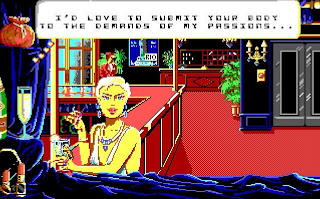
The game is set up like a detective adventure, but there isn't really much to do. Go to a new location, which is likely to look very much like every other similar location, and inquire after Emmanuelle:

Failing to find her, chat up the local girl hanging around in the foreground, pay her if necessary, and indulge in a sexual encounter:

Presumably the player's ongoing success will lift the obscuring blinds as the game goes on, but I wasn't compelled to reveal the pixelated nudity.
The player can also visit the local gambling den and hobnob with the hoi-polloi, although I only succeeded in offending them and getting myself thrown out:

The player also frequently visits the airport to travel elsewhere -- the female attendants also provide other services, but the male attendant is strictly business and makes no suggestive conversation, which surprised me considering the game is French in origin:


Returning to Paris without locating Emmanuelle ends the game, although the final message displayed isn't wholly negative -- it reads, Your impulses are fleeting! You are wise.
A curiosity, this Emmanuelle.

The book also served as a springboard for a series of movies, of course, starting with the artsy, arguably well-made Emmanuelle, but ultimately devolving into movies like Carry On Emmanuelle and Emmanuelle in Space. The game, at least, is based on the original novel, though its publishers were doubtless banking on people's familiarity with the property in other media.
The game is set up like a detective adventure, but there isn't really much to do. Go to a new location, which is likely to look very much like every other similar location, and inquire after Emmanuelle:

Failing to find her, chat up the local girl hanging around in the foreground, pay her if necessary, and indulge in a sexual encounter:


Presumably the player's ongoing success will lift the obscuring blinds as the game goes on, but I wasn't compelled to reveal the pixelated nudity.
The player can also visit the local gambling den and hobnob with the hoi-polloi, although I only succeeded in offending them and getting myself thrown out:

The player also frequently visits the airport to travel elsewhere -- the female attendants also provide other services, but the male attendant is strictly business and makes no suggestive conversation, which surprised me considering the game is French in origin:


Returning to Paris without locating Emmanuelle ends the game, although the final message displayed isn't wholly negative -- it reads, Your impulses are fleeting! You are wise.
A curiosity, this Emmanuelle.
Subscribe to:
Posts (Atom)


 Posts
Posts

